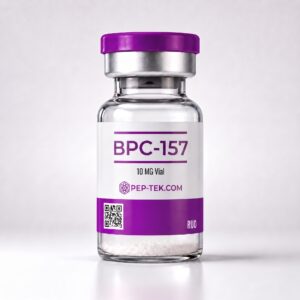
Available from PepTek
BPC-157 is a synthetic pentadecapeptide derived from gastric juice proteins, studied extensively in preclinical models for its effects on tissue signaling and cellular repair pathways.
Among the peptides currently attracting significant preclinical research interest, BPC-157 occupies a unique position. Understanding what is BPC-157 research peptide requires examining both its molecular origins and the body of in vitro and animal model data that has accumulated over the past three decades. BPC-157, or Body Protection Compound-157, is a synthetic pentadecapeptide consisting of 15 amino acids (Gly-Glu-Pro-Pro-Pro-Gly-Lys-Pro-Ala-Asp-Asp-Ala-Gly-Leu-Val). It is derived from a partial sequence of human gastric juice protein BPC, first isolated and characterized by researchers at the University of Zagreb in the early 1990s.
This compound is available exclusively as a research-grade material and is supplied by PepTek strictly for laboratory investigation. For a broader mechanistic overview, researchers may also consult our detailed article on BPC-157 Peptide: Research Profile and Mechanism of Action.
BPC-157 has a molecular formula of C62H98N16O22 and a molecular weight of approximately 1,419.5 Da. One of the compound’s most-studied properties in laboratory settings is its relative stability compared to endogenous gastric peptides. Researchers have noted that the synthetic sequence demonstrates resistance to proteolytic degradation in simulated gastric acid environments, which has made it a useful tool for studying peptide stability mechanisms in vitro [Sikiric et al., 1997].
Its primary sequence does not correspond to any known endogenous hormone or receptor ligand with confirmed pharmacological classification, placing it in a category of research peptides whose downstream signaling effects remain under active investigation. This is analogous to other research-stage peptides such as those described in our article on GHK-Cu: Copper Peptide Research Profile and Signaling Pathways, where peptide-receptor interactions continue to be characterized at the molecular level.
A substantial portion of BPC-157 preclinical literature focuses on its apparent influence on angiogenic signaling in animal models. Researchers have observed upregulation of VEGF (vascular endothelial growth factor) expression in wound sites of rodent subjects treated with BPC-157, compared to untreated controls [Sikiric et al., 2018]. These observations have been replicated across multiple wound model designs and suggest that the peptide may interact with the VEGFR2 signaling axis, though the precise binding mechanism has not yet been fully characterized in peer-reviewed structural studies.
Animal model studies have further indicated accelerated formation of granulation tissue and improved collagen fiber organization at treatment sites, findings consistent with modulatory activity on fibroblast behavior. It is important to note that these are observations in controlled laboratory and rodent settings and cannot be extrapolated to human outcomes.
Given its derivation from gastric juice proteins, it is unsurprising that gastrointestinal models have featured prominently in BPC-157 research. Studies in rat models of induced gastric ulceration have consistently reported accelerated mucosal restitution in BPC-157-treated cohorts versus controls [Sikiric et al., 2001]. Researchers have proposed that this effect involves modulation of the nitric oxide (NO) system, specifically through influence on eNOS and nNOS expression in gastric mucosal tissue.
Investigations into intestinal anastomosis models have similarly yielded data suggesting improved structural integrity at anastomotic sites in animal subjects, a finding of interest to researchers studying connective tissue repair mechanisms. These results have been published in peer-reviewed gastroenterology and surgery journals but remain confined to preclinical data sets.
Research on BPC-157 in tendon and muscle injury models represents one of the more widely cited clusters of studies for this compound. A frequently referenced study by Pevec et al. demonstrated that rats with surgically induced Achilles tendon transections treated with BPC-157 showed measurably different biomechanical tensile properties at the injury site compared to vehicle-treated controls at multiple healing time points [Pevec et al., 2010]. The researchers attributed these differences to enhanced fibroblast migration and collagen synthesis, though causal mechanisms have not been definitively established.
In skeletal muscle crush injury models, researchers have observed differences in the expression of growth factor receptors and inflammatory cytokine profiles in treated versus control tissue samples. These findings position BPC-157 as a useful tool compound for researchers studying the molecular events governing tissue remodeling, alongside structurally distinct compounds such as those discussed in the TB-500 (Thymosin Beta-4): Research Profile and Cellular Mechanisms article.
A growing area of BPC-157 preclinical inquiry involves its apparent modulatory effects on dopaminergic and serotonergic systems in rodent brain tissue. Researchers have reported alterations in dopamine turnover ratios and receptor expression profiles in nucleus accumbens and striatal regions of rats following systemic administration of BPC-157, compared to controls [Sikiric et al., 2014]. These observations have prompted interest in BPC-157 as a research tool for studying neurotransmitter pathway interactions, particularly in models of lesion-induced behavioral change.
It is worth contextualizing this line of inquiry alongside other neuropeptide research tools. Readers interested in related CNS-targeted peptide research may find relevant comparative context in our overview of Semax: ACTH-Derived Neuropeptide Research Profile, which details another preclinical tool compound studied for neuromodulatory properties in animal models.
Synthesizing the available preclinical literature, researchers have proposed several non-mutually exclusive mechanisms by which BPC-157 may exert its observed effects in model systems. These include:
It should be emphasized that these proposed mechanisms are derived from in vitro assays and animal models. The compound has not been evaluated in approved human clinical trials, and no mechanism of action has been confirmed in human subjects.
Understanding what is BPC-157 research peptide also requires transparency about the limitations of the existing literature. A significant proportion of published BPC-157 studies originate from a single research group at the University of Zagreb, which while scientifically productive raises questions about independent replication. Relatively few studies have been conducted by independent international laboratories using fully blinded, pre-registered protocols.
Additionally, most published data exists in rodent models, and inter-species translation of peptide pharmacology is inherently uncertain. Researchers working with BPC-157 in laboratory settings should approach the existing literature with appropriate methodological scrutiny and prioritize well-controlled, blinded experimental designs when generating new data.
BPC-157 remains an active subject of preclinical peptide research, with published studies spanning gastroenterology, orthopedics, neuroscience, and vascular biology. The compound exemplifies the broader field of what is BPC-157 research peptide investigation: a synthetic sequence with observed bioactivity in multiple model systems whose molecular mechanisms continue to be refined through ongoing laboratory work.
Research Use Disclaimer: BPC-157 supplied by PepTek is intended exclusively for in vitro laboratory research and preclinical animal studies conducted by qualified scientific personnel. This compound is not approved for human or veterinary use, has not been evaluated by the FDA or any regulatory authority for safety or efficacy in humans, and must not be administered to humans or animals outside of formally approved research protocols. Nothing in this article constitutes medical advice, a therapeutic claim, or a recommendation for any clinical application. All data referenced herein derives from preclinical studies and should be interpreted accordingly.