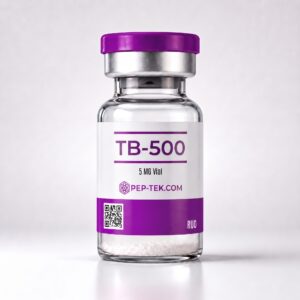
Available from PepTek
TB-500, a synthetic analog of Thymosin Beta-4, is a peptide of significant interest in cellular and molecular research. This profile examines its mechanisms, research history, and studied properties.
TB-500 peptide research has expanded considerably over the past two decades, driven by growing scientific interest in the role of actin-sequestering proteins in cellular repair, migration, and inflammatory response. TB-500 is a synthetic analog derived from the naturally occurring protein Thymosin Beta-4 (Tβ4), a 43-amino-acid polypeptide ubiquitously expressed in mammalian tissues. First isolated from thymic tissue, Tβ4 has since been identified in virtually every cell type studied, where it plays a central role in cytoskeletal dynamics and intracellular signaling. This profile examines the compound’s mechanism of action, the trajectory of its research history, and the body of evidence accumulated through in vitro and animal model studies.
Thymosin Beta-4 was initially characterized in the early 1960s as part of a broader investigation into thymic hormones and immune regulation. Pioneering work by Low and Goldstein in the 1970s helped isolate and sequence beta-thymosin peptides, establishing a foundation for understanding their biological roles [Low et al., 1981]. Early research focused primarily on Tβ4’s immunomodulatory properties, but subsequent decades revealed a far broader functional profile involving wound healing, angiogenesis, and tissue remodeling.
The development of TB-500 as a synthetic research analog allowed investigators to study these properties in controlled experimental settings without the variability inherent to naturally sourced peptides. By the 1990s and 2000s, researchers had begun characterizing Tβ4’s interaction with G-actin, identifying the LKKTET motif as the principal actin-binding sequence responsible for many of the peptide’s observed cellular effects [Safer et al., 1991]. This discovery became a cornerstone of TB-500 peptide research and directed subsequent mechanistic investigations.
The primary mechanism through which TB-500 exerts its studied effects is the sequestration of globular actin (G-actin). By binding G-actin monomers, Tβ4 regulates the pool of actin available for polymerization into filamentous actin (F-actin). This dynamic modulation of actin assembly is critical for processes including cell migration, wound contraction, and cytoskeletal remodeling. Research has demonstrated that the LKKTET hexapeptide sequence within Tβ4 is the minimal motif sufficient to bind actin and recapitulate several of the parent molecule’s cellular effects [Safer et al., 1991].
In vitro studies suggest that TB-500 promotes cell migration in part through the upregulation of matrix metalloproteinases (MMPs) and modulation of integrin-linked kinase (ILK) signaling pathways. Researchers have observed that Tβ4 activates ILK, which in turn phosphorylates downstream effectors including Akt and GSK-3β — pathways associated with cell survival and proliferation in experimental models [Bock-Marquette et al., 2004]. These findings have made TB-500 peptide research particularly relevant to investigators studying endothelial cell behavior and vascular biology.
Animal model studies indicate that Tβ4 exerts modulatory effects on inflammatory cascades. Researchers have observed reductions in pro-inflammatory cytokines, including TNF-α and IL-1β, in rodent models following Tβ4 administration. The peptide has also been studied in the context of NF-κB pathway inhibition, with some in vitro evidence suggesting it may attenuate inflammatory gene expression under specific experimental conditions. These observations have positioned TB-500 as a subject of interest within immunology and inflammatory disease research, though all findings remain at the preclinical stage.
One of the most extensively studied applications of Tβ4 in preclinical settings involves cardiac tissue. Bock-Marquette and colleagues demonstrated in animal models that Tβ4 promotes cardiomyocyte survival and activation of cardiac progenitor cells following ischemic injury [Bock-Marquette et al., 2004]. Subsequent research explored the peptide’s capacity to stimulate coronary vessel growth in experimentally induced myocardial infarction models in rodents, with researchers observing measurable improvements in vascular density in treated versus control groups [Smart et al., 2007].
TB-500 peptide research has also extended into the neuroscience domain. Animal model studies have investigated Tβ4’s role in promoting oligodendrocyte differentiation and remyelination in experimental models of demyelinating disease. Researchers have observed that systemic delivery of Tβ4 in rodent models of traumatic brain injury was associated with measurable improvements in behavioral outcomes alongside increased neurogenesis markers, suggesting potential relevance for investigators studying central nervous system repair mechanisms [Morris et al., 2010].
The corneal epithelium has served as a productive model system for studying Tβ4’s role in surface tissue repair. Researchers have demonstrated accelerated corneal wound closure in animal models treated with Tβ4, with associated increases in fibronectin and laminin expression at wound margins [Sosne et al., 2002]. Dermal wound healing models have similarly shown that Tβ4 application in animal studies promotes keratinocyte migration and collagen deposition, outcomes that investigators studying skin biology have found mechanistically informative.
For researchers interested in related peptide compounds studied for tissue repair mechanisms, the BPC-157 Peptide: Research Profile and Mechanism of Action offers a detailed examination of another compound frequently investigated alongside Tβ4 in preclinical wound healing and tissue modeling research.
Studies examining the pharmacokinetic behavior of Tβ4 in animal models have reported that the peptide demonstrates relatively rapid tissue distribution following systemic administration in experimental settings. Researchers have observed that Tβ4 is detectable in cardiac tissue, skeletal muscle, and plasma within hours of administration in rodent studies. The peptide’s short half-life has led investigators to explore modified delivery systems and analog structures — of which TB-500 represents one approach — to sustain bioavailability in experimental conditions. Importantly, TB-500 peptide research consistently operates within the bounds of controlled laboratory and preclinical frameworks.
TB-500 retains the LKKTET actin-binding domain of Tβ4 while presenting in a truncated form that researchers have employed to isolate specific mechanistic effects. The molecular weight of the full Tβ4 sequence is approximately 4,963 Da, and its predominantly unstructured conformation in solution is thought to facilitate interactions with a broad range of binding partners beyond actin, including thymosin receptors and extracellular matrix components. This structural flexibility has been discussed in the literature as a likely contributor to the peptide’s pleiotropic effects observed across multiple cell and tissue types in preclinical research.
TB-500 peptide research represents a compelling area of investigation in cell biology, vascular science, and regenerative medicine research. The accumulated body of in vitro and animal model evidence points to a mechanistically rich compound with roles in cytoskeletal regulation, cell migration, angiogenesis, and inflammatory modulation. Researchers continue to explore its properties across diverse experimental systems, and the compound remains an active subject of preclinical inquiry.
Research Use Disclaimer: TB-500 and all related compounds described in this article are intended strictly for in vitro and preclinical research purposes only. These compounds are not approved for human or animal consumption, are not intended for therapeutic, diagnostic, or clinical use, and should only be handled by qualified researchers in appropriate laboratory settings. Nothing in this article constitutes medical advice, dosing guidance, or a claim of therapeutic efficacy. All findings referenced herein derive from preclinical studies and should not be extrapolated to human health outcomes.