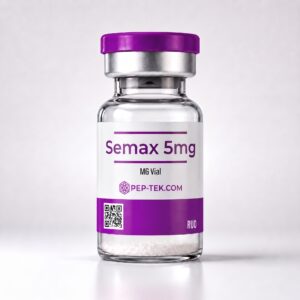
Available from PepTek
Semax is an ACTH-derived heptapeptide studied extensively in semax neuropeptide research for its neurotrophin-modulating and neuroprotective properties in preclinical models.
Semax is a synthetic heptapeptide analog derived from the adrenocorticotropic hormone (ACTH) fragment 4–10, with the sequence Met-Glu-His-Phe-Pro-Gly-Pro. Originally developed in the Soviet Union during the 1980s and 1990s by researchers at the Institute of Molecular Genetics of the Russian Academy of Sciences, Semax has attracted sustained scientific interest due to its apparent ability to modulate neurotrophic signaling pathways without the endocrine activity associated with full-length ACTH. As a subject of semax neuropeptide research, it occupies a unique position among short-chain peptides studied for central nervous system applications in preclinical and in vitro settings.
The ACTH 4–10 fragment has long been recognized as the minimal sequence responsible for the behavioral and neurotrophic effects observed in experiments with the parent hormone. Semax extends this fragment with a C-terminal Pro-Gly-Pro tripeptide, a modification designed by Myasoedov and colleagues to confer metabolic stability against peptidase degradation, thereby extending the compound’s half-life in biological systems [Myasoedov et al., 1999].
This structural engineering distinguishes Semax from its parent sequence and from many other neuropeptide analogs. Unlike full-length ACTH, Semax does not meaningfully stimulate cortisol or corticosteroid release in animal studies, making it a more selective research tool for dissecting neurotrophin-related signaling pathways independent of adrenal axis activation.
The most extensively studied mechanistic property of Semax in preclinical models is its capacity to upregulate brain-derived neurotrophic factor (BDNF) and its cognate receptor, tropomyosin receptor kinase B (TrkB). Researchers have observed that systemic administration of Semax in rodent models produces significant increases in BDNF mRNA expression in the hippocampus and frontal cortex [Dolotov et al., 2006]. BDNF plays a well-characterized role in neuronal survival, synaptic plasticity, and long-term potentiation, making this pathway a key focus of semax neuropeptide research.
In vitro studies suggest that Semax may also influence the expression of nerve growth factor (NGF) and neurotrophin-3 (NT-3), indicating a broader modulatory effect on the neurotrophin family rather than selective action on a single target.
Animal model studies indicate that Semax interacts with monoaminergic systems. Observed effects include alterations in dopamine turnover in striatal regions and modulation of serotonin receptor sensitivity. Researchers have proposed that these interactions may be secondary to BDNF upregulation, given BDNF’s established role in regulating dopaminergic neuron function, though direct receptor binding studies for Semax remain limited in the published literature.
As a fragment of ACTH, Semax retains structural homology with sequences that interact with melanocortin receptors, particularly MC4R. Some researchers have investigated whether partial agonism at central melanocortin receptors contributes to the peptide’s observed effects on cognitive parameters in animal models. Current evidence from semax neuropeptide research suggests this may be a contributing but not primary mechanism, and the relative contributions of melanocortin receptor engagement versus neurotrophin induction remain an active area of investigation.
Several in vitro and rodent studies have examined Semax’s effects on neuroinflammatory markers. Researchers have observed reductions in pro-inflammatory cytokine expression (including IL-6 and TNF-α) in brain tissue following ischemic challenge in animal models [Stavchansky et al., 2018]. Parallel observations of reduced oxidative stress markers suggest a potential role in modulating the cellular response to ischemic injury, though the precise upstream signaling events responsible for these effects remain under investigation. This area of inquiry shares conceptual territory with research on other tissue-protective peptides such as those profiled in the GHK-Cu copper peptide research profile and signaling pathways.
Semax was formally developed and patented in Russia, where it received registration as a pharmaceutical agent for narrow clinical indications — a regulatory context distinct from that of most Western countries, where it remains a research compound without approved status. The foundational work was conducted primarily by Myasoedov, Ashmarin, and colleagues at Russian academic institutions throughout the 1990s and into the 2000s.
International research interest expanded as the neurotrophic properties of ACTH fragments gained broader recognition. Studies published in peer-reviewed journals including Neurochemical Research, Brain Research, and Journal of Neurochemistry have contributed to a growing body of evidence describing Semax’s preclinical profile. It is worth noting that a substantial portion of the primary literature originates from Russian-language publications, which has historically limited accessibility for non-Russian-speaking researchers, though many key findings have been replicated or translated in English-language journals.
Researchers examining broader neuropeptide signaling networks may find useful comparative context in the BPC-157 peptide research profile and mechanism of action, which similarly documents a peptide with pleiotropic cytoprotective properties observed across multiple tissue systems in animal models.
Animal model studies, primarily in rodents, have consistently reported that Semax administration is associated with enhanced performance on spatial memory tasks, including the Morris water maze and radial arm maze paradigms [Vanhanen et al., as referenced in Grivennikov et al., 2008]. Researchers attribute these observations in part to the documented upregulation of hippocampal BDNF, though the precise cellular and synaptic mechanisms linking neurotrophin levels to behavioral outcomes in these models require further characterization.
A significant focus of semax neuropeptide research has been its evaluation in rodent models of cerebral ischemia. Studies employing middle cerebral artery occlusion (MCAO) models have reported reductions in infarct volume and improvements in neurological deficit scores in Semax-treated animals compared to controls [Stavchansky et al., 2018]. Researchers have proposed that the compound’s effects on BDNF expression and anti-inflammatory signaling may collectively contribute to this neuroprotective phenotype, though causative attribution across multiple simultaneous mechanisms remains methodologically challenging.
Behavioral pharmacology studies in rodents have examined Semax’s effects on anxiety-related behaviors using the elevated plus maze and open field test. Results have been variable across studies, with some researchers observing anxiolytic-like profiles and others reporting null or context-dependent effects. This variability underscores the importance of experimental design standardization in peptide research and highlights how findings from any single model should be interpreted cautiously.
A distinct line of inquiry within semax neuropeptide research involves the optic system. Russian research groups have published data from animal models of retinal ischemia suggesting that Semax may support retinal ganglion cell survival through BDNF-dependent mechanisms [Semenova et al., 2010]. These findings have prompted further interest in ACTH-fragment peptides as tools for studying neurotrophin signaling in ocular tissue, an area with significant translational research interest globally.
The preclinical evidence base for Semax is more extensive than for many research peptides, supported by several decades of published work. However, several limitations constrain interpretation. A majority of mechanistic studies involve acute or short-term administration paradigms in rodents, and long-term safety and pharmacodynamic data in larger species are sparse. Publication bias toward positive findings and the concentration of primary research within a limited number of institutions are additional considerations that critical reviewers must weigh.
Researchers interested in growth factor-modulating peptides may find it valuable to compare the neurotrophin-centric mechanism studied for Semax with the growth hormone secretagogue pathway examined in the Ipamorelin selective GHRP research profile, as both represent distinct strategies for modulating growth factor signaling through synthetic peptide tools.
The structural stability modifications incorporated into Semax — particularly the C-terminal Pro-Gly-Pro extension — represent a broader principle in peptide engineering that is also evident in other research compounds. For researchers interested in the intersection of peptide stability and tissue-level signaling, the TB-500 (Thymosin Beta-4) research profile and cellular mechanisms offers a complementary perspective on engineered peptide fragments with targeted biological activity.
Semax represents a well-characterized subject of neurochemical and neuropeptide research with a substantive preclinical literature spanning more than three decades. Its derived-from-ACTH structure, selective neurotrophin-modulatory profile, and studied neuroprotective properties in ischemia models have made it a productive tool for researchers investigating BDNF signaling, melanocortin receptor biology, and CNS cytoprotection in cellular and animal systems.
Research Use Disclaimer: All information presented in this profile is intended exclusively for scientific research and educational purposes. Semax is a research compound that has not been approved by the FDA or equivalent regulatory bodies for human or veterinary therapeutic use. Nothing in this article constitutes medical advice, dosing guidance, or a recommendation for human or animal administration. Researchers working with this compound should adhere to all applicable institutional, local, and national regulations governing the handling of research peptides. PepTek supplies Semax strictly for in vitro and preclinical research applications.