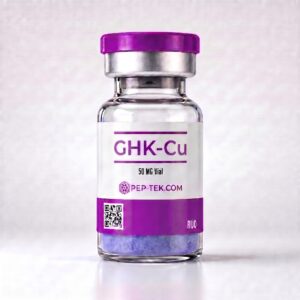
Available from PepTek
GHK-Cu copper peptide research examines its multi-pathway signaling activity, including gene expression modulation, antioxidant responses, and tissue remodeling observations in preclinical models.
GHK-Cu (glycyl-L-histidyl-L-lysine copper complex) is a naturally occurring tripeptide-copper chelate that has attracted sustained scientific interest since its initial isolation in human plasma. GHK-Cu copper peptide research spans several decades and encompasses a broad range of molecular biology, genomics, and tissue biology investigations. This profile summarizes the compound’s structural characteristics, proposed mechanisms, and the body of preclinical evidence accumulated through in vitro and animal model studies.
GHK-Cu consists of the tripeptide glycyl-L-histidyl-L-lysine coordinated to a copper(II) ion. The histidine residue plays a central role in metal coordination, forming a stable square-planar complex that influences the peptide’s interaction with cellular receptors and extracellular matrix proteins. The copper ion is integral to the compound’s observed biological activity; copper-free GHK demonstrates markedly reduced activity in most experimental systems, underscoring the importance of the metal-chelate structure [Pickart et al., 2012].
The molecular weight of GHK-Cu is approximately 340 Da, classifying it as a low-molecular-weight peptide capable of interacting with a wide array of cellular targets. Its copper-binding affinity (log K ≈ 16.4) is sufficient to facilitate copper donation to cuproenzymes, which researchers hypothesize may contribute to several of its observed effects on cellular metabolism.
The tripeptide GHK was first identified in the early 1970s by Loren Pickart, who isolated the compound from human plasma albumin and demonstrated its capacity to stimulate liver tissue regeneration in vitro [Pickart and Thaler, 1973]. Subsequent studies established that the biologically active form existed as a copper complex, leading to the formal characterization of GHK-Cu as a distinct research entity. Early investigations focused predominantly on connective tissue biology, where researchers observed significant modulation of collagen synthesis and matrix metalloproteinase (MMP) activity in cell culture models.
A significant expansion of GHK-Cu copper peptide research occurred with the advent of microarray and RNA sequencing technologies. Landmark genomic analyses by Pickart and Margolina identified GHK as capable of modulating the expression of more than 4,000 human genes, representing approximately one-fifth of the human genome [Pickart and Margolina, 2018]. Researchers observed upregulation of gene sets associated with antioxidant defense, DNA repair, mitochondrial biogenesis, and ubiquitin-proteasome pathways, while gene sets linked to inflammatory signaling and oncogenic transformation were observed to be downregulated in these experimental conditions. These findings positioned GHK-Cu as a subject of considerable interest in systems biology research.
In vitro studies consistently indicate that GHK-Cu influences the balance between extracellular matrix (ECM) synthesis and degradation. Researchers have observed that GHK-Cu stimulates fibroblast production of collagen, elastin, and proteoglycans while simultaneously modulating MMP activity in a context-dependent manner. A study by Wegrowski et al. demonstrated upregulation of decorin expression in fibroblast cultures treated with GHK, suggesting potential effects on collagen fibril organization [Wegrowski et al., 1992]. These ECM-related observations have made GHK-Cu copper peptide research a subject of interest to researchers studying connective tissue biology.
Animal model studies and cell culture experiments have explored GHK-Cu’s interactions with oxidative stress pathways. Researchers have reported activation of nuclear factor erythroid 2-related factor 2 (Nrf2) signaling in GHK-Cu-treated cell lines, which is associated with upregulation of antioxidant response element (ARE)-driven genes including superoxide dismutase, catalase, and glutathione-S-transferase isoforms. Parallel observations include suppression of nuclear factor kappa B (NF-κB) activity in inflammatory cell models, which investigators have proposed as a mechanistic basis for the anti-inflammatory patterns observed in preclinical systems [Pickart et al., 2012].
Researchers studying peptides with overlapping tissue-remodeling properties, such as those investigating BPC-157 peptide research and its mechanism of action, have noted that multiple research peptides appear to converge on similar downstream signaling nodes, including growth factor receptor pathways and cytokine modulation, though each compound demonstrates distinct structural and mechanistic features.
Preclinical investigations have examined GHK-Cu’s effects on neurotrophic factor expression. Animal model studies have reported increased expression of nerve growth factor (NGF) and brain-derived neurotrophic factor (BDNF) in GHK-treated preparations, prompting researchers to investigate potential interactions with neuronal survival and plasticity pathways [Pickart and Margolina, 2018]. These observations remain preliminary and have not been validated in controlled human research contexts.
GHK-Cu copper peptide research has extended to stem cell biology, where in vitro studies have investigated the compound’s effects on mesenchymal stem cell differentiation. Researchers have observed that GHK-Cu at nanomolar concentrations can influence the expression of pluripotency-associated transcription factors and lineage commitment markers in culture systems. These findings are considered exploratory and require further mechanistic validation.
GHK-Cu’s multi-target signaling profile has invited comparison with other research peptides that demonstrate pleiotropic activity. Investigators working in tissue biology have noted structural and functional parallels with actin-sequestering peptides; for example, researchers examining TB-500 (Thymosin Beta-4) cellular mechanisms have similarly identified broad gene-regulatory effects and extracellular matrix interactions as central features of interest, highlighting a broader research trend toward understanding how low-molecular-weight peptides can engage systemic signaling networks.
The majority of GHK-Cu copper peptide research has been conducted in cell culture systems (in vitro) and rodent models (in vivo). While these studies have generated a substantial body of mechanistic hypotheses, the translation of these findings to more complex biological systems remains an active area of investigation. Genome-wide expression analyses provide compelling evidence for broad transcriptional activity, though the functional consequences of these expression changes require further characterization [Pickart and Margolina, 2018].
Several important research gaps have been identified by investigators in this field. Dose-response relationships in animal models have been characterized only for select endpoints. Pharmacokinetic data, including bioavailability, tissue distribution, and metabolic fate in complex organisms, remain incompletely described. Furthermore, the relative contributions of free copper release versus intact peptide-copper complex activity to observed biological effects have not been fully resolved [Pickart et al., 2012].
GHK-Cu copper peptide research represents an active and evolving area of preclinical investigation, with evidence accumulated primarily from in vitro and animal model systems over several decades. The compound’s multi-pathway signaling activity and broad genomic influence make it a subject of considerable scientific interest across disciplines including molecular biology, tissue engineering, and systems pharmacology.
Research Use Disclaimer: All information presented in this profile is intended strictly for scientific research and educational purposes. GHK-Cu is a research compound supplied exclusively for in vitro and preclinical laboratory investigation. It is not approved by the FDA or any regulatory authority for human or animal use. Nothing in this article constitutes medical advice, dosing guidance, or a therapeutic claim of any kind. PepTek supplies research-grade compounds solely to qualified researchers operating within appropriate institutional frameworks.