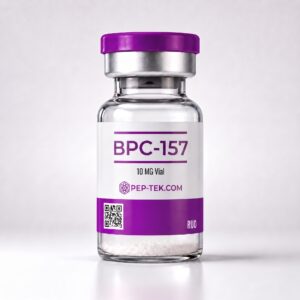
Available from PepTek
A review of key preclinical studies examining BPC-157 gut research gastrointestinal studies, focusing on mucosal protection, ulcer healing, and tissue repair mechanisms observed in animal models.
Body Protection Compound-157 (BPC-157) is a synthetic pentadecapeptide derived from a naturally occurring protein found in gastric juice. Since its isolation and characterization in the early 1990s, it has become a subject of sustained interest in gastrointestinal research. A growing body of preclinical literature focused on BPC-157 gut research gastrointestinal studies suggests that this peptide exhibits a range of cytoprotective and tissue-regenerative properties within the gastrointestinal (GI) tract, as observed exclusively in cell culture and animal model systems. This article summarizes several landmark preclinical investigations into its mucosal protective mechanisms and broader GI tract effects.
For researchers exploring the broader landscape of peptide-based research compounds, PepTek’s BPC-157 Peptide: Research Profile and Mechanism of Action provides a foundational overview of this compound’s molecular characteristics and proposed signaling pathways.
BPC-157 is composed of the amino acid sequence Gly-Glu-Pro-Pro-Pro-Gly-Lys-Pro-Ala-Asp-Asp-Ala-Gly-Leu-Val, yielding a molecular weight of approximately 1,419 Da. It is notable for its reported stability in gastric acid environments, which has made it particularly relevant to BPC-157 gut research gastrointestinal studies. Unlike many peptides that are rapidly degraded in the GI lumen, BPC-157 has been observed in animal studies to retain bioactivity in this environment [Sikiric et al., 1997].
Researchers have identified several mechanistic pathways through which BPC-157 may exert its effects on gastrointestinal tissue, including modulation of nitric oxide (NO) synthesis, interaction with the growth hormone receptor pathway, upregulation of growth factors such as EGF and VEGF, and stabilization of the gastric mucosal barrier.
One of the earliest and most cited investigations in BPC-157 gut research gastrointestinal studies was conducted by Sikiric and colleagues, examining the peptide’s effect on acetic acid-induced gastric ulcers in rats. Researchers observed significantly accelerated ulcer healing in BPC-157-treated groups compared to controls, with histological analyses revealing enhanced granulation tissue formation, improved mucosal epithelialization, and reduced inflammatory infiltrate. The study concluded that BPC-157 may promote gastric mucosal repair through upregulation of growth factor expression at the ulcer margin [Sikiric et al., 1997].
These tissue-repair observations bear a mechanistic resemblance to findings reported for other cytoprotective peptides studied in regenerative contexts. For instance, researchers studying GHK-Cu: Copper Peptide Research Profile and Signaling Pathways have similarly documented growth factor modulation and extracellular matrix remodeling in preclinical wound models.
A series of studies published by Sikiric’s research group examined the effects of BPC-157 administration in rodent models of inflammatory bowel disease (IBD), including both trinitrobenzenesulfonic acid (TNBS)- and cysteamine-induced colitis models. Animal model studies indicate that BPC-157-treated subjects demonstrated measurably reduced colonic mucosal damage scores, lower tissue levels of pro-inflammatory cytokines (including TNF-α and IL-6), and improved macroscopic integrity of the colon wall [Sikiric et al., 2010].
Researchers have observed that these anti-inflammatory effects may be partially mediated through BPC-157’s interaction with the nitric oxide system, a signaling axis that plays a central regulatory role in intestinal epithelial homeostasis. The peptide appeared to normalize dysregulated NO production in inflamed colonic tissue, supporting mucosal barrier function rather than exacerbating it.
Beyond the stomach and colon, BPC-157 gut research gastrointestinal studies have extended to examination of the esophagus and small intestine. In a rodent model of esophageal injury induced by HCl/NaOH caustic application, researchers observed that BPC-157 administration was associated with significantly reduced stricture formation and improved mucosal healing compared to vehicle-treated controls [Bardak et al., 2016]. The proposed mechanism involved enhanced angiogenesis at the injury site, consistent with BPC-157’s documented capacity to upregulate VEGF expression.
In short bowel syndrome models, animal model studies indicate that BPC-157 may support intestinal adaptation by promoting enterocyte proliferation and villus regeneration following massive small bowel resection, potentially through EGF receptor pathway engagement [Sikiric et al., 2010].
A particularly well-characterized area of BPC-157 gut research gastrointestinal studies involves models of non-steroidal anti-inflammatory drug (NSAID)-induced gastrointestinal damage. Researchers demonstrated that co-administration of BPC-157 in indomethacin- and aspirin-challenged rat models was associated with significant attenuation of gastric mucosal hemorrhage, reduced ulcer index scores, and preservation of mucosal prostaglandin levels [Sikiric et al., 2010]. These findings were replicated across multiple independent laboratory settings, lending additional weight to the reproducibility of the observed gastroprotective effects.
The cytoprotective signaling observed in these studies has prompted researchers to explore parallels with other gastrointestinal peptide systems. For context on how gut-active peptides interact with broader metabolic signaling, researchers may also reference PepTek’s profile on Semaglutide: GLP-1 Receptor Agonist Research and Mechanism of Action, which details another class of GI-active peptide ligands studied in metabolic contexts.
A recurring theme across BPC-157 gut research gastrointestinal studies is the peptide’s apparent interaction with the nitric oxide (NO) signaling system. Researchers have observed that BPC-157 may act as a nitric oxide system modulator, capable of both upregulating eNOS expression in ischemic or injured tissue while attenuating excessive iNOS-driven inflammation. This dual modulatory capacity may explain the compound’s apparent context-dependent cytoprotective effects [Sikiric et al., 2018].
Multiple in vitro and in vivo studies have documented BPC-157-associated increases in VEGF expression and endothelial cell migration, effects that would theoretically support mucosal revascularization following ischemic or chemically-induced injury. Researchers have observed that VEGF-2 receptor interactions may represent one primary molecular target through which BPC-157 initiates its pro-angiogenic effects in gastrointestinal tissue [Chang et al., 2010].
This angiogenic signaling dynamic shares conceptual parallels with tissue-repair mechanisms studied in other peptide research contexts. Researchers following regenerative peptide literature may find PepTek’s overview of TB-500 (Thymosin Beta-4): Research Profile and Cellular Mechanisms a relevant comparative reference, as TB-500 has similarly been studied for its VEGF-associated angiogenic properties in preclinical models.
In vitro studies suggest that BPC-157 may exert antioxidant-adjacent effects by reducing reactive oxygen species (ROS) accumulation in gastric mucosal cells subjected to oxidative challenge. This has led some researchers to hypothesize that BPC-157’s cytoprotective profile may partially overlap with endogenous antioxidant defense systems. For broader context on peptide-level antioxidant mechanisms, PepTek’s review of Glutathione: Tripeptide Antioxidant Research and Redox Signaling provides relevant background on how small peptides participate in cellular redox regulation [Sikiric et al., 2018].
It is essential to note that the preponderance of published research on BPC-157 originates from a single primary research group, which represents a notable limitation in terms of independent replication. Furthermore, the overwhelming majority of studies have been conducted in rodent models; no peer-reviewed, controlled clinical trials in human subjects have been published to date. The translational relevance of findings from rat gastric mucosa to human gastrointestinal physiology remains an open research question. Researchers engaging with this literature should interpret findings within the appropriate preclinical context.
The studies summarized in this article represent findings from preclinical, in vitro, and animal model research only. BPC-157 is classified strictly as a research compound and is intended exclusively for laboratory investigation. The observations described here—spanning gastric ulcer models, IBD models, NSAID-induced injury models, and mechanistic pathway analyses—have not been validated in human clinical trials and do not constitute evidence of safety or efficacy in humans.
Disclaimer: All BPC-157 research compounds available through PepTek are supplied for in vitro and preclinical research purposes only. This article does not constitute medical advice, does not imply therapeutic benefit, and should not be interpreted as a recommendation for any form of human or animal administration. Researchers are advised to comply with all applicable institutional and regulatory guidelines when working with peptide research compounds.