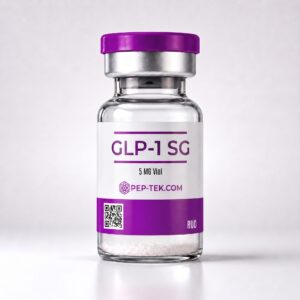
Available from PepTek
Semaglutide is a synthetic GLP-1 receptor agonist studied extensively in metabolic and endocrine research for its receptor binding properties and downstream signaling effects.
Semaglutide is a long-acting, acylated glucagon-like peptide-1 (GLP-1) analogue that has become a significant subject of interest in metabolic, endocrine, and neuroscience research. As a compound classified within semaglutide GLP-1 receptor agonist research, it offers investigators a structurally refined tool for studying the physiological consequences of GLP-1 receptor (GLP-1R) activation. Its extended half-life, high receptor affinity, and well-characterized pharmacokinetic profile make it a valuable reference compound in preclinical and translational research settings.
This article is intended strictly for informational and educational purposes relating to ongoing scientific research. All content pertains to laboratory and preclinical study contexts only.
Semaglutide shares approximately 94% amino acid sequence homology with endogenous human GLP-1(7–36) amide. Its structure incorporates several deliberate modifications that distinguish it from the native peptide. Key among these is the substitution of alanine at position 8 with alpha-aminoisobutyric acid (Aib), which confers resistance to dipeptidyl peptidase-4 (DPP-4) cleavage — the primary enzymatic degradation pathway for endogenous GLP-1 [Lau et al., 2015].
Additionally, semaglutide features a C18 fatty diacid chain attached via a hydrophilic linker to lysine at position 26. This acylation strategy promotes reversible, non-covalent binding to serum albumin, dramatically prolonging systemic circulation and enabling once-weekly dosing schedules in animal model studies. The combined structural modifications result in a compound with a half-life of approximately 165–184 hours in research subjects, compared to less than two minutes for the native peptide.
At the molecular level, semaglutide functions as a full agonist at the GLP-1 receptor, a class B G-protein-coupled receptor (GPCR) expressed broadly across pancreatic tissue, the central nervous system, cardiovascular tissue, and the gastrointestinal tract. Upon binding, semaglutide induces conformational changes in the receptor that promote coupling with the stimulatory Gs protein, triggering adenylyl cyclase activation and subsequent intracellular accumulation of cyclic adenosine monophosphate (cAMP) [Knudsen & Lau, 2019].
Elevated cAMP activates protein kinase A (PKA) and exchange proteins directly activated by cAMP (Epac), which in pancreatic beta cells have been observed in preclinical research to enhance glucose-dependent insulin secretion. This mechanistic cascade is central to the breadth of research applications surrounding semaglutide GLP-1 receptor agonist research, as GLP-1R is now recognized as a target with wide biological relevance beyond the endocrine pancreas.
GLP-1 receptors are expressed in multiple brain regions including the hypothalamus, brainstem, hippocampus, and reward circuitry. In vitro studies and animal model investigations suggest that semaglutide engages GLP-1R in the arcuate nucleus and nucleus tractus solitarius to modulate signaling pathways associated with energy homeostasis and appetite-related neuronal activity [Gabery et al., 2020]. Researchers have observed, in rodent models, reductions in food-seeking behavior correlating with GLP-1R activation in these regions, making this an active area of neuroendocrine research.
Parallel research into tissue-repair and cytoprotective peptides — such as the work profiled in the BPC-157 peptide research profile — highlights how structurally distinct peptides can share overlapping mechanistic terrain at the level of intracellular signaling, offering comparative frameworks useful in systems biology research.
The scientific lineage of semaglutide traces back to foundational work on the incretin system in the 1980s and 1990s. The identification of GLP-1 as an insulinotropic factor secreted from intestinal L-cells following nutrient ingestion established the rationale for GLP-1R as a research target. Early structural analogues such as exendin-4 (derived from the Gila monster salivary peptide) demonstrated proof of concept for extended GLP-1R agonism in animal models, informing the subsequent design of fully human-sequence-based analogues.
Semaglutide was developed with the explicit goal of optimizing receptor binding duration and DPP-4 resistance relative to earlier analogues. Preclinical studies conducted across the 2010s characterized its receptor binding kinetics, tissue distribution, and downstream signaling properties, generating a robust dataset that has supported its emergence as a reference standard compound in metabolic research [Lau et al., 2015].
In vitro studies using pancreatic beta cell lines and isolated islet preparations have examined how semaglutide-mediated GLP-1R activation influences insulin gene transcription, beta cell proliferation signals, and apoptosis-related pathways. Animal model studies in diabetic rodent models have indicated alterations in glycaemic parameters and pancreatic beta cell mass, consistent with GLP-1R-driven intracellular signaling effects [Christou et al., 2019].
GLP-1 receptors are expressed in cardiomyocytes, vascular endothelium, and smooth muscle cells. In vitro and rodent model research has explored whether semaglutide-related GLP-1R signaling influences markers of oxidative stress, inflammatory cytokine expression, and endothelial function. Researchers have observed, in isolated cardiac tissue preparations, cAMP-mediated effects on contractile parameters and stress response pathways, suggesting mechanistic relevance for cardiovascular biology research programs [Husain et al., 2019].
A growing area of semaglutide GLP-1 receptor agonist research involves the central nervous system, particularly in models of neuroinflammation and neurodegeneration. Animal model data have indicated that GLP-1R activation may modulate microglial activation states and neuronal survival signaling pathways. The mechanistic overlap between peptide-mediated cytoprotection and receptor-driven neuroprotection is an area of cross-disciplinary interest, drawing parallels to research on regenerative peptides such as those reviewed in the TB-500 (Thymosin Beta-4) cellular mechanisms profile, where intracellular signaling cascades similarly underpin observed cytoprotective properties.
Preclinical investigations have assessed GLP-1R expression in adipocytes and hepatocytes. In vitro studies suggest that receptor activation may influence lipogenic gene expression and fatty acid oxidation pathways, though the mechanistic picture remains an active area of investigation. Animal model studies in high-fat-diet-induced obesity models have provided data on adipose tissue remodeling in the context of sustained GLP-1R agonism, relevant to researchers studying energy substrate partitioning [Christou et al., 2019].
From a research design perspective, semaglutide’s pharmacokinetic characteristics are relevant considerations. Its high serum albumin binding (greater than 99%) affects free compound availability in biological assays. Researchers have noted that its extended half-life, while advantageous for sustained receptor occupancy studies, requires careful washout period planning in experimental designs. In animal model studies, steady-state plasma concentrations are typically achieved after four to five dosing intervals under standard subcutaneous administration paradigms, a factor relevant to the reproducibility of semaglutide GLP-1 receptor agonist research protocols.
Within the broader landscape of GLP-1R agonist research compounds, semaglutide is distinguished by its combination of human-sequence homology, albumin-binding half-life extension, and DPP-4 resistance. Compared to earlier research analogues such as liraglutide, researchers have observed greater potency at the GLP-1R in binding assays and more pronounced downstream cAMP responses in cellular models [Knudsen & Lau, 2019]. These properties position semaglutide as a useful positive control and mechanistic probe in studies evaluating GLP-1R biology across tissue systems. The breadth of semaglutide GLP-1 receptor agonist research continues to expand as investigators characterize receptor expression in less-studied tissue compartments and explore the downstream signaling networks that mediate its diverse observed effects in preclinical systems.
Semaglutide represents a structurally refined GLP-1 receptor agonist with well-characterized binding kinetics, an extended pharmacokinetic profile, and a broad tissue distribution of its target receptor. The compound continues to serve as an important tool in preclinical investigations spanning metabolic biology, neuroscience, cardiovascular physiology, and adipose tissue research.
Research Use Disclaimer: All information presented in this article pertains exclusively to preclinical, in vitro, and animal model research contexts. Semaglutide, as supplied by PepTek, is intended solely for laboratory research purposes by qualified scientific investigators. This compound is not intended for human or animal consumption, is not approved for therapeutic use in this context, and should not be interpreted as suitable for any clinical, diagnostic, or self-administration purpose. No medical claims are made or implied. Researchers should consult applicable institutional and regulatory guidelines when designing studies involving this compound.