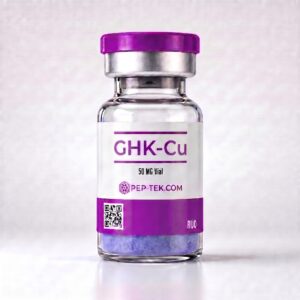
Available from PepTek
GHK-Cu is a naturally occurring copper-binding tripeptide studied extensively in vitro and in animal models for its roles in tissue remodeling, antioxidant signaling, and gene expression modulation.
The question of what is GHK-Cu copper peptide research has attracted significant scientific attention since the compound was first isolated from human plasma in 1973. GHK-Cu — glycyl-L-histidyl-L-lysine complexed with copper(II) — is a naturally occurring tripeptide that binds copper ions with high affinity and has since been identified in saliva, urine, and various tissues. Its discovery by Loren Pickart opened a decades-long line of investigation into how a small peptide could exert such wide-ranging effects on cellular signaling, extracellular matrix dynamics, and gene regulation. For researchers exploring the frontiers of peptide biology, understanding what is GHK-Cu copper peptide research means examining a rich body of published literature spanning wound biology, antioxidant pathways, and genomics.
GHK-Cu consists of the tripeptide sequence Gly-His-Lys coordinated with a Cu²⁺ ion. The histidine imidazole nitrogen and the terminal amino groups create a stable square-planar coordination complex. This copper-binding capacity is central to the compound’s observed biological activity in experimental systems, as copper is an essential cofactor in numerous enzymatic processes including superoxide dismutase (SOD) activity and lysyl oxidase-mediated collagen crosslinking.
In vitro studies suggest that the copper ion is not merely a passenger but an active participant in GHK-Cu’s interactions with cellular receptors and extracellular matrix components. Researchers have observed that the intact GHK-Cu complex is required for maximal activity in fibroblast migration assays, with the apo-peptide (copper-free GHK) exhibiting substantially reduced effects [Pickart et al., 2012].
One of the most compelling areas of what is GHK-Cu copper peptide research involves its extraordinary influence on gene expression. A landmark analysis by Pickart and Margolina, drawing on data from the Broad Institute’s Connectivity Map, examined GHK-Cu’s capacity to modulate large sets of human genes simultaneously. Researchers identified that GHK-Cu appeared to reset the expression patterns of genes associated with aging tissues toward profiles more consistent with younger phenotypes in cell culture systems [Pickart & Margolina, 2018].
Specifically, in silico and in vitro data indicated that GHK-Cu influenced over 4,000 human genes — upregulating approximately 50% and downregulating the remaining 50%. Genes associated with inflammation, metalloproteinase activity, and oxidative stress response were among those most consistently modulated. These observations were made in cell culture and computational models and should not be extrapolated to human therapeutic contexts without rigorous clinical validation.
Animal model studies and fibroblast culture experiments have repeatedly linked GHK-Cu to transforming growth factor-beta (TGF-β) signaling. Researchers have observed upregulation of TGF-β1 and its downstream mediators, including SMAD proteins, following GHK-Cu exposure in dermal fibroblast cultures. This pathway is mechanistically connected to collagen type I and III synthesis, fibronectin deposition, and basement membrane reorganization [Maquart et al., 1993].
In one well-cited in vitro study, Maquart and colleagues demonstrated that GHK-Cu stimulated collagen synthesis in fibroblast cultures at nanomolar concentrations — a finding that has since been replicated across multiple laboratory settings. The researchers noted concentration-dependent responses, with optimal effects observed within specific nanomolar-to-low-micromolar ranges in cell culture, underscoring the importance of precise experimental design.
Understanding what is GHK-Cu copper peptide research also requires examining its studied interactions with antioxidant defense systems. Several in vitro investigations have shown that GHK-Cu enhances the activity of copper/zinc superoxide dismutase (Cu/Zn-SOD), an enzyme that catalyzes the dismutation of superoxide radicals into hydrogen peroxide and molecular oxygen. By delivering bioavailable copper to SOD, GHK-Cu is hypothesized to augment endogenous reactive oxygen species (ROS) scavenging in experimental cell models.
This places GHK-Cu in an interesting mechanistic relationship with other antioxidant research compounds. For researchers studying redox biology, the broader literature on glutathione as a tripeptide antioxidant and redox signaling molecule provides useful comparative context for how small peptides can participate in cellular antioxidant networks through distinct but complementary mechanisms.
Animal model and cell culture studies have indicated that GHK-Cu may modulate nuclear factor kappa B (NF-κB) signaling, a central regulatory node in inflammatory gene expression. Researchers have observed reductions in pro-inflammatory cytokine production — including TNF-α and IL-6 — in GHK-Cu-treated macrophage cultures, consistent with NF-κB pathway suppression [Pickart et al., 2012]. These findings are preliminary and confined to experimental systems; no conclusions about anti-inflammatory activity in living organisms should be drawn from in vitro data alone.
GHK-Cu has been studied in standardized animal wound models since the 1980s. Researching what is GHK-Cu copper peptide research in this domain reveals a consistent pattern: animal model studies indicate accelerated wound contraction, increased angiogenesis, and improved granulation tissue quality in GHK-Cu-treated subjects compared to controls [Pickart, 1973]. In one rodent excisional wound model, topical application of GHK-Cu was associated with significantly increased tensile strength and collagen deposition at wound sites relative to vehicle-treated controls.
These tissue-remodeling properties have structural parallels with other peptides studied in repair biology. Researchers interested in extracellular matrix dynamics may find value in comparing GHK-Cu’s documented mechanisms to those described for BPC-157, a synthetic peptide with studied effects on tissue repair pathways, and TB-500 (Thymosin Beta-4), which has been examined for actin-mediated cellular migration. Each compound operates through distinct molecular mechanisms, and comparative research across these peptides remains an active area of investigation.
In vitro studies suggest GHK-Cu exerts a dual modulatory effect on matrix metalloproteinases (MMPs). Researchers have observed simultaneous upregulation of certain MMPs (notably MMP-2) alongside upregulation of tissue inhibitors of metalloproteinases (TIMPs), suggesting a remodeling — rather than purely degradative — phenotype in treated fibroblast cultures [Maquart et al., 1993]. This nuanced MMP/TIMP balance is considered important for orderly extracellular matrix turnover in wound healing research models.
A smaller but growing body of research has examined GHK-Cu in neurological cell models. In vitro studies suggest neuroprotective properties, including attenuation of oxidative damage in neuronal cultures exposed to hydrogen peroxide insults. Researchers have observed upregulation of brain-derived neurotrophic factor (BDNF) gene expression in some GHK-Cu-treated neural cell models, though the functional significance of these in vitro findings requires further investigation in validated animal models [Pickart & Margolina, 2018].
For researchers contextualizing neuropeptide research broadly, related compound profiles such as those for Semax, an ACTH-derived neuropeptide research compound, highlight how diverse structural classes of peptides are studied for their interactions with neural signaling systems through entirely different receptor-mediated and signaling mechanisms.
While the published literature on what is GHK-Cu copper peptide research is extensive, several methodological caveats merit attention. The majority of foundational studies were conducted in cell culture systems or small animal models, which limits direct extrapolation. Concentration ranges used in vitro often differ substantially from physiologically achievable levels. Additionally, the bioavailability, tissue distribution, and metabolic fate of exogenously administered GHK-Cu in complex biological systems have not been fully characterized. Researchers designing experiments with this compound should carefully consider these variables in their study protocols.
The compound’s broad genomic effects, while scientifically intriguing, also raise important questions about specificity and off-target interactions that warrant systematic investigation before any conclusions beyond the cell culture and animal model context can be drawn. Researchers exploring cellular energy metabolism and signaling crosstalk may also find relevant mechanistic parallels in the literature on NAD+ as a coenzyme in cellular metabolism research, particularly regarding redox state regulation and its interaction with gene expression programs.
GHK-Cu (glycyl-L-histidyl-L-lysine copper complex) is an extensively studied research compound with a well-documented published literature spanning gene expression, extracellular matrix biology, antioxidant signaling, and tissue remodeling — primarily in vitro and in animal models. The breadth of observed effects makes it a scientifically valuable tool for exploring fundamental cellular processes in controlled laboratory settings.
For researchers seeking a comprehensive structural and mechanistic profile, the GHK-Cu copper peptide research profile and signaling pathways resource provides additional detail on the compound’s molecular interactions and proposed mechanisms of action across experimental systems.
Research Use Disclaimer: All information presented in this article is intended strictly for scientific research and educational purposes. GHK-Cu, as supplied by PepTek, is a research compound only and is not approved for human or animal consumption, therapeutic use, or clinical application. No content in this article constitutes medical advice, dosing guidance, or a claim of therapeutic efficacy. Researchers should consult all applicable institutional, regulatory, and ethical guidelines before conducting experiments with this compound.