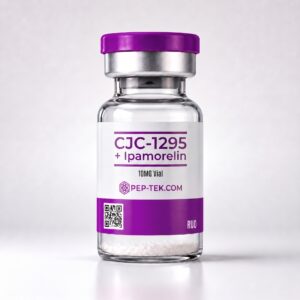
Available from PepTek
CJC-1295 and Ipamorelin are two distinct peptides studied for their complementary roles in growth hormone axis signaling. This research overview examines their individual mechanisms, combined actions, and the available preclinical evidence.
The CJC-1295 ipamorelin peptide blend research field has expanded considerably over the past two decades, driven by scientific interest in the complementary signaling pathways these two peptides engage within the somatotropic axis. CJC-1295, a synthetic analogue of growth hormone-releasing hormone (GHRH), and Ipamorelin, a selective growth hormone secretagogue (GHS), operate through distinct but functionally convergent mechanisms. When studied together in preclinical models, researchers have observed amplified growth hormone (GH) pulse characteristics compared to either compound administered alone. This profile summarizes the current state of published evidence, the individual and combined mechanisms of action, and the broader research context for these compounds.
CJC-1295 (also designated DAC:GRF) is a 30-amino acid peptide derived from the first 29 amino acids of endogenous GHRH, with the addition of a Drug Affinity Complex (DAC) lysine modification that enables covalent binding to circulating albumin. This structural feature substantially extends the peptide’s plasma half-life from minutes — as seen with native GHRH — to several days in animal models [Jetté et al., 2005]. CJC-1295 binds to the GHRH receptor (GHRHR) on pituitary somatotroph cells, stimulating intracellular cAMP accumulation and downstream GH synthesis and secretion.
Early research published in the Journal of Clinical Endocrinology & Metabolism demonstrated that CJC-1295 administration in human volunteers produced dose-dependent increases in mean plasma GH concentrations and IGF-1 levels, with effects persisting for up to 6 days following a single injection [Teichman et al., 2006]. This extended bioactivity distinguishes CJC-1295 from earlier GHRH analogues and has made it a subject of ongoing investigation into sustained somatotropic modulation.
Ipamorelin is a pentapeptide (Aib-His-D-2-Nal-D-Phe-Lys-NH₂) and a member of the ghrelin mimetic class of compounds. It acts as a selective agonist at the growth hormone secretagogue receptor type 1a (GHSR-1a), a G-protein coupled receptor expressed predominantly in pituitary somatotrophs and hypothalamic neurons. Unlike earlier GHS compounds such as GHRP-6 or GHRP-2, Ipamorelin demonstrates high selectivity for GH release with minimal stimulation of corticotropin (ACTH), cortisol, or prolactin secretion in animal models [Raun et al., 1998].
Preclinical studies in rats established that Ipamorelin elicits potent, dose-dependent GH release comparable in magnitude to GHRP-6, while exhibiting a markedly cleaner hormonal profile [Raun et al., 1998]. This selectivity profile has made Ipamorelin a preferred research tool when investigators seek to interrogate GHSR-1a biology without confounding neuroendocrine signals. Its relatively short plasma half-life — estimated at approximately 2 hours in rodent models — means it produces discrete, pulsatile GH release events rather than sustained elevation.
The foundational rationale for studying the CJC-1295 ipamorelin peptide blend lies in the distinct receptor systems each compound engages. Endogenous GH secretion is governed by the interplay between hypothalamic GHRH (stimulatory) and somatostatin (inhibitory), with ghrelin providing an additional stimulatory input via GHSR-1a. CJC-1295 amplifies the GHRH axis, while Ipamorelin engages the ghrelin/GHS receptor axis. Research in animal models has consistently demonstrated that combined stimulation of both GHRHR and GHSR-1a produces supra-additive or synergistic GH release compared to either receptor pathway activated in isolation [Bowers et al., 1998].
At the cellular level, GHRHR signaling operates primarily through Gs-coupled adenylyl cyclase activation and protein kinase A (PKA) pathways, whereas GHSR-1a signaling utilizes Gq/11 coupling to phospholipase C (PLC), inositol trisphosphate (IP₃), and intracellular calcium mobilization. The convergence of these two distinct second-messenger cascades on the same somatotroph cell population is hypothesized to underlie the amplified secretory response observed experimentally. Additionally, ghrelin-class ligands have been shown to partially suppress hypothalamic somatostatin tone, which may further disinhibit GH release when GHRH receptor pathways are simultaneously activated.
Researchers studying the CJC-1295 ipamorelin peptide blend research landscape have noted that this dual-axis model mirrors the physiological architecture of endogenous GH pulsatility, where each secretory burst reflects coordinated GHRH surges and somatostatin withdrawal. This biological plausibility has sustained interest in the combination as a research model for interrogating GH axis dynamics.
Animal model studies using combined GHRH analogue and GHS administration have consistently reported amplified GH pulse amplitude and increased mean GH concentrations compared to monotherapy controls. In aged rat models, where GH axis activity is characteristically attenuated, combined GHRH and GHSR-1a agonism has been shown to partially restore youthful GH secretory patterns [Thorner et al., 1997]. Downstream, researchers have observed corresponding increases in hepatic IGF-1 mRNA expression and circulating IGF-1 concentrations, reflecting amplified somatotropic signaling through the full GH-IGF-1 axis.
Several preclinical investigations have examined the effects of sustained GH axis stimulation on body composition parameters. Animal model studies employing GHRH analogues and GHS compounds have reported observations including reduced adipose tissue accumulation and preservation of lean body mass in aged rodent cohorts, consistent with the known lipolytic and anabolic properties of GH signaling. These findings represent observations in controlled research settings and should not be extrapolated to human therapeutic applications.
Endogenous GH secretion is tightly coupled to slow-wave sleep (SWS) in mammals. Researchers using GHSR-1a agonists in animal models have observed modifications in sleep architecture, including increased SWS duration, which may be mechanistically linked to central GHSR-1a expression in hypothalamic sleep-regulatory circuits. The relevance of these observations to the CJC-1295 ipamorelin peptide blend research context remains an area of active preclinical inquiry.
For researchers interested in broader peptide signaling networks, the tissue repair and cellular regeneration pathways studied in BPC-157 peptide research and its mechanism of action offer a complementary perspective on how peptide compounds can engage distinct biological axes. Similarly, the extracellular matrix and growth factor signaling explored in GHK-Cu copper peptide signaling pathway research illustrates the diversity of peptide-mediated cellular communication systems under investigation.
A critical consideration for researchers designing experiments with this blend is the pharmacokinetic mismatch between the two compounds. CJC-1295 with DAC exhibits a terminal half-life estimated at 6–8 days in human volunteers [Teichman et al., 2006], while Ipamorelin’s half-life is measured in hours. This differential means that CJC-1295 provides a sustained baseline elevation of GHRH receptor tone, upon which discrete Ipamorelin-induced GH pulses are superimposed. Research protocols must account for this kinetic asymmetry when interpreting endpoint data, particularly for studies measuring pulsatile versus tonic GH secretion patterns.
Researchers investigating metabolic peptide signaling more broadly may find useful methodological parallels in the Retatrutide triple receptor agonist research overview, which similarly addresses the complexity of multi-receptor pharmacodynamics in preclinical study design. Additionally, investigators studying peptide effects on tissue-level outcomes alongside GH axis modulation may wish to consult the TB-500 (Thymosin Beta-4) cellular mechanism research profile for context on actin-sequestration and cytoskeletal peptide biology.
While the preclinical evidence base for individual GHS and GHRH analogue compounds is well-established, peer-reviewed studies specifically examining the CJC-1295 ipamorelin peptide blend as a formulated combination remain limited. Most synergy evidence is inferred from mechanistic studies of GHRHR and GHSR-1a co-stimulation using structurally related compounds. Researchers should note that long-term effects of sustained somatotropic axis amplification, potential desensitization of pituitary receptors, and systemic consequences in diverse animal models require further systematic investigation. The absence of robust controlled clinical trial data for this specific combination represents a significant evidence gap that ongoing research programs may seek to address.
The CJC-1295 ipamorelin peptide blend research outlined in this profile reflects the current state of preclinical and early translational science as of the time of publication. All compounds described herein — including CJC-1295 and Ipamorelin — are intended strictly for in vitro and in vivo laboratory research purposes only. These compounds are not approved by the FDA or any regulatory authority for human or veterinary therapeutic use. Nothing in this article constitutes medical advice, therapeutic guidance, dosing recommendations, or an endorsement of any clinical application. Researchers should consult all applicable institutional, regulatory, and ethical guidelines before initiating studies involving these compounds. PepTek supplies research-grade peptides exclusively for qualified scientific investigators operating within approved research frameworks.