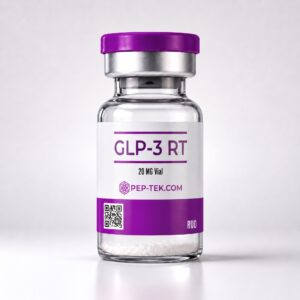
Available from PepTek
Retatrutide is a novel triple agonist peptide targeting GIP, GLP-1, and glucagon receptors simultaneously, under active investigation in preclinical and clinical research settings.
Among the most intensively studied compounds in contemporary metabolic research, retatrutide has drawn significant scientific attention as a retatrutide triple agonist peptide research subject due to its simultaneous engagement of three distinct receptor systems. Unlike earlier incretin-based research compounds that target a single or dual receptor pathway, retatrutide is designed to co-activate glucose-dependent insulinotropic polypeptide (GIP), glucagon-like peptide-1 (GLP-1), and glucagon receptors within a single molecular architecture. This tripartite mechanism positions it as a uniquely versatile tool for researchers investigating energy homeostasis, lipid metabolism, and related physiological pathways.
This profile provides an academic overview of retatrutide’s molecular design, proposed mechanisms, research history, and the available evidence from published studies. All content herein is intended strictly for scientific research purposes.
Retatrutide (also designated LY3437943) is a synthetic acylated peptide developed by Eli Lilly and Company. Its backbone is derived from GIP peptide sequence elements, with strategic amino acid modifications engineered to confer balanced agonist activity across all three target receptors: GIPR, GLP-1R, and GCGR. The molecule incorporates a fatty acid chain enabling albumin binding, which extends its half-life and supports once-weekly dosing schedules in clinical research trials.
The molecular weight and acylation chemistry of retatrutide are broadly consistent with other long-acting incretin peptides studied in the research landscape. Researchers have noted that achieving balanced tri-agonism — avoiding excessive bias toward any single receptor — represents a key design challenge, as each receptor subtype has distinct downstream signaling profiles and expression patterns across tissues including the pancreas, hypothalamus, liver, and adipose tissue [Coskun et al., 2022].
The GLP-1 receptor component of retatrutide’s activity is the most extensively characterized among the three pathways. GLP-1R signaling, primarily through cyclic AMP (cAMP) elevation and downstream protein kinase A activation, has been associated in research models with modulation of gastric emptying, hypothalamic satiety signaling, and pancreatic beta-cell function. Studies involving GLP-1R agonists have provided substantial mechanistic context for interpreting retatrutide’s effects in this axis.
GIPR co-agonism adds a complementary dimension to the compound’s research profile. In vitro studies and animal model data suggest that GIPR activation may potentiate GLP-1R-mediated effects on insulin secretion and additionally influence adipose tissue metabolism and central nervous system energy regulation. Researchers have observed that GIPR expression in hypothalamic neurons and adipocytes may contribute to body weight-related outcomes noted in animal model experiments [Finan et al., 2013].
The inclusion of glucagon receptor agonism distinguishes retatrutide triple agonist peptide research from dual GIP/GLP-1 agonist investigations. GCGR activation is associated in research models with increased hepatic glucose output, thermogenesis, and lipolysis. When combined with GLP-1R activity, researchers hypothesize that the hyperglycemic potential of isolated glucagon signaling is counterbalanced, while its energy-expenditure and lipid-mobilizing properties may remain operative. Animal model studies on related tri-agonist scaffolds have indicated enhanced fat oxidation metrics compared to mono- or dual-agonist comparators [Day et al., 2009].
The conceptual groundwork for tri-receptor agonism emerged from earlier research demonstrating that combining GLP-1 with glucagon activity in a single molecule could produce additive effects on body weight-related endpoints in rodent models without proportional adverse glycemic outcomes [Day et al., 2009]. Subsequent programs explored the addition of GIP receptor activity to this framework, building toward the tripartite approach represented by retatrutide.
Retatrutide itself entered Phase 1 clinical research trials, with Eli Lilly subsequently advancing the compound into Phase 2 investigations. A landmark Phase 2 trial published in 2023 in the New England Journal of Medicine reported findings from a 48-week randomized, double-blind, placebo-controlled study examining retatrutide across multiple dose cohorts in adult participants with obesity [Jastreboff et al., 2023]. Researchers observed statistically significant reductions in body weight across active treatment groups in a dose-dependent pattern, representing some of the most pronounced weight-related outcomes reported in a Phase 2 trial of this compound class to date.
Parallel Phase 2 data in participants with type 2 diabetes, also published in 2023, further characterized retatrutide’s effects on glycemic parameters, with researchers observing meaningful reductions in HbA1c levels across dose groups [Rosenstock et al., 2023]. These findings collectively established the evidence base that now drives ongoing retatrutide triple agonist peptide research in Phase 3 investigations.
Animal model studies on structurally related tri-agonist peptides have indicated enhanced resting energy expenditure and preferential reduction of visceral adipose tissue compared to controls. Researchers have attributed these observations partly to the GCGR component, which in rodent studies has been associated with upregulation of thermogenic gene expression in brown adipose tissue. The retatrutide triple agonist peptide research community continues to investigate whether analogous mechanisms operate in human tissue preparations.
Preclinical data on tri-agonist compounds have suggested reductions in hepatic triglyceride accumulation and markers associated with hepatic steatosis in diet-induced obesity models [Coskun et al., 2022]. This hepatic dimension has become an area of growing interest, with researchers exploring whether the simultaneous activation of GIPR, GLP-1R, and GCGR produces additive or synergistic effects on hepatic lipid flux that neither pathway alone replicates.
As an area of active investigation, researchers have begun examining cardiovascular-adjacent parameters in clinical study data. Heart rate changes and blood pressure metrics have been tracked in Phase 2 trial reports, consistent with standard monitoring for compounds acting on incretin and glucagon receptor pathways. These observations are preliminary and remain under investigation in ongoing trials.
Retatrutide exists within a broader landscape of peptide research exploring multi-receptor signaling strategies for understanding metabolic physiology. Researchers interested in peptide mechanisms of action across different biological systems may also find value in reviewing parallel research areas. For example, studies on tissue-protective peptides such as those detailed in the BPC-157 peptide research profile and mechanism of action offer complementary perspectives on how structurally diverse peptides engage different receptor and signaling systems. Similarly, research into cytoskeletal and regenerative signaling described in the TB-500 (Thymosin Beta-4) research profile and cellular mechanisms illustrates the breadth of biological processes that synthetic and naturally derived peptides are being used to investigate in controlled research settings.
The mechanistic diversity of retatrutide triple agonist peptide research — spanning central nervous system satiety circuits, hepatic metabolism, adipose thermogenesis, and pancreatic function — makes it one of the more complex peptide systems currently under active characterization. Researchers continue to refine in vitro binding assays, receptor occupancy models, and downstream signaling pathway analyses to better delineate the relative contributions of each receptor arm to observed outcomes.
The evidence reviewed in this article is drawn from peer-reviewed preclinical studies, Phase 1, and Phase 2 clinical research publications. Retatrutide remains an investigational compound. All findings described herein derive from controlled research settings, and the compound is not approved for therapeutic use in any jurisdiction at the time of writing. Retatrutide triple agonist peptide research is ongoing, and conclusions regarding its biological effects should be interpreted within the appropriate scientific context.
Disclaimer: All information presented in this article is intended exclusively for scientific research and educational purposes. Retatrutide and all compounds discussed on the PepTek platform are research-use-only materials, not intended for human or animal consumption, self-administration, or therapeutic application. Nothing in this article constitutes medical advice, clinical guidance, or a recommendation for any specific use.