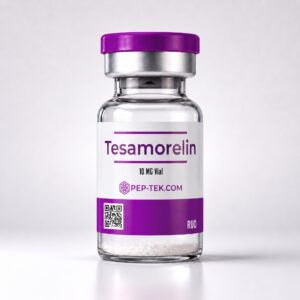
Available from PepTek
Tesamorelin is a synthetic GHRH analogue studied in research contexts for its effects on growth hormone secretion and metabolic parameters. This profile examines its mechanism, research history, and published evidence.
Tesamorelin is a stabilized synthetic analogue of endogenous growth hormone-releasing hormone (GHRH) that has been the subject of substantial preclinical and clinical research. As a tesamorelin GHRH analogue research subject, it occupies a notable position in the peptide science literature due to its structural modifications that extend biological half-life and its well-characterized interactions with pituitary somatotrophs. This profile summarizes its molecular characteristics, mechanism of action, and the body of published research examining its studied properties.
Endogenous GHRH is a 44-amino acid peptide produced in the hypothalamus that stimulates the anterior pituitary to release growth hormone (GH). Native GHRH is rapidly degraded by dipeptidyl peptidase IV (DPP-IV), limiting its utility as a research tool when administered exogenously. Tesamorelin addresses this limitation through the addition of a trans-3-hexenoic acid group at the N-terminus, which confers resistance to enzymatic cleavage while preserving the full 44-amino acid GHRH sequence [Falutz et al., 2007].
This structural modification distinguishes tesamorelin from truncated GHRH fragments and makes it a valuable probe in research settings designed to interrogate the GH/IGF-1 axis with greater temporal resolution than native GHRH allows.
Tesamorelin exerts its studied effects primarily through binding to the GHRH receptor (GHRHR), a G protein-coupled receptor expressed predominantly on somatotroph cells of the anterior pituitary. Receptor engagement activates the Gs/adenylyl cyclase/cAMP signaling cascade, leading to protein kinase A (PKA) activation and downstream phosphorylation events that stimulate both GH synthesis and pulsatile GH secretion [Prakash and Goa, 1999].
In vitro and animal model studies have demonstrated that GHRHR activation by tesamorelin results in elevated circulating GH, which in turn stimulates hepatic and peripheral insulin-like growth factor-1 (IGF-1) production. Researchers have observed that this axis activation follows the physiological pulsatile pattern of endogenous GH release rather than producing continuous supraphysiological elevation, a property considered significant in mechanistic research [Falutz et al., 2010]. The preservation of pulsatility is thought to reflect the compound’s dependence on intact somatostatin feedback loops, making tesamorelin a useful tool for studying hypothalamic-pituitary axis regulation.
Early investigations into synthetic GHRH analogues began in the 1980s following the isolation and characterization of native GHRH. Tesamorelin emerged from efforts to develop metabolically stable GHRH compounds suitable for extended research protocols. Initial preclinical studies in rodent and primate models established its pharmacokinetic profile and confirmed GH-stimulating activity comparable to native GHRH at equivalent molar doses.
Systematic clinical research into tesamorelin GHRH analogue research accelerated in the 2000s, particularly in the context of HIV-associated lipodystrophy, a condition characterized by aberrant visceral adiposity that researchers hypothesized was partly mediated by GH axis dysregulation. The compound became a widely studied model in this area, generating a series of randomized controlled trials that provided granular data on GH axis modulation in human subjects [Stanley et al., 2012].
Multiple clinical studies have investigated tesamorelin’s effects on visceral adipose tissue (VAT) in research cohorts. Falutz et al. conducted a multicenter, double-blind, placebo-controlled trial and reported statistically significant reductions in trunk fat as measured by CT imaging in the tesamorelin-treated group compared to placebo over 26 weeks [Falutz et al., 2010]. Researchers have observed that these changes in adipose distribution correlated with GH and IGF-1 elevations, supporting the mechanistic hypothesis that GH axis stimulation mediates lipolytic effects in visceral depots.
Beyond body composition endpoints, researchers have examined tesamorelin’s effects on lipid metabolism. Animal model studies and human research cohorts have reported alterations in triglyceride levels following sustained GHRH analogue administration, though investigators note that concurrent changes in insulin sensitivity require careful consideration in experimental design [Falutz et al., 2007]. This metabolic complexity makes tesamorelin a useful compound for studying the interplay between the GH axis and lipid homeostasis in controlled research settings.
Researchers studying metabolic peptides may find it instructive to compare the signaling diversity observed in tesamorelin research with that documented for other metabolically active compounds. For example, the multi-receptor agonist retatrutide represents a distinct mechanistic approach to metabolic axis research, engaging GIP, GLP-1, and glucagon receptors simultaneously rather than acting through the GH axis.
An emerging area of tesamorelin GHRH analogue research involves the central nervous system. Baker et al. published findings from a randomized trial examining cognitive function in older adults treated with tesamorelin, reporting that researchers observed improvements in verbal memory and executive function scores relative to placebo [Baker et al., 2012]. The investigators proposed that IGF-1 elevation may mediate neuroprotective effects, consistent with preclinical data showing IGF-1 receptor expression in hippocampal tissue. This line of inquiry remains an active area of investigation in geriatric and neuroscience research communities.
Studies characterizing tesamorelin’s pharmacokinetics have reported a plasma half-life of approximately 26–38 minutes following subcutaneous administration in research subjects, substantially longer than native GHRH. Peak plasma concentrations are observed within 15–30 minutes, with GH pulses detectable for several hours post-administration. This kinetic profile supports its utility in timed experimental paradigms designed to capture pulsatile GH dynamics.
Researchers investigating peptide stability and signaling kinetics may also find relevant mechanistic parallels in the literature on other structurally active peptides. The well-characterized receptor signaling cascades described for GHK-Cu copper peptide signaling pathways offer a useful comparative framework for understanding how relatively small structural modifications can produce pronounced differences in biological activity duration.
Published clinical trials have systematically collected adverse event data in tesamorelin research cohorts. Researchers have noted that fluid retention, peripheral edema, and injection site reactions represent the most frequently documented findings, consistent with GH axis activation across compound classes. Importantly, studies have examined glucose metabolism parameters extensively, given known GH-mediated effects on insulin sensitivity. Investigators report that fasting glucose and HbA1c changes were modest and generally within normal ranges in trial populations, though researchers emphasize that individuals with impaired glucose metabolism represent a population requiring careful study design consideration [Stanley et al., 2012].
For researchers studying tissue-level responses to peptide interventions, the mechanistic literature surrounding tissue repair peptides such as BPC-157 provides complementary context regarding how distinct peptide classes modulate cellular responses through non-overlapping receptor systems.
Contemporary tesamorelin GHRH analogue research extends across several domains including metabolic biology, neuroendocrinology, and aging science. The compound continues to serve as a reference tool for characterizing GHRH receptor pharmacology and as a positive control in GH axis stimulation assays. Its well-defined pharmacokinetic and pharmacodynamic profile makes it particularly suitable for studies requiring reproducible GH axis activation in controlled experimental systems.
Researchers examining peptide-mediated tissue remodeling may also benefit from reviewing work on cytoskeletal and extracellular matrix-modulating peptides. The distinct cellular mechanisms described in TB-500 thymosin beta-4 research illustrate how different peptide classes engage parallel but mechanistically separate pathways relevant to tissue homeostasis research.
Tesamorelin represents a well-characterized synthetic GHRH analogue with a substantial published research literature supporting its utility as a tool compound for investigating the GH/IGF-1 axis, metabolic regulation, and neuroendocrine function. The depth of tesamorelin GHRH analogue research across peer-reviewed journals provides researchers with a robust foundation for designing mechanistic studies in appropriate in vitro and animal model systems.
Research Use Disclaimer: All information presented in this profile is intended strictly for scientific research and educational purposes. Tesamorelin, as supplied by PepTek, is a research compound and is not approved, intended, or suitable for human or animal consumption, self-administration, or therapeutic use. Nothing in this article constitutes medical advice, dosing guidance, or a therapeutic recommendation. Researchers should comply with all applicable institutional, regulatory, and legal requirements governing the use of research compounds in their jurisdiction.