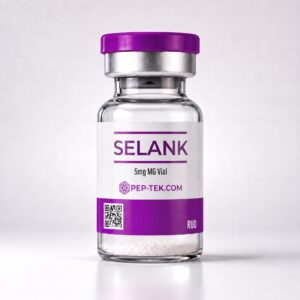
Available from PepTek
Selank is a synthetic heptapeptide developed in Russia, studied for anxiolytic and nootropic properties in preclinical and limited clinical research models.
Researchers investigating neuropsychiatric compounds have devoted considerable attention to Selank, a synthetic heptapeptide analog of the endogenous immunomodulatory peptide tuftsin. The question of what is selank peptide research anxiolytic potential centers on a structurally engineered molecule — Thr-Lys-Pro-Arg-Pro-Gly-Pro — that was developed at the Institute of Molecular Genetics of the Russian Academy of Sciences during the 1990s. Unlike tuftsin itself, which is rapidly degraded by serum peptidases, Selank incorporates a stabilizing C-terminal extension (Gly-Pro) that confers enhanced metabolic stability, making it a more tractable subject for laboratory investigation [Semenova et al., 2010].
This article summarizes key published preclinical and early clinical research on Selank, focusing on its proposed mechanisms of action, observed behavioral effects in animal models, and its interactions with neurotransmitter systems. All findings described herein are derived from controlled research settings and are presented for scientific informational purposes only.
Selank (also designated TP-7) was designed as a more stable derivative of tuftsin (Thr-Lys-Pro-Arg), a tetrapeptide fragment of immunoglobulin G that exhibits immunomodulatory properties. The addition of the Pro-Gly-Pro sequence to the C-terminus was reported to significantly prolong the half-life of the molecule in biological fluids compared to the parent peptide. Researchers at the Zakusov Institute of Pharmacology confirmed that this structural modification allowed for longer-lasting measurable effects in rodent behavioral paradigms without requiring continuous administration [Kozlovskaya et al., 2002].
Selank’s chemical profile places it within a broader class of synthetic neuropeptides being studied for central nervous system activity. Researchers studying related neuropeptide analogs, such as those examining Semax, an ACTH-derived neuropeptide, have similarly noted that C-terminal stabilization strategies enhance both metabolic resilience and CNS bioavailability in rodent models.
The foundational preclinical evidence addressing what is selank peptide research anxiolytic behavior comes largely from rodent paradigms. Semenova et al. (2010) administered Selank intranasally to Wistar rats and assessed behavior across several validated anxiety-related tests, including the elevated plus maze (EPM) and the open field test. Researchers observed a statistically significant increase in time spent in the open arms of the EPM, a conventional indicator of reduced anxiety-like behavior, without the concurrent motor sedation typically associated with classical benzodiazepine-class compounds [Semenova et al., 2010].
In the open field test, Selank-treated animals demonstrated increased exploratory locomotion without evidence of hyperactivity, a pattern that researchers have interpreted as consistent with anxiolysis rather than general CNS stimulation. These observations were replicated across multiple dosing conditions and routes of administration, reinforcing the internal consistency of the behavioral data.
A notable feature of the published preclinical literature is the comparison of Selank against established reference anxiolytic compounds such as diazepam and buspirone. Kozlovskaya et al. (2002) reported that while Selank produced comparable reductions in anxiety-like behavior to low-dose diazepam in the EPM model, it did not produce equivalent impairments in rotarod performance or conditioned avoidance tasks — measurements researchers use as proxies for sedation and motor disruption. This differential profile has made Selank a subject of continued mechanistic inquiry into non-sedating anxiolytic pathways.
A central question in understanding what is selank peptide research anxiolytic mechanism involves its interactions with classical neurotransmitter systems. Electroencephalographic and receptor-binding studies conducted in rodent models have suggested that Selank may modulate GABAergic tone, potentially through indirect facilitation of GABA-A receptor activity, though direct receptor binding affinity for GABA-A has not been conclusively established in the published literature [Semenova et al., 2010].
Serotonergic involvement has also been proposed. Analyses of brain homogenates from Selank-treated animals indicated alterations in serotonin turnover rates in limbic regions, including the hippocampus and amygdala — structures critically implicated in the processing of threat-related stimuli. Researchers have noted that these findings align with the known role of serotonin in anxiety regulation, though causal mechanistic pathways remain an active area of investigation.
Perhaps the most extensively studied molecular correlate of Selank administration in animal models is its apparent influence on brain-derived neurotrophic factor (BDNF) expression. Inozemtseva et al. (2014) reported that intranasal Selank administration in rats produced measurable upregulation of BDNF mRNA in hippocampal tissue, an observation of significant interest given the role of BDNF in synaptic plasticity and stress resilience [Inozemtseva et al., 2014]. Researchers have speculated that this BDNF-related activity may underlie at least part of the anxiolytic profile observed in behavioral studies, though the precise signaling cascade remains incompletely characterized.
This intersection of peptide-mediated neurotrophic support and stress biology parallels research conducted on other bioactive peptides. For example, investigations into GHK-Cu copper peptide signaling pathways have similarly identified upregulation of growth factor expression as a mechanistic theme in peptide neurobiology research.
Another proposed mechanism involves the modulation of enkephalin-degrading enzymes. Research groups have reported that Selank may inhibit enkephalinase activity, potentially elevating endogenous opioid peptide levels in synaptic clefts [Kozlovskaya et al., 2002]. Enkephalins are known to modulate both pain and anxiogenic responses, and their preservation in synaptic spaces could contribute to the anxiolytic-like phenotype observed in animal models. This mechanism, if validated in further studies, would represent a pharmacologically distinct anxiolytic pathway from either benzodiazepine or SSRI-class reference compounds.
Given Selank’s structural derivation from tuftsin — itself an immunomodulatory tetrapeptide — researchers have also examined its effects on immune signaling. Studies in rodent models have reported alterations in the expression of interleukin-6 (IL-6) and other cytokines following Selank administration, suggesting a bidirectional interaction between its neurological and immunological activity profiles [Uchakina et al., 2008]. The neuroinflammatory hypothesis of anxiety and mood dysregulation has made these immunological findings a point of growing scientific interest.
The intersection of peptide chemistry, oxidative biology, and neuroimmune signaling is a recurring theme across multiple research domains. Scientists studying antioxidant neuroprotection have noted conceptual parallels with compounds such as those reviewed in research on glutathione as a tripeptide antioxidant in redox signaling, where endogenous peptide structures mediate pleiotropic biological responses.
A limited body of early-phase human research has been published, primarily from Russian academic institutions. Zozulya et al. (2001) reported on a small-scale clinical investigation in subjects diagnosed with generalized anxiety disorder, in which researchers observed reductions in self-reported anxiety scores over a defined observation window following intranasal Selank administration [Zozulya et al., 2001]. The researchers noted an absence of sedation-related adverse events, consistent with the preclinical rodent data. However, the study cohort size, methodological constraints, and regional publication context necessitate that these findings be interpreted with caution and regarded as hypothesis-generating rather than confirmatory.
Researchers investigating the broader landscape of synthetic neuropeptide research may also find value in reviewing the comprehensive Selank synthetic anxiolytic peptide research overview available in the PepTek research library, which contextualizes these findings within the full arc of published literature.
For those interested in structurally related synthetic neuropeptides that share Russian academic origins, research on Semax as an ACTH-derived neuropeptide provides a useful comparative framework for understanding how C-terminal peptide engineering shapes CNS pharmacological profiles.
The research summarized in this article represents findings from preclinical animal studies and limited early-phase observational research. Selank is classified as a research compound and is supplied by PepTek exclusively for laboratory and scientific research purposes. Selank is not approved for human or animal consumption, is not intended for therapeutic use, and no medical claims are made regarding its properties or effects. Researchers working with this compound should adhere to all applicable institutional review guidelines and regulatory frameworks governing peptide research compounds. All dosing, administration, and experimental parameters described in cited literature are referenced solely to characterize the scientific context of published studies, not to recommend any protocol for use outside of controlled research settings.