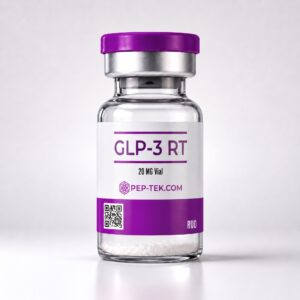
Disclaimer: All content on this page is intended strictly for scientific research and educational purposes. Retatrutide is not approved for human or animal consumption. Nothing herein constitutes medical advice, dosing guidance, or therapeutic recommendation. This compound is available for in vitro and authorized preclinical research use only.
What Is Retatrutide Triple Agonist Peptide? An Introduction
Retatrutide (LY3437943) is a synthetic peptide developed by Eli Lilly and Company that functions as a simultaneous agonist at three distinct incretin and metabolic hormone receptors: the glucose-dependent insulinotropic polypeptide receptor (GIPR), the glucagon-like peptide-1 receptor (GLP-1R), and the glucagon receptor (GCGR). Understanding what is retatrutide triple agonist peptide requires examining how it differs mechanistically from earlier single- or dual-receptor agonists that have preceded it in the research literature.
While researchers have extensively studied single-axis GLP-1 receptor agonists such as those reviewed in our article on Semaglutide: GLP-1 Receptor Agonist Research and Mechanism of Action, and dual-agonist compounds as covered in the overview of Tirzepatide: GLP-1/GIP Dual Agonist Research Profile, retatrutide represents the next evolution in incretin-based peptide pharmacology — adding coordinated glucagon receptor engagement to the mechanistic profile.
This article focuses on specific published clinical and preclinical research examining retatrutide’s receptor engagement, metabolic effects observed in animal models, and findings from Phase 1 and Phase 2 human research trials, all considered strictly within a scientific research framework.
Receptor Pharmacology and Molecular Mechanism
Triple Receptor Co-Agonism Architecture
Retatrutide was engineered as a peptide analogue of oxyntomodulin, a naturally occurring gut-derived peptide known to engage both GLP-1R and GCGR. Lilly’s medicinal chemistry program extended this scaffold to incorporate optimized GIPR agonism. The resulting compound exhibits balanced but distinct activity at all three receptors, with researchers noting that the relative agonist potency at each receptor can be modulated by structural modifications to the peptide backbone [Coskun et al., 2022].
The GLP-1R component is understood to contribute to insulin secretion potentiation in a glucose-dependent manner and to appetite-regulating signals via hypothalamic and brainstem circuits. The GIPR component has been studied for its role in augmenting insulin response and, more recently, for direct effects on adipose tissue and energy sensing. The GCGR component, when activated, is associated in research models with increased hepatic glucose output, thermogenesis, and lipid oxidation — a mechanism that distinguishes what is retatrutide triple agonist peptide from dual-agonist frameworks.
Fatty Acid Conjugation and Half-Life Extension
Like other long-acting research peptides in its class, retatrutide incorporates a C18 fatty diacid moiety enabling reversible albumin binding. This conjugation strategy extends the circulating half-life of the peptide, supporting once-weekly administration paradigms in clinical research protocols. Researchers have noted that this half-life extension strategy is consistent with approaches observed in related incretin peptide research [Finan et al., 2015].
Preclinical Research Findings
Animal Model Studies on Body Weight and Adiposity
Preclinical studies using diet-induced obese (DIO) rodent models demonstrated that triple receptor co-agonism produced significantly greater reductions in body weight and fat mass compared to either GLP-1R mono-agonism or GLP-1R/GIPR dual agonism alone. Researchers observed that the addition of glucagon receptor agonism appeared to amplify energy expenditure and fatty acid oxidation beyond what GLP-1R or GIPR activation alone could achieve [Briere et al., 2018]. These findings contributed to the scientific rationale for advancing triple agonism into human research trials.
In hepatic studies conducted in rodent models, retatrutide-class triple agonists were associated with reductions in liver lipid accumulation, a finding researchers have connected to the GCGR-mediated upregulation of hepatic fatty acid oxidation pathways. This intersection of metabolic pathways is also of interest when considering compounds studied for their roles in cellular energy metabolism, such as those examined in NAD+: Coenzyme Research Profile and Cellular Metabolism Studies.
Phase 1 Clinical Research: Safety and Pharmacokinetics
The first published Phase 1 study of retatrutide enrolled healthy human research participants and individuals with type 2 diabetes to evaluate pharmacokinetic parameters, tolerability, and initial signals of pharmacodynamic activity [Urva et al., 2022]. This study, published in Diabetes, Obesity and Metabolism, reported that retatrutide demonstrated predictable pharmacokinetics consistent with once-weekly dosing. Researchers observed dose-dependent reductions in body weight and fasting plasma glucose across the studied dose range, with the majority of adverse events categorized as gastrointestinal in nature — consistent with the known profile of GLP-1R-engaging peptides. No serious safety signals were identified in this initial study.
Understanding what is retatrutide triple agonist peptide in this early clinical context is important: Phase 1 data represents preliminary human pharmacology research, not therapeutic validation.
Phase 2 Clinical Research: The NEJM Publication
Study Design and Participant Population
The landmark Phase 2 randomized controlled trial of retatrutide was published in The New England Journal of Medicine in 2023 [Jastreboff et al., 2023]. This trial enrolled 338 adult participants with obesity (BMI ≥ 30 kg/m²) or overweight (BMI ≥ 27 kg/m² with at least one weight-related comorbidity) in a double-blind, placebo-controlled design across multiple dose cohorts over 48 weeks. Participants did not have type 2 diabetes at enrollment.
\h3>Key Observed Outcomes in Research Participants
Researchers observed that participants receiving the highest studied dose of retatrutide achieved a mean reduction in body weight of approximately 24.2% from baseline at 48 weeks, which was substantially greater than the placebo group’s observed change. Across dose cohorts, statistically significant reductions in waist circumference, fasting lipid parameters, and glycemic markers were also recorded. The research team noted that a meaningful proportion of participants in higher dose groups achieved ≥20% body weight reduction — a threshold rarely observed with previously studied single- or dual-agonist peptide compounds.
Adverse events were predominantly gastrointestinal, including nausea, vomiting, and diarrhea, and were reported at higher frequencies in the active treatment arms compared to placebo. These events were largely described by researchers as mild to moderate in severity and were most common during dose escalation phases.
Implications for Triple Agonism Research
The Phase 2 data published by Jastreboff and colleagues helped establish what is retatrutide triple agonist peptide within the evolving taxonomy of incretin-based research compounds. The magnitude of weight-related outcomes observed prompted researchers to hypothesize that the additive glucagon receptor axis contributes meaningfully to the overall metabolic effect profile beyond what GLP-1R/GIPR dual agonism is observed to produce. Ongoing Phase 3 research is designed to extend these observations across longer time horizons and broader participant populations.
Structural and Comparative Research Context
From a peptide chemistry standpoint, retatrutide exemplifies a broader trend in metabolic peptide research toward engineered multi-receptor engagement. Researchers studying other multi-target peptide architectures — such as those examining growth hormone secretagogue combinations reviewed in CJC-1295 + Ipamorelin Blend: Research Overview of Synergistic Mechanisms — have similarly explored whether coordinated engagement of complementary receptor systems can produce effects that are qualitatively or quantitatively distinct from mono-target approaches.
For researchers comparing the incretin peptide landscape, a detailed profile of the predecessor dual-agonist framework can be found in PepTek’s overview of Retatrutide: Triple GIP/GLP-1/Glucagon Agonist Research Overview, which contextualizes the compound’s receptor pharmacology alongside related incretin peptide research.
Research Context
Understanding what is retatrutide triple agonist peptide from a scientific standpoint requires situating the available data within its appropriate research context. The studies summarized here — including the 2023 Phase 2 NEJM trial — represent controlled scientific investigations conducted under regulatory oversight with qualified research investigators. These data do not constitute evidence of safety or efficacy for any use outside of formally supervised research protocols.
Retatrutide is available through PepTek strictly as a research compound for qualified investigators engaged in authorized in vitro or preclinical studies. It is not intended for human or animal consumption, is not a pharmaceutical drug, and has not received regulatory approval for any therapeutic indication. No content in this article should be interpreted as medical advice, a treatment recommendation, or dosing guidance of any kind.
Researchers interested in related metabolic peptide literature are encouraged to consult the full body of peer-reviewed research cited below and to review related compound profiles available in the PepTek research library.