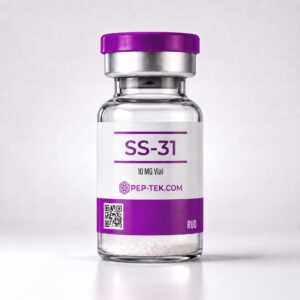
Available from PepTek
SS-31 is a mitochondria-targeting peptide studied extensively in preclinical models for its cardiolipin-binding and ROS-scavenging properties. Published research highlights its role in preserving mitochondrial structure and function.
SS-31 (also designated Szeto-Schiller peptide 31, or elamipretide in investigational contexts) is a synthetic tetrapeptide with the sequence D-Arg-Dmt-Lys-Phe-NH₂. Its unique alternating aromatic-cationic structure allows it to selectively concentrate within the inner mitochondrial membrane, where it interacts with cardiolipin — a phospholipid critical to maintaining mitochondrial architecture and electron transport chain (ETC) efficiency. SS-31 mitochondrial protection research studies have grown substantially over the past two decades, with investigators exploring its effects in models of ischemia-reperfusion injury, neurodegeneration, aging-related mitochondrial decline, and metabolic dysfunction. The following summary reviews key published findings that have shaped current understanding of this compound’s mechanistic profile.
Cardiolipin is an anionic phospholipid almost exclusively localized to the inner mitochondrial membrane. It plays a structural role in stabilizing respiratory chain supercomplexes and facilitating ATP synthase activity. During periods of oxidative stress or cellular injury, cardiolipin becomes peroxidized, disrupting cristae architecture and impairing cytochrome c retention — a key step toward apoptotic signaling. SS-31 binds selectively to cardiolipin via electrostatic and hydrophobic interactions, and researchers have proposed that this binding stabilizes the lipid against peroxidation and supports supercomplex assembly [Szeto, 2014].
This mechanism distinguishes SS-31 from generalized antioxidant strategies. Unlike compounds that broadly scavenge reactive oxygen species throughout the cytoplasm — such as those studied in Glutathione: Tripeptide Antioxidant Research and Redox Signaling — SS-31 appears to act at the precise subcellular site where mitochondrial ROS generation originates.
One of the most extensively studied applications in SS-31 mitochondrial protection research studies involves cardiac ischemia-reperfusion (I/R) injury. In a landmark study by Cho et al. (2007), researchers demonstrated that SS-31 administered to isolated cardiomyocytes prior to simulated ischemia significantly reduced cytochrome c release, attenuated mitochondrial membrane potential collapse, and decreased cell death compared to vehicle controls. In an in vivo rat model of myocardial infarction, SS-31 pretreatment was associated with a measurable reduction in infarct size and improved post-reperfusion cardiac output [Cho et al., 2007].
A subsequent study by Dai et al. (2013) extended these findings to aged mouse hearts, which inherently exhibit compromised mitochondrial function. The researchers observed that SS-31 treatment normalized mitochondrial membrane potential, improved state 3 respiration rates, and reduced markers of oxidative damage in aged myocardial tissue. Importantly, aged hearts treated with SS-31 showed a recovery profile following I/R that approached that of younger controls, suggesting the compound’s capacity to mitigate age-associated mitochondrial vulnerability [Dai et al., 2013].
SS-31 mitochondrial protection research studies have also examined skeletal muscle physiology. Siegel et al. (2013) investigated SS-31 in a mouse model of Duchenne muscular dystrophy (mdx mice), where mitochondrial dysfunction contributes significantly to fiber damage and weakness. Researchers found that SS-31 treatment improved mitochondrial respiration and reduced calcium-induced mitochondrial permeability transition pore (mPTP) opening in isolated muscle fibers. These effects correlated with improved in vivo grip strength measurements and reduced plasma markers of muscle damage, providing a mechanistic framework linking mitochondrial stability to contractile function [Siegel et al., 2013].
The relevance of mitochondrial bioenergetics to tissue maintenance is also explored in research on NAD⁺ metabolism. Studies summarized in NAD+: Coenzyme Research Profile and Cellular Metabolism Studies illustrate how upstream coenzyme availability intersects with the ETC dynamics that SS-31 is proposed to stabilize.
The kidneys are metabolically among the most demanding organs, with proximal tubular cells heavily reliant on oxidative phosphorylation. SS-31 mitochondrial protection research studies in renal models have produced consistently notable findings. Szeto et al. (2011) demonstrated that SS-31 administered to rats subjected to renal ischemia-reperfusion significantly preserved tubular architecture, reduced creatinine elevation, and attenuated mitochondrial fragmentation in tubular epithelial cells. Electron microscopy analyses in that study revealed that SS-31-treated animals maintained more organized cristae morphology compared to untreated controls, providing structural evidence consistent with cardiolipin stabilization [Szeto et al., 2011].
Subsequent rodent studies have replicated these renal findings in cisplatin-induced nephrotoxicity models, where mitochondrial dysfunction is an established early event in tubular injury, further supporting the compound’s mechanistic profile across diverse injury paradigms.
Given the exceptional mitochondrial demands of neural tissue, several research groups have investigated SS-31 in models relevant to neurodegeneration and aging. Yang et al. (2009) reported that SS-31 attenuated amyloid-beta-induced mitochondrial dysfunction in neuronal cell cultures, reducing ROS production and preserving mitochondrial membrane potential at nanomolar concentrations. In a separate aging-focused study, researchers observed that chronic SS-31 administration in aged mice was associated with improvements in mitochondrial bioenergetics across multiple tissues, including brain and heart, without evidence of toxicity at the concentrations studied [Dai et al., 2014].
This intersection of peptide research and neuroprotection is a theme shared by other synthetic peptides under active investigation. For context on neuropeptide research methodologies, researchers may find value in reviewing studies outlined in Semax: ACTH-Derived Neuropeptide Research Profile, which similarly emphasizes in vitro and animal model approaches to characterizing peptide activity in neural contexts.
Across the body of SS-31 mitochondrial protection research studies, several overlapping mechanisms have been proposed to account for observed effects:
Researchers studying cellular redox homeostasis in the context of peptide interventions may also find relevant parallels in the copper peptide research documented in GHK-Cu: Copper Peptide Research Profile and Signaling Pathways, which similarly explores how small peptides modulate oxidative stress and tissue maintenance pathways at the molecular level.
While SS-31 mitochondrial protection research studies present a compelling mechanistic and preclinical picture, several important limitations characterize the existing literature. The majority of high-evidence studies involve rodent models or in vitro systems, and translation to human biology cannot be assumed. Dose-response relationships characterized in animal studies do not directly correspond to any parameters applicable to human research contexts. Furthermore, long-term safety characterization in whole-organism models remains an active area of inquiry, and the precise stoichiometry and dynamics of cardiolipin binding in vivo continue to be refined. Researchers should evaluate findings within the controlled parameters of each individual study design.
The published studies summarized here represent a cross-section of the preclinical literature on SS-31 and its proposed mitochondrial mechanisms. This article is intended exclusively for researchers and scientific professionals seeking an overview of available published data. SS-31, as supplied by PepTek, is provided strictly as a research compound for laboratory and investigational use only. It is not intended for human or animal consumption, is not a drug or therapeutic agent, and has not been approved by the FDA or any regulatory authority for clinical use. No information in this article constitutes medical advice, dosing guidance, or a therapeutic recommendation of any kind. Researchers should consult applicable institutional and regulatory guidelines governing the use of research compounds in their work.