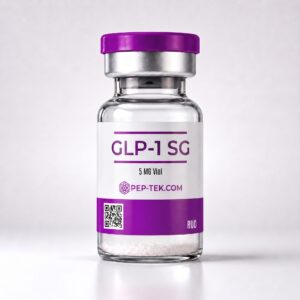
Available from PepTek
Semaglutide GLP-1 receptor signaling mechanism research explores how this long-acting GLP-1 analogue engages its receptor to modulate cAMP cascades, insulin secretion, and appetite signaling pathways.
Semaglutide is a synthetic analogue of glucagon-like peptide-1 (GLP-1), engineered to resist enzymatic degradation and extend receptor engagement far beyond the native hormone’s brief plasma half-life of approximately two minutes. Research into semaglutide GLP-1 receptor signaling mechanism has expanded considerably over the past decade, offering detailed molecular insight into how this compound interacts with the GLP-1 receptor (GLP-1R) to initiate cascading intracellular events. All findings referenced here originate from preclinical and clinical research contexts and are presented strictly for scientific informational purposes.
GLP-1 receptors belong to the class B family of G protein-coupled receptors (GPCRs), characterized by a large extracellular domain that facilitates high-affinity peptide binding. Structural studies using cryo-electron microscopy have mapped how the C-terminal alpha-helical region of GLP-1 engages the receptor’s extracellular domain, while the N-terminal portion inserts into the transmembrane bundle to initiate receptor activation [Liang et al., 2017].
Semaglutide differs from native GLP-1(7-36) amide through three key structural modifications: a substitution of alanine at position 8 with alpha-aminoisobutyric acid to resist DPP-4 cleavage, a C18 fatty diacid chain attached at lysine 34 via a linker, and a lysine-to-arginine substitution at position 34. The fatty acid moiety enables reversible albumin binding, effectively reducing renal clearance and extending the plasma half-life to approximately one week in research models [Lau et al., 2015]. These modifications preserve full agonist activity at GLP-1R while dramatically enhancing pharmacokinetic properties relevant to research applications.
Studies examining semaglutide GLP-1 receptor signaling mechanism research consistently demonstrate that receptor activation couples primarily to Gs proteins, stimulating adenylyl cyclase and elevating intracellular cyclic adenosine monophosphate (cAMP). Elevated cAMP activates protein kinase A (PKA), which phosphorylates multiple downstream targets including voltage-gated potassium channels, the ryanodine receptor, and transcription factors relevant to cellular function. In parallel, cAMP activates exchange protein directly activated by cAMP 2 (Epac2), which has been shown in pancreatic beta-cell models to facilitate calcium mobilization and vesicle priming independent of PKA [Drucker, 2018].
Beyond canonical Gs signaling, research models have identified that GLP-1R activation also recruits beta-arrestin proteins, mediating receptor desensitization and internalization via endocytic pathways. Beta-arrestin-dependent signaling has been observed to activate ERK1/2 mitogen-activated protein kinase cascades, which researchers have associated with cellular proliferation and survival responses in in vitro pancreatic models. The balance between G protein-mediated and beta-arrestin-mediated signaling—a concept referred to as biased agonism—is an active area of semaglutide GLP-1 receptor signaling mechanism research, as subtle differences in agonist structure may favor distinct downstream pathways [Zhang et al., 2020].
In vitro and animal model research have also identified cross-talk between GLP-1R signaling and the phosphoinositide 3-kinase (PI3K)/Akt pathway. Researchers have observed that GLP-1R agonism can phosphorylate Akt in neuronal and pancreatic cell lines, with downstream effects on mTOR complex 1 activity. This intersection with metabolic sensing pathways provides a mechanistic framework for understanding the breadth of cellular responses documented across multiple tissue types in preclinical studies.
GLP-1R is most densely expressed in pancreatic beta cells, and preclinical studies indicate that receptor activation augments glucose-stimulated insulin secretion through the cAMP/PKA and Epac2 pathways described above. Animal model studies further suggest that sustained GLP-1R activation may influence beta-cell mass through effects on proliferation and apoptotic signaling, though the translational relevance of these findings to human research remains under active investigation [Nauck & Meier, 2019].
GLP-1R expression has been documented in multiple hypothalamic nuclei, the brainstem, and reward circuitry regions including the ventral tegmental area. Research examining semaglutide GLP-1 receptor signaling mechanism in neural contexts suggests that receptor activation in the arcuate nucleus modulates neuropeptide Y and pro-opiomelanocortin neurons, influencing appetite signaling circuits. This central mechanism complements research on other neuropeptide systems; for comparative context, researchers interested in central peptide signaling may find the Semax ACTH-derived neuropeptide research profile of interest, as both compounds engage distinct but overlapping neuromodulatory frameworks.
GLP-1R has been identified in cardiomyocytes, vascular smooth muscle cells, and endothelial cells in preclinical models. Animal model studies have examined the effects of receptor activation on cardiac function, vascular tone, and inflammatory marker expression. Additionally, GLP-1R signaling interactions with hepatic lipid metabolism pathways have been explored in rodent models, providing context for understanding systemic metabolic research findings associated with this compound class.
Radioligand binding assays and functional cAMP accumulation studies have been used to characterize semaglutide’s affinity and efficacy at GLP-1R relative to native GLP-1 and other synthetic analogues. Research indicates that semaglutide exhibits full agonist efficacy with comparable or superior receptor affinity relative to shorter-acting GLP-1 analogues, attributed in part to the conformational stabilization conferred by its fatty acid modification [Lau et al., 2015]. Selectivity profiling against related class B GPCRs, including the glucagon receptor and GIP receptor, demonstrates high selectivity for GLP-1R, distinguishing semaglutide mechanistically from dual and triple agonist research compounds. Researchers examining multi-receptor incretins may find relevant mechanistic comparisons in the Tirzepatide GLP-1/GIP dual agonist research profile and the Retatrutide triple agonist research overview.
Emerging preclinical research has begun to characterize interactions between GLP-1R signaling and broader metabolic regulatory networks. Studies in rodent models have observed that GLP-1R activation may influence mitochondrial biogenesis markers and oxidative stress pathways in hepatic and adipose tissue. The intersection of peptide signaling with cellular redox status represents a growing area of inquiry; for foundational context on redox signaling research, the Glutathione tripeptide antioxidant research and redox signaling article provides relevant mechanistic background. Similarly, the role of coenzyme availability in metabolic signaling contexts is examined in the NAD+ coenzyme research profile and cellular metabolism studies.
The scientific foundation for GLP-1 receptor research was established in the late 1980s with the isolation and characterization of GLP-1 from intestinal L-cells and the cloning of its receptor. Early research demonstrated the glucose-dependent nature of GLP-1-stimulated insulin secretion, a property that distinguished this incretin from earlier secretagogue compounds. The identification of DPP-4 as the primary GLP-1 degrading enzyme motivated the structural engineering strategies that produced long-acting analogues. Semaglutide was developed through iterative medicinal chemistry efforts at Novo Nordisk and entered the published research literature in earnest following preclinical characterization studies in the early 2010s. Comprehensive semaglutide GLP-1 receptor signaling mechanism research including structural receptor interaction data has accelerated significantly since 2017 with advances in cryo-EM methodology enabling direct visualization of peptide-receptor complexes [Liang et al., 2017].
The mechanistic data summarized in this article derive from in vitro cell-based assays, recombinant receptor systems, and animal model studies. Researchers examining semaglutide GLP-1 receptor signaling mechanism research should consult primary literature for full experimental context, including species-specific differences in receptor pharmacology and signaling pathway architecture [Drucker, 2018; Nauck & Meier, 2019].
Research Use Disclaimer: All compounds and mechanisms described in this article are presented exclusively for scientific research and educational purposes. Semaglutide and related research compounds available through PepTek are intended solely for use in qualified laboratory research settings. Nothing in this article constitutes medical advice, dosing guidance, or therapeutic recommendation. These compounds are not approved for human or animal consumption, and no claims of safety or efficacy in humans are implied or should be inferred. Researchers should comply with all applicable institutional and regulatory requirements governing the use of research compounds.