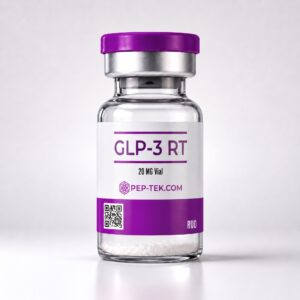
Available from PepTek
A summary of the landmark retatrutide phase 2 trial research examining this triple GIP/GLP-1/glucagon receptor agonist, including key findings on metabolic and body weight outcomes in human subjects.
Retatrutide (LY3437943) represents a structurally novel synthetic peptide designed to simultaneously engage three incretin and glucagon-related receptors: the glucose-dependent insulinotropic polypeptide (GIP) receptor, the glucagon-like peptide-1 (GLP-1) receptor, and the glucagon receptor (GCGR). This triple-agonist architecture distinguishes retatrutide from earlier dual-agonist compounds currently under investigation in the research community. The retatrutide phase 2 trial research published in 2023 provided the first large-scale, randomized, controlled human data on this compound’s pharmacodynamic profile and has drawn significant scientific attention. This article summarizes the key design elements, observed outcomes, and mechanistic interpretations from that pivotal study.
The phase 2 clinical trial, led by Jastreboff and colleagues and published in The New England Journal of Medicine in 2023, enrolled 338 adult participants classified as having overweight or obesity (body mass index ≥27 kg/m²), without type 2 diabetes [Jastreboff et al., 2023]. The trial was a randomized, double-blind, placebo-controlled, multiple-dose study lasting 48 weeks. Participants were assigned to one of several retatrutide dose escalation cohorts or placebo. The primary endpoint was the percentage change in body weight from baseline at week 24, with secondary endpoints extending to week 48.
This structure is consistent with rigorous phase 2 methodology, providing dose-ranging data that informs the design of subsequent phase 3 trials. Researchers used subcutaneous administration routes and followed standardized titration schedules to assess tolerability across dose levels.
The most prominently reported finding in the retatrutide phase 2 trial research was a substantial observed reduction in body weight across the active treatment cohorts. At week 48, the highest-dose group (12 mg) demonstrated a mean body weight reduction of approximately 24.2% from baseline, compared to 2.1% in the placebo group [Jastreboff et al., 2023]. This magnitude of weight change observed in a phase 2 setting was notably higher than data reported in comparable trials for dual-agonist compounds, prompting researchers to speculate about the additive or synergistic contribution of glucagon receptor co-activation.
For researchers studying incretin-based mechanisms, these findings contextualize ongoing investigations into how multi-receptor engagement may amplify metabolic signaling beyond what single-target agonists achieve. Readers interested in the mechanistic profile of related dual-agonist compounds may find value in PepTek’s research overview on Tirzepatide: GLP-1/GIP Dual Agonist Research Profile, which provides comparative context on receptor co-agonism strategies.
Secondary endpoints in the study included changes in waist circumference, fasting insulin, lipid panel parameters, and systolic blood pressure. Researchers observed statistically significant improvements across multiple cardiometabolic markers in the higher-dose cohorts. Fasting triglycerides, LDL-cholesterol, and systolic blood pressure all showed directional changes consistent with favorable metabolic modulation, though the authors appropriately note these findings require confirmation in larger, longer-duration studies.
The glucagon receptor component of retatrutide’s pharmacology is thought to contribute specifically to hepatic lipid mobilization and increased energy expenditure, distinguishing it mechanistically from pure GLP-1 receptor agonists such as those reviewed in PepTek’s article on Semaglutide: GLP-1 Receptor Agonist Research and Mechanism of Action.
A central area of scientific interest arising from the retatrutide phase 2 trial research is the hypothesis that co-activation of GIP, GLP-1, and glucagon receptors produces non-additive, synergistic effects on energy homeostasis. Preclinical research in rodent models had previously suggested that glucagon receptor agonism enhances thermogenesis and hepatic fat oxidation, while GLP-1 receptor activation modulates appetite and gastric emptying, and GIP receptor signaling may potentiate insulin secretion and adipocyte lipid metabolism [Coskun et al., 2022].
In the context of the phase 2 human data, the observed body weight changes are consistent with this multi-pathway model, though researchers emphasize that disentangling the individual receptor contributions in a human cohort remains methodologically complex. Ongoing mechanistic studies are expected to utilize receptor-specific antagonists in controlled in vitro and animal model settings to parse these contributions.
Researchers have proposed that retatrutide’s engagement of GLP-1 receptors in hypothalamic and brainstem circuits reduces food intake via central satiety signaling, while glucagon receptor activation may independently upregulate basal metabolic rate. This dual mechanism affecting both energy intake and energy expenditure is considered a key differentiating feature in the compound’s research profile [Finan et al., 2015].
This intersection of metabolic peptide signaling and energy regulation is also explored in research on growth hormone secretagogues. For comparative reference, PepTek’s profile on Tesamorelin: GHRH Analogue Research Profile and Studied Effects examines a structurally distinct peptide with studied effects on visceral adipose tissue in research models, offering a useful point of contrast for scientists studying peptide-mediated lipid metabolism.
The safety and tolerability data reported in the phase 2 trial indicated that adverse events were predominantly gastrointestinal in nature, consistent with the class effects observed with other GLP-1 receptor agonist compounds. Nausea, vomiting, and diarrhea were the most commonly reported events, with frequency and severity generally dose-dependent. The highest-dose cohort had a discontinuation rate of approximately 16% due to adverse events [Jastreboff et al., 2023].
Researchers also noted modest increases in heart rate in the active treatment groups, a pharmacodynamic effect that has been attributed to glucagon receptor activation and that will require further characterization in cardiovascular outcome trials. No unexpected safety signals were identified during the 48-week observation period, though investigators stress that longer and larger trials are necessary to establish a comprehensive safety profile.
The findings from the retatrutide phase 2 trial research have generated substantial interest in the broader scientific community studying metabolic peptide pharmacology. Several research questions remain open, including optimal receptor activation ratios for different metabolic phenotypes, long-term effects on lean body mass preservation, and mechanistic outcomes in populations with type 2 diabetes or non-alcoholic steatohepatitis (NASH).
Phase 3 trials are currently underway or in planning, with endpoints designed to address cardiovascular outcomes and longer-term metabolic trajectories. In parallel, preclinical researchers continue to investigate retatrutide’s molecular interactions using receptor binding assays and cell-based signaling models. For a broader overview of retatrutide’s structural and mechanistic classification within the incretin peptide research landscape, researchers may consult PepTek’s companion article: Retatrutide: Triple GIP/GLP-1/Glucagon Agonist Research Overview.
Additionally, the metabolic systems engaged by retatrutide intersect with cellular energy regulation pathways studied through other research compounds. Scientists examining the broader landscape of metabolic coenzyme research may find PepTek’s article on NAD+: Coenzyme Research Profile and Cellular Metabolism Studies a relevant reference when modeling downstream energy homeostasis mechanisms at the cellular level.
The retatrutide phase 2 trial research summarized in this article represents a significant data point in the scientific investigation of multi-receptor incretin agonism. The observations reported by Jastreboff and colleagues provide a foundation for ongoing mechanistic and translational studies. As with all research compound investigations, the data generated from this and related studies are intended exclusively to advance scientific understanding and do not constitute clinical guidance of any kind.
Disclaimer: All information presented in this article is intended strictly for research and educational purposes. Retatrutide is a research compound and is not approved for human or animal use by any regulatory authority. Nothing in this article constitutes medical advice, dosing guidance, or therapeutic recommendation. PepTek supplies research-grade compounds exclusively for use in licensed laboratory and scientific research settings. Researchers are responsible for compliance with all applicable regulations governing the use of research compounds in their jurisdiction.