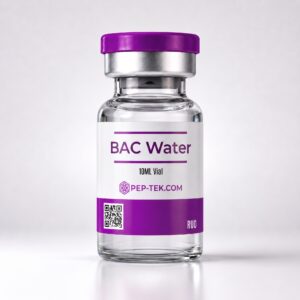
Available from PepTek
A research methodology guide covering peptide reconstitution best practices, solvent selection including BAC water, sterile water, and proper handling techniques for laboratory use only.
Proper peptide reconstitution methodology is foundational to reproducible, high-integrity research outcomes. When researchers work with lyophilized peptide compounds, the process of returning them to solution — reconstitution — directly influences peptide stability, bioactivity in assay systems, and shelf life of prepared stocks. This article outlines the analytical considerations, solvent selection rationale, and laboratory handling protocols relevant to peptide reconstitution research methodology BAC water and alternative solvent approaches, intended exclusively for use by qualified researchers in controlled laboratory settings.
Lyophilized peptides are supplied in a freeze-dried state to maximize long-term stability during storage and shipping. However, once researchers prepare a working solution, the peptide becomes susceptible to a range of degradation mechanisms including hydrolysis, oxidation, aggregation, and enzymatic breakdown. The choice of reconstitution solvent, the technique used, and subsequent storage conditions are not merely procedural footnotes — they are critical experimental variables [Fosgerau & Hoffmann, 2015].
Inconsistent reconstitution practices can introduce batch-to-batch variability that confounds research findings, particularly in studies involving structurally sensitive peptides. Researchers studying compounds such as those profiled in the BPC-157 peptide research profile or TB-500 (Thymosin Beta-4) cellular mechanisms research must apply rigorous reconstitution standards to ensure that observed experimental effects are attributable to the compound rather than solvent artifacts or degradation byproducts.
Bacteriostatic water (BAC water) is sterile water for injection that contains 0.9% benzyl alcohol as a preservative. Benzyl alcohol inhibits microbial growth, allowing multi-use vials to remain microbiologically stable over an extended period — typically up to 28 days after initial puncture under proper cold-chain conditions. This property makes BAC water a commonly referenced solvent in peptide reconstitution research methodology BAC water contexts where researchers require multi-aliquot access to a single vial of reconstituted peptide stock.
Researchers should be aware that benzyl alcohol, while effective as a preservative, can interact with certain peptide structures. Peptides containing reactive side chains — particularly cysteine-containing sequences or those with free thiol groups — may experience compatibility issues. Additionally, highly acidic or basic peptides may require pH-adjusted solvents prior to introducing BAC water [Manning et al., 2010].
Sterile water for injection contains no preservatives or additives. It is appropriate for single-use reconstitution where the entire prepared volume will be used within a short research window, or where the peptide sequence is known to be sensitive to benzyl alcohol. SWFI is often employed when researchers prepare peptide solutions for immediate in vitro assay use, minimizing potential confounding chemical interactions.
The primary limitation of SWFI in research contexts is that opened vials are vulnerable to microbial contamination, making strict aseptic technique mandatory. Single-draw use is the standard recommendation for maintaining solution integrity.
Certain peptides exhibit poor aqueous solubility due to hydrophobic residue content or charge distribution. For these compounds, researchers frequently employ dilute acetic acid (typically 0.1%–1% v/v), acetonitrile, or dimethyl sulfoxide (DMSO) as initial co-solvents. A common laboratory approach involves dissolving the lyophilized material in a small volume of acetic acid solution, then diluting to the target concentration with sterile or bacteriostatic water [Hamley, 2017].
Peptides such as those examined in GHK-Cu copper peptide signaling pathway research involve metal-coordinating sequences that may require specific buffer systems to preserve coordination chemistry during reconstitution. Researchers are advised to consult primary literature specific to each compound’s physicochemical profile before selecting a solvent system.
Researchers should calculate target molarity based on the molecular weight of the specific peptide and the supplied mass. Gravimetric methods are preferred over volumetric assumptions when working with sub-milligram quantities. UV absorbance at 280 nm (for peptides containing tryptophan or tyrosine residues) or alternative colorimetric assays such as BCA protein assay can serve as verification steps [Wiechelman et al., 1988].
This step is especially pertinent in research involving metabolically active peptides like those studied in CJC-1295 + Ipamorelin synergistic mechanism research or Ipamorelin selective GHRP research, where concentration accuracy directly affects assay dose-response interpretation.
Once reconstituted, peptide solutions have a significantly shorter stability window than lyophilized stocks. General laboratory guidance, supported by stability studies, recommends the following for research stock management:
Research-grade peptide reconstitution methodology should incorporate analytical verification steps to confirm compound integrity post-reconstitution. High-performance liquid chromatography (HPLC) with UV or mass spectrometric detection (LC-MS) is the gold standard for purity confirmation and detection of degradation products. Researchers working with structurally complex peptides or those studying redox-sensitive sequences — such as those relevant to glutathione tripeptide antioxidant and redox signaling research — should pay particular attention to oxidation-related impurity profiles [Fosgerau & Hoffmann, 2015].
Dynamic light scattering (DLS) can be employed to assess aggregation state, while circular dichroism (CD) spectroscopy allows researchers to monitor secondary structure retention post-reconstitution. These analytical tools are especially relevant when structural conformation is critical to the experimental endpoint being studied.
Understanding peptide reconstitution research methodology BAC water and associated analytical validation is not a one-size-fits-all undertaking. Researchers are encouraged to establish solvent and storage conditions empirically for each peptide system under investigation, using available physicochemical data as a starting point.
The methodology outlined in this article is intended exclusively for use by qualified scientists and researchers operating within licensed laboratory environments in compliance with all applicable institutional, local, and national regulations. All compounds referenced in this context are for research purposes only. Nothing contained in this article constitutes medical advice, clinical guidance, therapeutic recommendation, or instruction for use in humans or animals. PepTek supplies research compounds solely for in vitro and preclinical research applications. Researchers bear full responsibility for compliance with all applicable regulatory frameworks governing the procurement, handling, and use of research compounds in their jurisdiction.
Sound peptide reconstitution research methodology BAC water practices, rigorous analytical verification, and meticulous documentation are the foundation of reproducible peptide research. Adherence to these standards supports the integrity of scientific findings and advances the broader understanding of peptide biology in controlled experimental contexts.