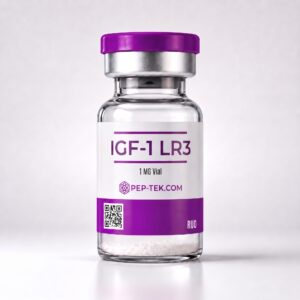
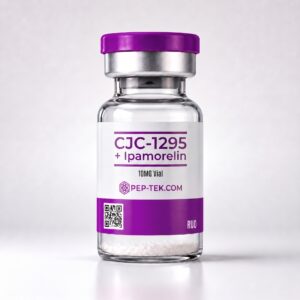
Available from PepTek
IGF-1 LR3 vs CJC-1295 peptide research reveals two distinct growth-related pathways. This comparison covers structural differences, receptor mechanisms, and how researchers select between them.
In the landscape of peptide-based research, few comparisons generate more scientific interest than the IGF-1 LR3 vs CJC-1295 peptide research discussion. While both compounds influence growth-related signaling cascades, they do so through fundamentally different molecular targets, upstream pathways, and temporal dynamics. Understanding these distinctions allows researchers to design more precise experimental models and draw more meaningful conclusions about each compound’s unique biological role.
IGF-1 LR3 (Long R3 Insulin-like Growth Factor-1) is a synthetic analogue of endogenous IGF-1, consisting of 83 amino acids. It incorporates two key structural modifications relative to native IGF-1: an N-terminal 13-amino acid extension and an arginine substitution at position 3 (replacing glutamic acid). These modifications dramatically reduce IGF-1’s binding affinity for insulin-like growth factor binding proteins (IGFBPs), which ordinarily sequester the native hormone in circulation. The result is a compound with a significantly extended half-life — estimated at approximately 20–30 hours in in vitro conditions — compared to native IGF-1’s half-life of minutes [Baxter et al., 1992]. By evading IGFBP sequestration, IGF-1 LR3 provides researchers with a tool to study prolonged, unimpeded IGF-1 receptor (IGF-1R) activation in cell culture and animal models.
CJC-1295 is a synthetic analogue of growth hormone-releasing hormone (GHRH), built on a 29-amino acid backbone derived from the first 29 residues of endogenous GHRH. Its defining structural feature is a C-terminal Drug Affinity Complex (DAC) modification — a lysine residue conjugated to a maleimidoproprionic acid moiety — that enables covalent binding to circulating albumin. This albumin-binding mechanism shields CJC-1295 from enzymatic degradation by dipeptidyl peptidase IV (DPP-IV), extending its plasma half-life to an estimated 6–8 days in animal studies [Jetté et al., 2005]. This is in stark contrast to endogenous GHRH, which is rapidly cleaved within minutes of release. Researchers studying CJC-1295 are therefore examining a tool designed to produce sustained stimulation of growth hormone (GH) secretion from the anterior pituitary.
IGF-1 LR3 exerts its effects by binding directly and with high affinity to the IGF-1 receptor (IGF-1R), a transmembrane receptor tyrosine kinase. Upon binding, IGF-1R undergoes autophosphorylation, initiating downstream signaling through two primary cascades: the PI3K/Akt/mTOR pathway, which is closely associated with protein synthesis and cellular survival, and the Ras/MAPK/ERK pathway, implicated in cell proliferation and differentiation [Adams, 2000]. Because IGF-1 LR3 bypasses IGFBP regulation, researchers are able to study these downstream effects in isolation, without the confounding influence of binding protein competition. This makes IGF-1 LR3 particularly valuable in in vitro cell proliferation assays and muscle satellite cell research models.
The direct nature of IGF-1 LR3’s action places it at the downstream end of the GH/IGF-1 axis. It does not rely on pituitary GH secretion or hepatic IGF-1 production to exert its studied effects, which distinguishes it sharply from upstream modulators like CJC-1295.
CJC-1295 operates upstream by binding to the GHRH receptor (GHRHR) on somatotroph cells of the anterior pituitary. This Gs-coupled receptor interaction activates adenylate cyclase, elevates intracellular cAMP levels, and stimulates both the synthesis and pulsatile release of growth hormone [Frohman & Jansson, 1986]. The GH subsequently secreted enters systemic circulation, stimulates hepatic IGF-1 production, and initiates the downstream signaling events described above — but through a physiologically regulated cascade rather than direct receptor activation.
This upstream mechanism has important implications for researchers. Because CJC-1295 works through the hypothalamic-pituitary axis, it preserves certain feedback mechanisms, including somatostatin-mediated inhibition of GH release. Researchers studying CJC-1295 are therefore examining a more physiologically contextualized form of GH axis stimulation. For studies on how GHRH prolongation affects GH pulse architecture, CJC-1295 is a commonly used tool. For related research on GHRH analogues and their studied effects, researchers may also reference work on Tesamorelin: GHRH Analogue Research Profile and Studied Effects, another GHRH-class compound with its own distinct structural modifications.
One of the most practically significant distinctions in the IGF-1 LR3 vs CJC-1295 peptide research comparison involves their respective activity windows and receptor targets. IGF-1 LR3’s extended half-life (~20–30 hours in vitro) compared to native IGF-1 allows researchers to conduct longer-term cell culture experiments with sustained IGF-1R activation without repeated dosing. CJC-1295’s albumin-binding half-life (~6–8 days in animal studies) enables researchers to study the effects of prolonged GHRHR stimulation across a multi-day experimental window.
It is also worth noting that CJC-1295 is frequently studied in combination with growth hormone-releasing peptides (GHRPs). Researchers exploring synergistic pituitary signaling often design experiments that pair CJC-1295 with ghrelin-mimetic peptides. Detailed analysis of one such pairing can be found in PepTek’s research overview of the CJC-1295 + Ipamorelin Blend: Research Overview of Synergistic Mechanisms, as well as in dedicated research on Ipamorelin: Selective GHRP Research Profile.
A critical conceptual distinction in the IGF-1 LR3 vs CJC-1295 peptide research comparison is axis position. CJC-1295 operates at the apex of the GH/IGF-1 axis — at the pituitary — while IGF-1 LR3 acts at the terminal effector level, bypassing pituitary and hepatic intermediaries entirely. This means that research using CJC-1295 will still be subject to the natural regulatory constraints of somatostatin tone and pituitary GH reserve, whereas IGF-1 LR3 studies can isolate receptor-level activity in a more controlled, IGFBP-free environment.
Researchers interested in comparing these compounds with other peptides involved in tissue repair and cellular signaling may find relevant structural context in work on GHK-Cu: Copper Peptide Research Profile and Signaling Pathways, a tripeptide studied for its role in growth factor modulation and tissue remodeling, or in research on TB-500 (Thymosin Beta-4): Research Profile and Cellular Mechanisms, which engages distinct but complementary cellular repair pathways.
The IGF-1 LR3 vs CJC-1295 peptide research comparison highlights how two structurally and mechanistically divergent compounds can both inform our understanding of the GH/IGF-1 axis from entirely different vantage points. IGF-1 LR3 provides researchers with direct, prolonged IGF-1R activation free from IGFBP interference, while CJC-1295 enables sustained upstream GHRHR stimulation with preserved physiological feedback architecture. The selection between these compounds depends entirely on the specific research question, model system, and axis level under investigation.
Research Use Disclaimer: All information presented in this article is intended strictly for scientific research and educational purposes. IGF-1 LR3, CJC-1295, and all compounds discussed on this platform are research chemicals supplied exclusively for in vitro and laboratory animal studies conducted by qualified researchers. These compounds are not approved for human or animal consumption, are not intended to diagnose, treat, cure, or prevent any condition, and must not be used outside of a controlled research environment. PepTek supplies these compounds in compliance with applicable regulations governing research-use-only materials.