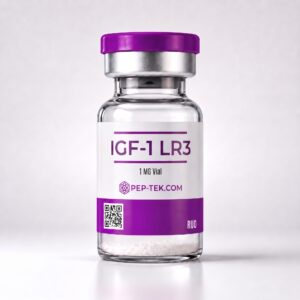
Available from PepTek
IGF-1 LR3 muscle satellite cell research examines how this extended-half-life IGF-1 analogue activates quiescent satellite cells and drives myogenic proliferation in controlled laboratory models.
Insulin-like growth factor 1 Long R3 (IGF-1 LR3) is a synthetic analogue of endogenous IGF-1 engineered with a 13-amino acid N-terminal extension and an Arg-to-Glu substitution at position 3. These modifications substantially reduce its affinity for IGF-binding proteins (IGFBPs), resulting in a significantly extended plasma half-life relative to native IGF-1. This biochemical profile has made IGF-1 LR3 a valuable tool in skeletal muscle biology research, particularly in studies examining satellite cell biology, myogenesis, and the molecular signaling cascades that govern muscle repair. The breadth of IGF-1 LR3 muscle satellite cell research spans in vitro cell culture systems, rodent injury models, and mechanistic pathway analyses, collectively advancing the scientific understanding of how IGF-1 signaling regulates adult muscle plasticity.
Skeletal muscle satellite cells are a population of adult stem cells that reside beneath the basal lamina of mature muscle fibers in a mitotically quiescent state. Upon exposure to mechanical stress, injury, or appropriate growth factor signaling, these cells become activated, re-enter the cell cycle, and undergo asymmetric division to generate myoblasts capable of differentiating and fusing with existing fibers or forming new myotubes [Charge & Rudnicki, 2004]. The fidelity of this process depends on a well-characterized transcriptional program involving myogenic regulatory factors (MRFs) such as MyoD, Myf5, myogenin, and MRF4.
IGF-1 and its downstream effectors—primarily the PI3K/Akt/mTOR and MAPK/ERK pathways—are recognized as central modulators of satellite cell function. Because native IGF-1 is rapidly sequestered by circulating IGFBPs, researchers have turned to IGF-1 LR3 as a tool to interrogate these pathways with greater temporal precision in controlled research environments.
A foundational series of experiments utilizing primary mouse satellite cells and C2C12 murine myoblast cultures demonstrated that IGF-1 receptor (IGF-1R) stimulation by IGF-1 LR3 robustly increases cellular proliferation as measured by BrdU incorporation and Ki-67 immunolabeling. Researchers observed dose-dependent upregulation of MyoD and Myf5 transcript levels, suggesting that IGF-1 LR3 promotes the transition from quiescence to an actively cycling myogenic state [Barton-Davis et al., 1998]. Critically, these studies also noted accelerated myotube formation upon serum withdrawal, indicating that the analogue supports not only proliferative expansion but also downstream differentiation signals.
Separate in vitro work confirmed that IGF-1 LR3 activates the PI3K/Akt axis in satellite cell-derived cultures, with downstream phosphorylation of mTORC1 substrates including p70S6K and 4E-BP1. These findings align with parallel research into other peptide growth regulators, such as the growth hormone secretagogue systems studied in CJC-1295 + Ipamorelin blend research, where upstream endocrine signals converge on similar anabolic cascades.
In rodent models of skeletal muscle overload and cardiotoxin-induced injury, intramuscular delivery of IGF-1 LR3 has been investigated for its effects on satellite cell number, myonuclear accretion, and fiber cross-sectional area. Musaro and colleagues demonstrated that localized IGF-1 isoform expression in transgenic mouse muscle substantially amplified the satellite cell-mediated regenerative response following injury, with activated satellite cells exhibiting enhanced Pax7 and MyoD co-expression [Musaro et al., 2001]. Subsequent researchers extrapolating from this transgenic model used IGF-1 LR3 as a pharmacological surrogate, observing comparable augmentation of satellite cell activation indices in wild-type animals subjected to eccentric loading protocols.
These findings resonate with broader research into tissue-repair peptides. For instance, studies on TB-500 (Thymosin Beta-4) and BPC-157 similarly investigate satellite cell-adjacent mechanisms, including cytoskeletal remodeling and angiogenic support of regenerating tissue, highlighting the multifactorial nature of muscle repair biology.
A mechanistic study by Rommel and colleagues characterized how IGF-1 signaling bifurcates downstream of Akt to simultaneously promote protein synthesis via mTOR and suppress protein degradation via phosphorylation-mediated inhibition of FoxO transcription factors [Rommel et al., 2001]. IGF-1 LR3 muscle satellite cell research building on this framework has used the analogue to map the temporal sequence of pathway activation, demonstrating that early Akt phosphorylation (within 15–30 minutes of ligand exposure) precedes mTOR substrate phosphorylation and is upstream of myogenin induction.
Parallel activation of the MAPK/ERK pathway by IGF-1 LR3 has been documented in several myoblast preparations, with ERK1/2 phosphorylation associated primarily with the proliferative phase, while differentiation correlates more strongly with sustained Akt/mTOR activity. This dual signaling architecture provides a mechanistic basis for the satellite cell population expansion observed in vivo models treated with the analogue.
One of the more extensively studied phenomena in IGF-1 LR3 muscle satellite cell research is myonuclear accretion—the incorporation of satellite cell-derived nuclei into existing muscle fibers, which is considered a prerequisite for sustained hypertrophic growth beyond a proposed myonuclear domain ceiling. Research by Adams and Haddad demonstrated that mechanical overload combined with elevated local IGF-1 signaling significantly increased the number of centrally located and peripherally incorporated nuclei in rodent plantaris muscle, a finding associated with satellite cell fusion events [Adams & Haddad, 1996]. Researchers subsequently used IGF-1 LR3 to replicate and extend these observations in cell culture fusion assays, noting that IGFBP-free stimulation achieved more consistent myonuclear incorporation than equimolar native IGF-1 preparations.
Effective satellite cell activation and myoblast proliferation are metabolically demanding processes. Researchers investigating IGF-1 LR3 muscle satellite cell research have begun to integrate findings with studies on cellular energy currency and redox balance. The intersection of IGF-1 signaling with mitochondrial biogenesis programs, for example, is an emerging area of inquiry; some in vitro data suggest that IGF-1R activation may upregulate PGC-1α expression in satellite cell progeny, potentially linking anabolic signaling to oxidative capacity development. This connection bridges conceptually to research on metabolic coenzymes such as those profiled in NAD+ coenzyme research and cellular metabolism studies, where cellular energy status is shown to influence stem cell fate decisions. Similarly, redox homeostasis in proliferating progenitor cells—relevant to research covered in the GHK-Cu copper peptide signaling pathway research—may modulate the fidelity of IGF-1-driven myogenic programs.
A critical technical advantage of IGF-1 LR3 in research settings is its negligible IGFBP binding affinity (approximately 1,000-fold lower than native IGF-1 for IGFBP-3). This property allows researchers to administer defined concentrations to cell culture systems without the confounding variable of endogenous IGFBP sequestration, providing cleaner dose-response relationships and more reproducible receptor occupancy estimates. This pharmacodynamic clarity has been instrumental in establishing the concentration ranges at which satellite cell mitotic index peaks versus the concentrations at which differentiation markers are maximally induced [Tomas et al., 1994].
The body of published literature on IGF-1 LR3 muscle satellite cell research represents a significant contribution to our mechanistic understanding of myogenesis, satellite cell biology, and the IGF-1 receptor signaling axis. These studies have been conducted exclusively in cell culture systems and animal models, and the data summarized in this article reflect observations made under controlled research conditions only.
Disclaimer: All compounds discussed in this article, including IGF-1 LR3, are intended strictly for in vitro and preclinical research use only. This content is provided for informational and scientific reference purposes. IGF-1 LR3 is not approved by the FDA or any regulatory authority for human or veterinary therapeutic use. Nothing in this article constitutes medical advice, dosing guidance, or a recommendation for use in humans or animals. PepTek supplies research compounds exclusively to qualified researchers in appropriate laboratory settings.