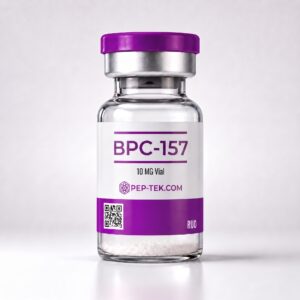
Available from PepTek
A researcher's guide to properly storing and handling BPC-157 research peptide, covering lyophilized stability, reconstitution protocols, and analytical verification methods for laboratory use.
Proper handling and storage of research-grade peptides is a foundational requirement for maintaining experimental integrity. BPC-157 (Body Protection Compound-157), a synthetic pentadecapeptide derived from a gastric protein sequence, has attracted significant research interest for its studied roles in tissue modeling, angiogenic signaling, and cytoprotective cellular pathways [Sikiric et al., 2018]. Because peptide compounds are inherently sensitive to environmental variables — including temperature, light, humidity, and pH — understanding how to store BPC-157 research peptide correctly is essential for any laboratory working with this compound. This methodology guide outlines best practices for storage, reconstitution, analytical verification, and day-to-day handling in a research context.
Researchers interested in a broader mechanistic overview of this compound may first wish to review the BPC-157 Peptide: Research Profile and Mechanism of Action article, which provides foundational context on the compound’s studied biological activity.
BPC-157 has the molecular formula C62H98N16O22 and a molecular weight of approximately 1,419.5 g/mol. As a peptide chain of 15 amino acids (Gly-Glu-Pro-Pro-Pro-Gly-Lys-Pro-Ala-Asp-Asp-Ala-Gly-Leu-Val), it contains multiple peptide bonds that are susceptible to hydrolytic degradation under aqueous conditions. Additionally, its free amino groups and carboxyl termini render it sensitive to oxidative stress and pH extremes.
In lyophilized (freeze-dried) form, BPC-157 exhibits markedly superior stability compared to its reconstituted state. The removal of water during lyophilization dramatically slows hydrolysis and oxidative degradation reactions, making the lyophilized powder the preferred form for long-term storage in research settings [Muttenthaler et al., 2021].
For long-term archival storage, lyophilized BPC-157 research peptide should be maintained at −20°C or below in a dedicated research freezer. Under these conditions, and when protected from moisture and light, the compound is generally considered stable for 24 months or longer, contingent upon the quality of the initial lyophilization process and packaging integrity. Vials should be stored in an airtight container — ideally with a desiccant packet — to prevent moisture infiltration through septum micropores.
If lyophilized BPC-157 vials are expected to be used within a 2–4 week period, refrigeration at 2°C–8°C is acceptable, provided vials remain sealed and are protected from moisture. Researchers should allow cold vials to equilibrate to room temperature before opening to prevent condensation from forming inside the vial, which could introduce moisture and initiate degradation.
BPC-157 is soluble in sterile water and dilute acetic acid solutions. For most in vitro research applications, researchers have reconstituted the peptide using sterile bacteriostatic water or 0.9% sterile saline. Some protocols utilize dilute acetic acid (0.1%–1%) to aid initial dissolution, particularly at higher concentration ranges [Sikiric et al., 2016]. The choice of solvent should be determined by the specific downstream assay requirements and the buffer compatibility of the experimental system.
Once reconstituted, BPC-157 solutions are significantly less stable than the lyophilized powder. Aqueous peptide solutions are subject to hydrolysis, oxidation, and microbial contamination. Reconstituted solutions should be stored at 2°C–8°C and used within 7–14 days. For applications requiring longer working stock lifespans, researchers may prepare aliquots and store them at −20°C, limiting each aliquot to a single freeze-thaw cycle. This approach mirrors best practices used for structurally similar cytoprotective peptides; comparable aliquoting strategies are described in research handling guides for compounds such as TB-500 (Thymosin Beta-4): Research Profile and Cellular Mechanisms.
Rigorous research programs require analytical confirmation of peptide identity and purity prior to use in experiments. Several established analytical methods are applicable to BPC-157 characterization.
Reverse-phase HPLC (RP-HPLC) is the gold standard for assessing peptide purity in research-grade compounds. Using a C18 stationary phase with an acetonitrile/water gradient containing 0.1% trifluoroacetic acid (TFA), researchers can resolve BPC-157 from related impurities and degradation products. Research-grade BPC-157 is typically characterized at ≥98% purity by HPLC analysis. Retention time confirmation against a reference standard provides additional identity verification [Muttenthaler et al., 2021].
Electrospray ionization mass spectrometry (ESI-MS) or matrix-assisted laser desorption/ionization (MALDI-MS) can confirm the molecular weight of BPC-157 (theoretical [M+H]⁺ ≈ 1420.5 Da). Tandem mass spectrometry (MS/MS) fragmentation analysis further validates the amino acid sequence. Researchers should request a Certificate of Analysis (CoA) that includes mass spectrometry data when sourcing BPC-157 for experimental work.
Maintaining analytical rigor in peptide research is a shared methodological principle across compound classes. For example, researchers working with redox-active compounds such as those discussed in the Glutathione: Tripeptide Antioxidant Research and Redox Signaling profile face analogous challenges in preventing oxidative degradation during storage and handling.
Standard laboratory personal protective equipment (PPE) — including nitrile gloves, safety glasses, and a lab coat — should be worn when handling BPC-157 research peptide in powder or solution form. All reconstitution and aliquoting procedures should be performed in a laminar flow hood or biosafety cabinet to prevent contamination of the compound and to maintain a clean working environment.
BPC-157 solutions are compatible with standard borosilicate glass vials and polypropylene microcentrifuge tubes. Researchers should avoid prolonged contact with certain plasticizers (e.g., polyvinyl chloride tubing) that may adsorb peptides or leach compounds into the solution. Low-binding polypropylene tubes are recommended for working aliquots, particularly at low concentrations where surface adsorption losses can be significant [Sikiric et al., 2018].
Research-grade peptide inventories should be maintained with detailed logs recording lot numbers, receipt dates, storage conditions, reconstitution dates, and experimental assignments. This documentation supports reproducibility and facilitates troubleshooting of anomalous experimental results. Proper chain-of-custody documentation is a standard expectation across peptide research programs, including those involving compounds like the GHK-Cu: Copper Peptide Research Profile and Signaling Pathways, where precise concentration control is similarly critical.
In some research workflows, investigators may wish to re-lyophilize dilute BPC-157 solutions using a laboratory lyophilizer (freeze-dryer) to concentrate working stocks. This approach is technically feasible but introduces additional risk of peptide degradation during the freeze-drying process if ramp rates are not optimized. Researchers undertaking this procedure should validate peptide integrity by RP-HPLC following re-lyophilization before using the resulting material in experiments [Vlieghe et al., 2010].
Understanding how to store BPC-157 research peptide correctly is a prerequisite for generating reproducible and reliable experimental data. The stability characteristics of BPC-157 — including its superior shelf life in lyophilized form, its susceptibility to hydrolysis in aqueous solution, and its sensitivity to oxidative and photolytic degradation — are consistent with those of other synthetic research peptides and should be managed accordingly using established laboratory best practices.
Researchers seeking to contextualize BPC-157 storage methodology within broader peptide research programs may find it useful to review handling frameworks for related synthetic peptides, such as those outlined in the Selank: Synthetic Anxiolytic Peptide Research Overview, which addresses stability considerations for another synthetic research peptide.
Research Use Disclaimer: All information presented in this article is intended strictly for use by qualified researchers in licensed laboratory settings. BPC-157 is a research compound supplied exclusively for in vitro and preclinical research purposes. It is not approved by the FDA or any regulatory authority for human or animal consumption, therapeutic use, or any clinical application. Nothing in this article constitutes medical advice, dosing guidance, or a recommendation for use outside of a controlled research environment. Researchers are responsible for compliance with all applicable institutional, local, and federal regulations governing the use of research compounds.