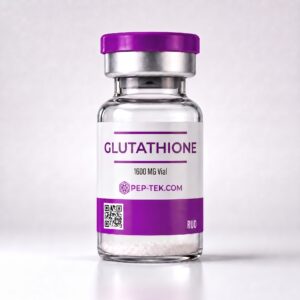
Available from PepTek
Research into glutathione oxidative stress research reveals the tripeptide's central role in cellular redox homeostasis, ROS neutralization, and stress signaling across multiple experimental models.
Glutathione (GSH), the most abundant intracellular thiol antioxidant, has been the subject of extensive investigation in the context of glutathione oxidative stress research. As a tripeptide composed of glutamate, cysteine, and glycine, GSH participates in a wide range of redox reactions that help maintain cellular homeostasis. Decades of published research have established its role not merely as a passive scavenger of reactive oxygen species (ROS), but as an active participant in redox signaling, detoxification, and stress response pathways. This summary examines key published studies that have advanced understanding of glutathione’s function in oxidative stress contexts across multiple experimental systems.
For a comprehensive structural and biochemical overview of the molecule itself, researchers may consult PepTek’s foundational reference on glutathione as a tripeptide antioxidant and its redox signaling mechanisms, which outlines the biosynthetic pathway and enzymatic recycling processes central to its function.
A landmark body of work by Fernández-Checa and colleagues examined the role of mitochondrial glutathione (mGSH) in hepatocellular oxidative stress. Published in Hepatology, these studies demonstrated that selective depletion of the mitochondrial GSH pool — while leaving cytosolic GSH relatively intact — significantly amplified mitochondrial ROS generation and increased susceptibility to oxidant-induced cell death in isolated hepatocyte models [Fernández-Checa et al., 1997]. The research highlighted that mGSH represents a distinct, functionally critical pool that cannot be simply extrapolated from total cellular GSH measurements. These findings have since shaped how investigators design experiments around compartmentalized redox biology.
This compartmentalization concept is particularly relevant to broader discussions of cellular energy metabolism. Researchers studying related metabolic cofactors such as those reviewed in PepTek’s article on NAD+ as a coenzyme in cellular metabolism studies will recognize the overlapping relationship between mitochondrial redox state and NAD+/NADH ratios, both of which interact with glutathione recycling enzymes such as glutathione reductase.
A widely cited study by Jones et al. (2000), published in Free Radical Biology and Medicine, established methodological frameworks for using the ratio of reduced glutathione (GSH) to oxidized glutathione (GSSG) as a quantitative index of cellular redox state [Jones et al., 2000]. The researchers employed stable isotope-labeled tracers and HPLC-based assays in human plasma and tissue samples to demonstrate that the GSH/GSSG ratio responds dynamically to experimental oxidant challenge. Importantly, the study concluded that total glutathione measurements alone are insufficient to characterize the redox environment — the oxidation state of the glutathione pool provides critical mechanistic information in glutathione oxidative stress research.
This ratio-based analytical approach has since been adopted broadly in in vitro and animal model studies, allowing researchers to correlate specific oxidative challenges with quantifiable shifts in redox equilibrium without relying on indirect markers.
The transcription factor Nrf2 (nuclear factor erythroid 2–related factor 2) has been identified as a master regulator of antioxidant gene expression, including the rate-limiting enzyme in glutathione synthesis, glutamate-cysteine ligase (GCL). Research by Itoh et al. (1997), published in Genes & Development, first demonstrated the functional link between Nrf2 and antioxidant response element (ARE)-driven gene transcription in mouse embryonic fibroblasts [Itoh et al., 1997]. Subsequent studies confirmed that Nrf2 activation under conditions of oxidative stress drives upregulation of both GCL catalytic and modifier subunits, substantially increasing cellular GSH synthesis capacity.
This pathway has become a central target of investigation in glutathione oxidative stress research, particularly in studies examining how cells adapt to chronic or acute ROS exposure. Researchers have observed that Nrf2 knockout cell lines show dramatically reduced GSH pools and heightened vulnerability to oxidant challenge, while Nrf2 overexpression models demonstrate enhanced resilience, establishing the transcription factor as a key upstream determinant of GSH-mediated protection.
The central nervous system presents a particularly compelling research context for glutathione, given neurons’ high metabolic activity, limited replicative capacity, and relatively low intrinsic antioxidant defenses compared to astrocytes. A series of studies by Dringen and colleagues, published in Journal of Neurochemistry and Antioxidants & Redox Signaling, mapped the intercellular transfer of GSH precursors between astrocytes and neurons in co-culture models [Dringen et al., 2000]. The research demonstrated that astrocytes export glutathione, which is cleaved extracellularly to provide cysteinylglycine and cysteine for neuronal GSH resynthesis — a metabolic relay that serves as a critical neuroprotective mechanism under oxidative conditions.
These neuronal redox findings intersect with research into neuropeptide systems. Investigators examining compounds such as those covered in PepTek’s overview of Semax as an ACTH-derived neuropeptide may find relevant context in understanding how background redox state can influence neuronal signaling environments in experimental models.
Beyond its direct chemical reactivity, glutathione exerts its antioxidant function largely through enzymatic pathways. The glutathione peroxidase (GPx) family — particularly GPx1 and GPx4 — catalyzes the reduction of hydrogen peroxide and lipid hydroperoxides using GSH as the electron donor, producing GSSG and water or the corresponding alcohol. A comprehensive review by Brigelius-Flohé and Maiorino (2013) in Biochimica et Biophysica Acta catalogued the tissue distribution, substrate specificity, and regulatory features of all eight human GPx isoforms, situating them within the broader framework of glutathione oxidative stress research [Brigelius-Flohé & Maiorino, 2013].
GPx4, in particular, has attracted significant research interest for its unique ability to reduce phospholipid hydroperoxides within cell membranes — a function directly relevant to ferroptosis, a form of regulated cell death driven by lipid peroxidation. In vitro studies have shown that GPx4 inhibition rapidly depletes membrane-associated GSH equivalents and triggers ferroptotic cascades, underscoring glutathione’s structural role in membrane integrity under oxidative conditions.
Glutathione-S-transferases (GSTs) represent another enzymatic interface through which glutathione participates in cellular stress responses. Beyond their classical detoxification role — conjugating GSH to electrophilic compounds for export — certain GST isoforms have been shown to regulate kinase signaling cascades including JNK and MAPK pathways. Animal model studies indicate that GSTA1 overexpression attenuates ROS-driven apoptosis in hepatic cells, while GST pi isoforms modulate JNK activation in a GSH-dependent manner. This positions glutathione oxidative stress research at the intersection of classical antioxidant biology and signal transduction research.
Researchers interested in how peptide-based compounds interact with oxidative signaling environments may also find comparative value in reviewing PepTek’s research profile on GHK-Cu as a copper peptide in signaling pathway research, given that copper-dependent enzymes such as superoxide dismutase operate in parallel redox defense networks alongside glutathione-dependent systems.
The studies summarized here collectively illustrate the multidimensional role glutathione plays in cellular responses to oxidative stress — from compartmentalized mitochondrial pools and transcriptional regulation via Nrf2, to enzymatic neutralization of lipid peroxides and modulation of apoptotic signaling. Ongoing glutathione oxidative stress research continues to refine methodological tools for quantifying redox state and to clarify how GSH homeostasis interacts with other metabolic and signaling systems at the cellular level.
Research Use Disclaimer: All information presented in this article is intended strictly for research and educational purposes. Glutathione and related compounds discussed herein are research compounds only. Nothing in this article constitutes medical advice, therapeutic guidance, or dosing instructions. These compounds are not approved for human or animal consumption, and no claims regarding health benefits or clinical efficacy are made or implied. Researchers should consult current institutional and regulatory guidelines when conducting experiments involving these compounds.