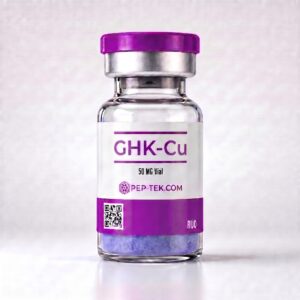
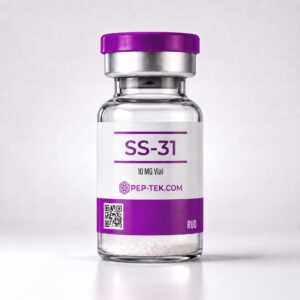
Available from PepTek
GHK-Cu and SS-31 represent two distinct peptide research tools targeting oxidative stress and cellular repair via copper-mediated signaling and mitochondrial membrane protection respectively.
In the expanding field of peptide science, researchers investigating cellular stress responses, redox biology, and tissue repair have increasingly focused on two structurally and mechanistically distinct compounds: GHK-Cu (copper(II)-glycyl-L-histidyl-L-lysine) and SS-31 (elamipretide, D-Arg-2′6′-Dmt-Lys-Phe-NH₂). The GHK-Cu vs SS-31 copper peptide research landscape reflects a broader scientific interest in how targeted molecular tools can modulate oxidative damage through entirely different biological entry points. This article provides a structured comparison of their chemistry, mechanisms of action, and reported research applications to help investigators understand which compound may be appropriate for specific experimental contexts.
GHK-Cu consists of the tripeptide glycyl-L-histidyl-L-lysine coordinated with a copper(II) ion. This complex was first identified in human plasma by Pickart and Thaler in 1973 and has since been extensively characterized. The histidine residue serves as the primary copper-binding site through its imidazole nitrogen, while the glycine and lysine residues contribute to the overall chelation geometry. The copper ion is held in a square-planar coordination complex that is biologically active yet structurally labile — permitting copper transfer to enzymatic targets within cellular environments [Pickart & Thaler, 1973]. GHK-Cu’s small size (molecular weight ~340 Da as a free peptide) contributes to its observed tissue penetrance in experimental models.
For a broader examination of GHK-Cu’s signaling behavior in research settings, PepTek’s dedicated profile on GHK-Cu: Copper Peptide Research Profile and Signaling Pathways provides an in-depth overview of its documented molecular interactions.
SS-31 (Szeto-Schiller peptide 31) is a synthetic tetrapeptide developed by Hazel Szeto and Peter Schiller. Its sequence — D-Arg-2′6′-Dmt-Lys-Phe-NH₂ — incorporates alternating aromatic and cationic residues, a structural motif that confers high affinity for cardiolipin, the signature phospholipid of the inner mitochondrial membrane. Critically, SS-31 contains no metal ion and does not function through copper chemistry. Its molecular weight is approximately 639 Da. The D-arginine and dimethyltyrosine (Dmt) residues are non-natural amino acid derivatives that enhance metabolic stability compared to all-L-chain peptides [Szeto, 2008]. This structural design is purpose-built for membrane targeting rather than systemic signaling.
Research indicates that GHK-Cu operates through multiple intersecting pathways. The copper component participates in superoxide dismutase (SOD) activity, supporting enzymatic antioxidant defense at the cellular level. Beyond direct antioxidant effects, GHK-Cu has been shown in vitro to modulate gene expression broadly — a 2010 microarray analysis by Pickart et al. identified upregulation of genes associated with tissue remodeling, anti-inflammatory signaling, and antioxidant response elements [Pickart et al., 2012]. GHK-Cu also appears to activate the Nrf2/ARE pathway, a master regulator of cellular antioxidant gene transcription, which connects its activity to broader redox signaling networks. Researchers studying GHK-Cu vs SS-31 copper peptide research often note that GHK-Cu’s influence is wide-spectrum and transcriptional in nature, rather than organelle-specific.
This systemic antioxidant signaling places GHK-Cu research in conceptual proximity to compounds like glutathione — for a detailed examination of redox signaling in peptide research, see PepTek’s article on Glutathione: Tripeptide Antioxidant Research and Redox Signaling.
SS-31’s mechanism is more anatomically precise. In vitro and animal model studies indicate that SS-31 accumulates selectively at the inner mitochondrial membrane, driven electrostatically by the membrane potential and structurally by its high affinity for cardiolipin [Birk et al., 2013]. Cardiolipin is essential for the structural integrity of the electron transport chain (ETC) supercomplexes and for cytochrome c retention. When cardiolipin is peroxidized — a hallmark of mitochondrial oxidative stress — ETC efficiency collapses and cytochrome c may be released, initiating apoptotic cascades.
Researchers have observed that SS-31 binding to cardiolipin appears to inhibit cardiolipin peroxidation, stabilize cytochrome c interactions, and preserve ETC supercomplex architecture [Szeto, 2014]. This results in reduced mitochondrial reactive oxygen species (ROS) generation and improved ATP synthesis efficiency in isolated mitochondria and cell culture models. Animal model studies have further indicated preserved mitochondrial morphology under conditions of induced stress.
The mitochondrial energy axis targeted by SS-31 intersects conceptually with NAD⁺ biology — researchers exploring cellular bioenergetics may find PepTek’s article on NAD+: Coenzyme Research Profile and Cellular Metabolism Studies a useful complementary reference.
GHK-Cu has accumulated a substantial body of in vitro and animal model data related to connective tissue, wound models, and extracellular matrix (ECM) dynamics. In vitro studies suggest GHK-Cu stimulates collagen and glycosaminoglycan synthesis, promotes fibroblast proliferation and migration, and modulates matrix metalloproteinase (MMP) activity in ways consistent with tissue remodeling processes [Maquart et al., 1993]. These properties make it a compound of primary interest in dermatology and wound biology research contexts, where copper-dependent enzyme activity (e.g., lysyl oxidase) is mechanistically relevant. SS-31 has not demonstrated comparable activity in ECM-focused research models, reflecting its mechanistic specificity for mitochondria.
When the research question centers on mitochondrial dysfunction, ROS overproduction from the ETC, or conditions associated with cardiolipin remodeling, SS-31 emerges as the more targeted experimental tool. Animal model studies have examined SS-31 in models of ischemia-reperfusion injury, age-associated mitochondrial decline, and metabolic stress — consistently reporting attenuation of mitochondrial ROS and preservation of ATP output [Sabbah et al., 2016]. GHK-Cu contributes antioxidant support in these contexts but does not directly address the mitochondrial membrane architecture that SS-31 engages.
In GHK-Cu vs SS-31 copper peptide research comparisons, this distinction is experimentally meaningful: GHK-Cu functions upstream at the gene regulation and copper enzyme level, while SS-31 functions at the point of mitochondrial membrane lipid chemistry.
GHK-Cu is water-soluble and relatively stable in aqueous solution at physiological pH, though copper redox cycling requires careful experimental controls to avoid artifactual oxidation. The compound is commercially available as a lyophilized powder and is typically reconstituted in sterile water or PBS for in vitro use. SS-31 is also water-soluble, benefiting from its cationic character, and exhibits good stability owing to its D-amino acid and synthetic residue content which resist proteolytic degradation. Researchers conducting GHK-Cu vs SS-31 copper peptide research in cell culture should note that SS-31’s mitochondrial accumulation is concentration- and membrane potential-dependent, requiring careful dosing calibration at the experimental level.
The decision framework between these compounds in experimental design follows directly from the research question:
Both compounds may also be studied in parallel in experimental designs where investigators seek to distinguish transcriptional antioxidant responses from organelle-level membrane protection — an approach that adds mechanistic resolution to oxidative stress research.
For researchers exploring other tissue-protective peptides studied in preclinical models, PepTek’s research profiles on BPC-157 Peptide: Research Profile and Mechanism of Action and TB-500 (Thymosin Beta-4): Research Profile and Cellular Mechanisms offer complementary perspectives on peptide-mediated cellular signaling in research contexts.
The GHK-Cu vs SS-31 copper peptide research comparison presented in this article is intended solely to support the scientific research community in understanding the structural and mechanistic distinctions between these two compounds. All referenced studies are derived from peer-reviewed in vitro, cell culture, or animal model research. Neither GHK-Cu nor SS-31 is approved for human or veterinary therapeutic use, and nothing in this article should be interpreted as dosing guidance, medical advice, or endorsement of any therapeutic application. PepTek supplies these compounds exclusively for laboratory research purposes by qualified investigators in appropriate research settings.