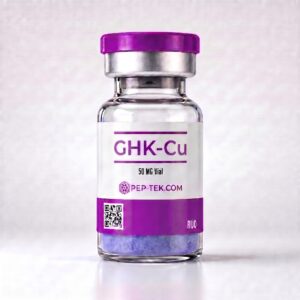
Available from PepTek
GHK-Cu is a naturally occurring copper-binding tripeptide studied extensively for its role in DNA repair gene regulation and genomic stability research.
GHK-Cu (glycyl-L-histidyl-L-lysine copper complex) has emerged as one of the most extensively investigated naturally occurring tripeptides in the field of molecular biology. Originally isolated from human plasma in 1973 by Loren Pickart, this copper-chelating peptide has since attracted sustained scientific interest due to its wide-ranging interactions with gene expression networks — particularly those governing DNA repair, antioxidant defense, and genomic maintenance. Research into GHK-Cu DNA repair gene regulation research has expanded considerably over the past two decades, driven in part by advances in gene expression profiling and transcriptomic analysis.
For researchers seeking a foundational overview of GHK-Cu’s broader signaling context, the GHK-Cu: Copper Peptide Research Profile and Signaling Pathways article provides essential background on its structural properties and receptor interactions.
GHK (Gly-His-Lys) is a tripeptide that forms a stable square-planar coordination complex with cupric ions (Cu²⁺). The histidine imidazole ring, along with the glycine amino terminus and lysine amine, contribute to a high-affinity copper-binding site. This coordination chemistry is critical: copper serves as a cofactor for numerous enzymes involved in oxidative defense and DNA repair, and GHK-Cu is thought to facilitate copper bioavailability within cellular environments.
The peptide’s relatively low molecular weight (~340 Da as the free tripeptide) allows it to interact directly with cellular membranes and intracellular signaling cascades. Researchers have noted that GHK-Cu modulates the activity of superoxide dismutase (SOD), a copper-dependent antioxidant enzyme whose function is closely tied to the preservation of genomic integrity [Pickart & Margolina, 2018].
Among the most compelling lines of evidence in GHK-Cu DNA repair gene regulation research comes from transcriptomic studies published by Pickart and Margolina using the Broad Institute’s Connectivity Map (CMAP) database. Their analysis suggested that GHK-Cu modulates the expression of over 31% of human genes examined — a remarkably broad genomic footprint for a small peptide. Critically, a subset of these genes is directly implicated in DNA damage response (DDR) pathways, nucleotide excision repair (NER), and base excision repair (BER) [Pickart & Margolina, 2018].
Among the upregulated gene categories researchers identified were those encoding proteins involved in chromatin remodeling, double-strand break (DSB) repair, and cell cycle checkpoint activation. These pathways are fundamental to preventing mutational accumulation and maintaining genomic fidelity, particularly under conditions of oxidative stress.
GHK-Cu has been observed in multiple in vitro models to upregulate genes in the Nrf2 (nuclear factor erythroid 2–related factor 2) antioxidant response pathway. Nrf2 governs the transcription of enzymes including heme oxygenase-1 (HO-1), NAD(P)H quinone oxidoreductase 1 (NQO1), and glutathione S-transferases — all of which contribute to reducing oxidative DNA lesions such as 8-oxoguanine [Huang et al., 2015].
The relationship between redox balance and DNA repair is well established in the scientific literature. Researchers studying the tripeptide antioxidant glutathione have documented parallel Nrf2-mediated mechanisms; readers interested in that intersection may find the article on Glutathione: Tripeptide Antioxidant Research and Redox Signaling a useful comparative reference. Similarly, the relationship between GHK-Cu DNA repair gene regulation research and metabolic coenzymes has been explored alongside studies on NAD+: Coenzyme Research Profile and Cellular Metabolism Studies, given NAD+’s central role in PARP-1-mediated DNA strand break repair.
In vitro studies have indicated that GHK-Cu may influence the activity of key BER enzymes, including OGG1 (8-oxoguanine DNA glycosylase), which is responsible for excising the most common oxidative DNA lesion — 8-oxo-7,8-dihydroguanine (8-oxoG). Researchers have proposed that GHK-Cu’s copper-chaperoning activity may support the metalloenzyme functions associated with BER, though direct mechanistic studies at the enzymatic level remain an active area of investigation [Hong et al., 2001].
Gene expression data from multiple model systems suggests that GHK-Cu positively regulates p53 pathway components, including genes involved in G1/S checkpoint activation following DNA damage. The tumor suppressor protein p53 coordinates the cellular response to DNA strand breaks by inducing cell cycle arrest, facilitating repair, or triggering apoptosis when damage is irreparable. Research publications have noted that GHK-Cu appears to upregulate GADD45 family members — stress-response genes that directly participate in nucleotide excision repair and cell cycle arrest [Pickart & Margolina, 2018].
Chronic low-grade inflammation is recognized as a major driver of DNA damage through reactive oxygen species (ROS) and reactive nitrogen species (RNS). In cell-based studies, GHK-Cu has been reported to suppress pro-inflammatory cytokine gene expression, including TNF-α and IL-6, via NF-κB pathway inhibition [Pickart et al., 2012]. Researchers have theorized that this anti-inflammatory gene suppression creates a cellular microenvironment less conducive to oxidative DNA damage — an indirect but mechanistically coherent contribution to genomic integrity research.
While GHK-Cu DNA repair gene regulation research is a primary focus of contemporary molecular studies, investigators have also extensively characterized GHK-Cu’s upregulation of extracellular matrix (ECM) genes. These include collagen types I, III, and IV, fibronectin, and decorin — findings that have made GHK-Cu a prominent subject in wound healing and tissue remodeling research [Pickart et al., 2012]. The collagen-promoting activity is mechanistically distinct from DNA repair modulation but shares a common upstream element: copper-dependent enzyme activation, particularly lysyl oxidase, which is essential for crosslinking collagen and elastin fibers.
The preponderance of published evidence in this area derives from in vitro cell culture systems and, to a lesser extent, rodent model studies. Fibroblast cell lines, keratinocytes, and hepatocyte-derived models have been used most frequently to characterize GHK-Cu’s genomic effects. Animal model studies have explored wound repair endpoints as correlates of tissue remodeling gene expression, though these findings remain in the preclinical domain and require further validation in well-controlled experimental settings.
Researchers have noted methodological variability across published studies, including differences in GHK-Cu concentration ranges used in cell culture (typically nanomolar to low micromolar), the specific assay platforms employed, and the gene expression normalization strategies used. These variables underscore the need for standardized experimental frameworks as GHK-Cu DNA repair gene regulation research matures as a field [Huang et al., 2015].
GHK-Cu represents a compelling research tool for investigating the molecular intersections of copper metabolism, gene expression regulation, and DNA damage response pathways. The available body of evidence — spanning transcriptomic analyses, in vitro biochemical studies, and animal model investigations — supports continued scientific inquiry into its mechanisms of action at the genomic level. Researchers interested in parallel peptide-mediated signaling investigations may also find value in reviewing the TB-500 (Thymosin Beta-4): Research Profile and Cellular Mechanisms and BPC-157 Peptide: Research Profile and Mechanism of Action profiles for comparative context on peptide-level gene modulation in preclinical models.
Research Use Disclaimer: All information presented in this article is intended strictly for scientific research and educational purposes. GHK-Cu, as supplied by PepTek, is a research compound only and is not intended for human or animal consumption, therapeutic application, or clinical use of any kind. Nothing in this article constitutes medical advice, a health claim, or a recommendation for any specific use. Researchers should conduct all investigations in compliance with applicable institutional and regulatory guidelines.