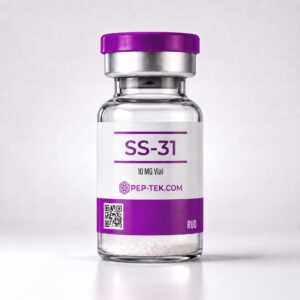
Available from PepTek
SS-31, also known as the Szeto-Schiller peptide, is a mitochondria-targeted aromatic-cationic tetrapeptide studied for its cardiolipin-binding and antioxidant properties in preclinical research models.
Among the most studied mitochondria-targeted compounds in contemporary peptide research, SS-31 — formally designated as D-Arg-2′6′-Dmt-Lys-Phe-NH₂ and commonly referred to as the Szeto-Schiller peptide — has attracted substantial interest for its unique structural interaction with the inner mitochondrial membrane. Named after its co-developers, Hazel H. Szeto and Peter W. Schiller, this aromatic-cationic tetrapeptide is the subject of a growing body of preclinical and early-phase research examining mitochondrial function, oxidative stress regulation, and cellular bioenergetics.
Understanding what is SS-31 Szeto Schiller peptide requires examining its structural design: the alternating aromatic and cationic residues in SS-31 are thought to allow selective accumulation at the inner mitochondrial membrane, independent of mitochondrial membrane potential — a property that distinguishes it from other mitochondria-targeting approaches such as triphenylphosphonium (TPP)-conjugated compounds.
The mechanistic foundation of SS-31 research centers on its interaction with cardiolipin, a unique phospholipid almost exclusively expressed in the inner mitochondrial membrane. Cardiolipin plays essential roles in organizing the electron transport chain (ETC) supercomplexes and maintaining membrane curvature required for efficient ATP synthesis.
In a landmark study by Birk et al. (2013), researchers demonstrated that SS-31 binds directly to cardiolipin and, in doing so, prevents cardiolipin peroxidation — a damaging process implicated in the disruption of cytochrome c’s electron carrier function. The researchers observed that cardiolipin peroxidation converts cytochrome c into a peroxidase, accelerating reactive oxygen species (ROS) production and triggering apoptotic cascades. SS-31’s binding appeared to sequester cardiolipin in a configuration that preserved cytochrome c’s electron transfer function while limiting its peroxidase activity [Birk et al., 2013].
This mechanism places SS-31 research in a conceptually distinct category from broad-spectrum antioxidant compounds. Rather than scavenging free radicals systemically, the peptide appears to act at a highly specific mitochondrial locus. Researchers studying related antioxidant pathways may find it useful to compare these findings with research on glutathione as a tripeptide antioxidant and its role in redox signaling, which operates through distinct cytosolic and mitochondrial mechanisms.
One of the most replicated observations across SS-31 preclinical studies involves its apparent capacity to support ETC supercomplex organization and ATP synthase activity. Sabbah et al. (2016) conducted research in a canine model of heart failure with reduced ejection fraction, in which animals received SS-31 infusion over a defined experimental window. The research team reported improved indices of mitochondrial respiration and cardiac energetics in treated animals relative to controls, with observed changes in ATP production rates and cristae morphology suggesting enhanced mitochondrial structural integrity [Sabbah et al., 2016].
These findings parallel a broader scientific interest in compounds that modulate mitochondrial energy metabolism. Researchers interested in the relationship between mitochondrial NAD⁺ dynamics and electron transport efficiency may also wish to consult the research profile on NAD+ as a coenzyme in cellular metabolism studies, which addresses complementary pathways in bioenergetic regulation.
A substantial proportion of published SS-31 research involves ischemia-reperfusion (I/R) injury models, where rapid restoration of blood flow following ischemic periods is known to generate oxidative bursts that damage mitochondria. Cho et al. (2007) examined SS-31 in a rodent cardiac I/R model and reported that pre-treatment with the peptide was associated with reductions in infarct size and improved post-reperfusion cardiac function in animal subjects. The investigators proposed that SS-31’s cardiolipin-protective effects limited the ROS burst associated with mitochondrial permeability transition pore (mPTP) opening during reperfusion [Cho et al., 2007].
Subsequent rodent model research by Szeto (2014) provided a comprehensive mechanistic review, consolidating findings across renal, cardiac, and neurological I/R models. The review highlighted that SS-31’s membrane potential-independent mitochondrial accumulation allows it to remain protective even when the mitochondrial membrane is depolarized — conditions under which membrane-potential-dependent targeting strategies become ineffective [Szeto, 2014].
Research into what is SS-31 Szeto Schiller peptide has increasingly intersected with the biology of mitochondrial aging. Mitochondria in aged tissues characteristically exhibit disrupted cristae architecture, reduced ETC supercomplex stability, and elevated ROS output. Whitson et al. (2020) investigated the effects of SS-31 treatment in aged mouse models, reporting that the peptide was associated with partial restoration of mitochondrial cristae morphology and improvements in state 3 respiration in skeletal muscle tissue. The authors interpreted these results as consistent with SS-31’s cardiolipin-remodeling activity reversing age-associated ultrastructural deterioration at the inner mitochondrial membrane [Whitson et al., 2020].
This intersection of peptide research and cellular aging biology represents a growing frontier. Researchers investigating signaling peptides with broad cytoprotective properties may also wish to examine the literature on GHK-Cu copper peptide signaling pathways, which has been studied for its distinct roles in gene expression regulation and tissue remodeling.
Beyond cardiac applications, preclinical research has examined SS-31 in renal and neurological models. In acute kidney injury (AKI) models involving nephrotoxic agents or I/R, animal studies have reported attenuated markers of tubular cell injury following SS-31 administration, with proposed mechanisms involving preservation of proximal tubule cell mitochondrial integrity. In neurological model contexts, researchers have investigated SS-31 in models of Alzheimer’s-associated amyloid-beta toxicity and Parkinson’s-associated dopaminergic neurotoxicity, observing in vitro and in vivo reductions in oxidative markers and improvements in mitochondrial membrane potential in treated cell and animal preparations.
These findings illustrate the breadth of the research landscape surrounding the SS-31 Szeto Schiller peptide and its potential utility as a mechanistic probe for studying mitochondrial dysfunction across multiple disease-relevant biological systems.
Understanding what is SS-31 Szeto Schiller peptide also requires distinguishing it from other peptide classes studied in the research context. Unlike neuropeptides such as those reviewed in the Semax ACTH-derived neuropeptide research profile, which primarily act through receptor-mediated CNS signaling cascades, SS-31 exerts its studied effects through direct membrane biochemistry at the subcellular level, without dependence on receptor binding. Similarly, unlike growth hormone secretagogues, SS-31’s research interest is not concentrated in endocrine axes but in the fundamental bioenergetic machinery shared across virtually all aerobic eukaryotic cell types.
Researchers studying cytoprotective peptides with tissue-repair-oriented mechanisms may also find comparative value in reviewing data on BPC-157 peptide research and its cellular mechanism of action, which involves distinct angiogenic and growth factor-mediated pathways.
The studies summarized in this article represent a cross-section of preclinical and mechanistic research into SS-31, the Szeto-Schiller peptide, conducted in cell culture systems and animal models. The findings described reflect observations made in controlled research settings and do not constitute evidence of safety or efficacy in humans. The research on what is SS-31 Szeto Schiller peptide remains in the investigational domain.
Disclaimer: SS-31 is available from PepTek exclusively as a research compound for use in licensed laboratory and preclinical research settings. It is not approved for human or animal consumption, is not intended to diagnose, treat, cure, or prevent any disease or medical condition, and must not be used outside of a certified research environment. No information in this article should be construed as medical advice, dosing guidance, or therapeutic recommendation of any kind.