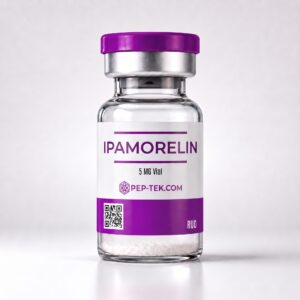
Researchers investigating growth hormone secretagogues have increasingly focused on ipamorelin as a model compound for understanding selective GH axis modulation. For scientists asking what is ipamorelin peptide research and why it matters, this article summarizes key published studies that have shaped the current understanding of this pentapeptide’s mechanisms and observed effects in controlled research settings. All findings described here are derived from in vitro and animal model studies and are intended strictly for scientific reference.
Background: Ipamorelin as a Research Compound
Ipamorelin (Aib-His-D-2-Nal-D-Phe-Lys-NH₂) is a synthetic pentapeptide classified as a growth hormone-releasing peptide (GHRP) and ghrelin receptor agonist. It was developed in the late 1990s by Novo Nordisk and has since become a widely studied compound in neuroendocrine research due to its high selectivity for the GH secretagogue receptor (GHS-R1a) without the pronounced cortisol- or prolactin-stimulating effects observed with earlier GHRPs [Raun et al., 1998].
Unlike earlier peptides in the GHRP class, ipamorelin’s selectivity profile made it an attractive research tool for isolating GH axis effects from confounding hormonal signals. Researchers exploring related compounds in the growth hormone secretagogue space may also find value in reviewing the Ipamorelin: Selective GHRP Research Profile and the CJC-1295 + Ipamorelin Blend: Research Overview of Synergistic Mechanisms for additional mechanistic context.
Key Published Studies on Ipamorelin
Raun et al. (1998) — Foundational Selectivity Study
The foundational characterization of ipamorelin was published by Raun and colleagues in the European Journal of Endocrinology. This study examined ipamorelin’s GH-releasing properties in rats and compared its hormonal effects to those of GHRP-6 and GHRP-2. Researchers observed that ipamorelin produced robust, dose-dependent GH release in rat models without the significant increases in ACTH, cortisol, or prolactin that were measured in GHRP-6-treated animals [Raun et al., 1998].
The authors concluded that ipamorelin represented a new class of selective GH secretagogue with a cleaner endocrine profile than its predecessors — a finding that has informed subsequent research into what is ipamorelin peptide research as a discipline. This selectivity has made ipamorelin a preferred tool in studies where researchers need to modulate GH signaling without introducing cortisol-related variables.
Svensson et al. (2000) — Bone and Body Composition Research
A subsequent study by Svensson and colleagues examined the effects of ipamorelin administration in aged rats over a 12-week period. Researchers analyzed parameters including bone mineral content, body weight composition, and IGF-1 plasma levels. Animal model data indicated that ipamorelin-treated subjects demonstrated measurable increases in bone mineral content compared to controls, along with changes in lean body mass distribution [Svensson et al., 2000].
The researchers noted that these observations were consistent with GH-axis stimulation and suggested that ipamorelin might be a useful research tool in models designed to study age-related changes in skeletal and body composition parameters. These findings remain relevant to ongoing inquiries into what is ipamorelin peptide research when applied to gerontological animal models.
Johansen et al. (1999) — Gastrointestinal Motility Studies
Ipamorelin’s ghrelin receptor activity prompted researchers to investigate its potential effects beyond GH secretion. Johansen and colleagues published findings examining ipamorelin’s effects on gastrointestinal motility in rat models, noting that the compound influenced gastric emptying rates through GHS-R1a-mediated pathways [Johansen et al., 1999].
This line of research is significant because it expanded the scientific understanding of what is ipamorelin peptide research beyond strictly endocrine contexts and into enteric nervous system biology. The study highlighted the distributed expression of GHS-R1a receptors throughout gastrointestinal tissue and how synthetic ghrelin mimetics like ipamorelin interact with those receptor populations in controlled animal model settings.
Mechanistic Considerations
GHS-R1a Receptor Binding and Signal Transduction
Ipamorelin functions primarily through agonism at the GHS-R1a receptor, a G protein-coupled receptor expressed in the pituitary, hypothalamus, and peripheral tissues. Upon binding, researchers have observed activation of phospholipase C signaling cascades, leading to intracellular calcium mobilization and downstream GH secretion from somatotroph cells [Raun et al., 1998].
In vitro studies using pituitary cell cultures have confirmed that ipamorelin stimulates GH release in a concentration-dependent manner and that this effect is blocked by GHS-R antagonists, confirming receptor specificity. This mechanistic clarity is one reason ipamorelin remains a commonly used reference compound in receptor pharmacology research.
Interaction with the GHRH Axis
Research has also examined how ipamorelin interacts with endogenous GHRH signaling. Animal model studies indicate that ipamorelin and GHRH operate through distinct but complementary receptor pathways, and that co-administration in rat models produces additive or synergistic GH pulses compared to either agent alone. This mechanistic synergy has been explored more extensively in research on combination peptide systems — an area also covered in the Tesamorelin: GHRH Analogue Research Profile and Studied Effects, which examines the GHRH side of this dual-pathway system.
Comparative Research Context: Ipamorelin and Related Secretagogues
Understanding what is ipamorelin peptide research requires placing ipamorelin within the broader landscape of GH secretagogue science. Compared to GHRP-2 and GHRP-6, ipamorelin demonstrates markedly reduced effects on cortisol and aldosterone secretion, making it a more selective tool for isolating GH axis biology in animal models [Raun et al., 1998].
Among synthetic growth hormone secretagogues, ipamorelin is often grouped with compounds studied for metabolic and anabolic signaling. Researchers interested in broader metabolic peptide research may also find the mechanistic profiles of incretin-based compounds relevant — for instance, the Semaglutide: GLP-1 Receptor Agonist Research and Mechanism of Action article provides a useful comparative framework for understanding how different receptor-targeting peptides modulate metabolic signaling through distinct pathways.
Additionally, research on cellular repair and signaling compounds like those examined in the GHK-Cu: Copper Peptide Research Profile and Signaling Pathways overview illustrates the diverse mechanistic strategies researchers employ when studying peptide activity at the cellular level — a context that enriches understanding of ipamorelin’s receptor-mediated signaling studies.
Limitations and Gaps in Current Research
While in vitro and rodent model studies have provided substantial data on ipamorelin’s receptor pharmacology and physiological effects, researchers have identified several limitations in the existing literature. Most published studies have used acute or short-term administration paradigms in young or middle-aged rodent models. Long-term studies examining receptor desensitization, tachyphylaxis, and downstream IGF-1 regulation across extended timeframes remain limited.
Additionally, species-specific differences in GHS-R1a expression and GH pulse dynamics mean that rodent data cannot be directly extrapolated to other biological systems. Researchers continue to call for more mechanistic studies using diverse model organisms and longer observation windows to fully characterize ipamorelin’s receptor biology.
Research Context
The studies summarized in this article represent published preclinical and in vitro research conducted in controlled laboratory settings. Ipamorelin, as supplied by PepTek, is intended exclusively for legitimate scientific research purposes by qualified investigators. It is not approved for human or animal consumption, is not a pharmaceutical product, and should not be interpreted as having therapeutic, clinical, or medical applications.
All information presented here — including findings related to what is ipamorelin peptide research — is derived from published peer-reviewed literature and is provided for educational and scientific reference only. Researchers working with this compound are responsible for compliance with all applicable institutional, local, and national regulations governing research chemical use.
PepTek supplies research-grade compounds exclusively for in vitro and preclinical research. No information on this site constitutes medical advice, clinical guidance, or a recommendation for human use.