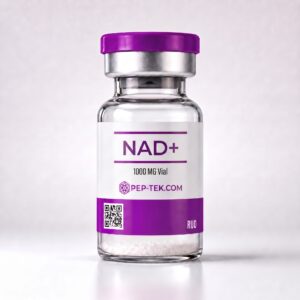
Available from PepTek
NAD+ (nicotinamide adenine dinucleotide) is a coenzyme central to cellular metabolism and energy production. Research explores its roles in redox reactions, DNA repair, and aging biology.
Researchers investigating cellular metabolism and longevity biology have increasingly focused on nicotinamide adenine dinucleotide (NAD+) as a molecule of significant scientific interest. For those exploring what is NAD+ supplement research, the answer begins at the biochemical level: NAD+ is a dinucleotide coenzyme found in all living cells, functioning as a critical electron carrier in redox reactions and as a substrate for enzymes involved in DNA repair, gene expression regulation, and mitochondrial biogenesis. Its dual role as both a metabolic cofactor and a signaling molecule has made it a focal point of aging research, metabolic biology, and neuroscience over the past two decades.
For a broader overview of NAD+’s coenzyme profile and cellular metabolism studies, researchers may consult PepTek’s dedicated reference on NAD+: Coenzyme Research Profile and Cellular Metabolism Studies.
NAD+ exists in two primary redox forms: the oxidized form (NAD+) and the reduced form (NADH). In glycolysis, the citric acid cycle, and oxidative phosphorylation, NAD+ accepts electrons from metabolic substrates, becoming NADH, which subsequently donates those electrons to the mitochondrial electron transport chain to generate ATP. This electron shuttling is fundamental to aerobic respiration and energy homeostasis in eukaryotic cells.
Beyond its redox role, NAD+ serves as the obligate substrate for three major classes of enzymes: sirtuins (SIRT1–SIRT7), poly(ADP-ribose) polymerases (PARPs), and cyclic ADP-ribose synthases (CD38/CD157). Sirtuins are NAD+-dependent deacylases implicated in chromatin remodeling, metabolic regulation, and stress response. PARPs consume NAD+ during DNA strand break repair, a process that, under conditions of genotoxic stress, can rapidly deplete cellular NAD+ pools. CD38 is a major NAD+-consuming enzyme whose activity increases with age, contributing to age-associated NAD+ decline [Camacho-Pereira et al., 2016].
One of the landmark studies that catalyzed modern NAD+ research was published by Gomes and colleagues in Cell in 2013. Using murine models, Gomes et al. demonstrated that declining nuclear NAD+ levels with age impaired SIRT1-mediated regulation of mitochondrial homeostasis. In aged mice, researchers observed a pseudohypoxic state in muscle cells—characterized by stabilization of HIF-1α and disruption of nuclear-mitochondrial communication—that could be partially reversed through NAD+ precursor supplementation in the animal model [Gomes et al., 2013]. This study was pivotal in framing NAD+ decline not merely as a symptom of aging but as a potential mechanistic contributor to age-related mitochondrial dysfunction.
Leonard Guarente’s research program at MIT has produced extensive literature on the relationship between NAD+, sirtuins, and metabolic health. Guarente’s 2013 review in Cell outlined how SIRT1 activity is tightly coupled to NAD+ availability, such that fluctuations in the NAD+/NADH ratio function as a metabolic sensor linking nutrient status to gene regulation. In animal model studies, SIRT1 activation under caloric restriction was associated with improved mitochondrial function and altered lipid metabolism [Guarente, 2013]. These observations have driven significant interest in understanding what is NAD+ supplement research in the context of metabolic biology.
A widely cited study by Mills and colleagues, published in Cell Metabolism in 2016, examined the effects of long-term nicotinamide mononucleotide (NMN) — a direct NAD+ precursor — administration in aged mouse models. Researchers observed that NMN supplementation significantly elevated NAD+ levels in multiple tissues, including skeletal muscle, liver, and adipose tissue. Furthermore, treated aged mice demonstrated improvements in energy metabolism, insulin sensitivity, lipid profiles, physical activity, and eye function compared to controls [Mills et al., 2016]. These findings represent some of the most comprehensive preclinical data available on NAD+ precursor biology, though researchers emphasize that animal model results do not necessarily translate directly to human outcomes.
Research published by Bai and colleagues in Genes & Development demonstrated that PARP-1 hyperactivation under conditions of genotoxic stress rapidly depletes intracellular NAD+ pools, subsequently impairing SIRT1 activity and mitochondrial function in mouse models. This study illustrated the competitive relationship between DNA repair processes and sirtuin-mediated metabolic regulation for the available NAD+ substrate [Bai et al., 2011]. Understanding this competition is relevant to researchers exploring NAD+ dynamics under conditions of oxidative or genotoxic stress — an area that intersects with broader redox biology research such as that examined in the context of Glutathione: Tripeptide Antioxidant Research and Redox Signaling.
While much NAD+ research has been conducted in cell culture and animal models, human studies have begun to emerge. Martens and colleagues published a randomized, double-blind, placebo-controlled trial in Nature Communications in 2018 examining the effects of nicotinamide riboside (NR) — another NAD+ precursor — on NAD+ metabolism in healthy middle-aged and older adults. Researchers confirmed that oral NR supplementation significantly increased whole blood NAD+ levels in human participants without notable adverse effects at the doses studied. The research team also observed reductions in circulating inflammatory markers in a subset of participants, though the authors noted that larger, longer-duration studies are necessary to draw definitive conclusions [Martens et al., 2018]. This represents an important step in translating preclinical NAD+ findings into human research contexts.
Researchers have characterized multiple biosynthetic routes through which cells replenish NAD+ pools. The Preiss-Handler pathway utilizes nicotinic acid (niacin/vitamin B3) via NAPRT enzyme activity. The de novo synthesis pathway proceeds from tryptophan through the kynurenine pathway. The salvage pathway — of greatest relevance to current preclinical supplementation research — recycles nicotinamide and incorporates exogenous precursors such as NMN and NR. NMN enters cells through the Slc12a8 transporter identified in mice, while NR is phosphorylated intracellularly to NMN before conversion to NAD+. Understanding these pathways is central to answering what is NAD+ supplement research and interpreting preclinical data on NAD+ restoration strategies.
Preclinical studies have explored NAD+’s role in neuronal energy metabolism and stress resilience. In vitro studies suggest that maintaining NAD+ levels supports neuronal mitochondrial function under conditions of oxidative stress. Animal model research has indicated potential relevance of NAD+ biology to neurodegenerative processes, given that brain tissue exhibits high metabolic demands and significant PARP and sirtuin activity. This area of NAD+ research shares conceptual overlaps with neuropeptide biology investigated in compounds such as those described in the Semax: ACTH-Derived Neuropeptide Research Profile, where researchers examine cellular mechanisms supporting neuronal resilience.
Researchers working with NAD+ in laboratory settings must account for its rapid intracellular turnover — estimated half-life of approximately 1–2 hours in mammalian cells under normal conditions. Accurate measurement of NAD+ and NADH requires careful sample handling to prevent oxidation, typically using rapid freeze-clamping of tissue samples or acid-precipitation methods prior to enzymatic cycling assays or LC-MS/MS quantification. Compartmental differences between mitochondrial and cytosolic NAD+ pools further complicate whole-cell measurements, and researchers are encouraged to employ subcellular fractionation or genetically encoded biosensors where compartment-specific data is required.
Those conducting research involving metabolic coenzymes may also find relevant methodological parallels in how researchers approach other cellular signaling molecules, such as the copper-binding tripeptide discussed in the GHK-Cu: Copper Peptide Research Profile and Signaling Pathways.
The body of published literature summarized here represents a growing and active field of inquiry into what is NAD+ supplement research at the preclinical and early clinical level. Studies conducted in cell culture systems and animal models have characterized NAD+ as a multifunctional coenzyme with roles in energy metabolism, DNA repair, sirtuin signaling, and mitochondrial homeostasis. Human research remains in early stages, with current published data primarily establishing pharmacokinetics and tolerability of NAD+ precursors in healthy adult populations.
Disclaimer: All information presented in this article is intended strictly for scientific research and educational purposes. NAD+ and all related compounds discussed herein are research chemicals only. Nothing in this article constitutes medical advice, therapeutic guidance, or dosing instruction. These compounds are not approved for human or animal consumption, and PepTek supplies them exclusively for in vitro and preclinical research applications. Researchers should consult applicable institutional and regulatory guidelines before conducting studies involving these materials.