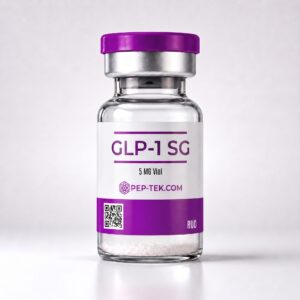
Available from PepTek
Semaglutide is a GLP-1 receptor agonist peptide studied extensively in preclinical and clinical research for its metabolic and glycemic regulatory mechanisms.
Among the most intensively studied synthetic peptide analogues in contemporary metabolic research, semaglutide has emerged as a focal point for investigators exploring glucagon-like peptide-1 (GLP-1) receptor signaling pathways. Understanding what is semaglutide GLP-1 peptide research requires examining both its structural origins and the body of published studies that have characterized its receptor-level activity, downstream signaling cascades, and observed biological effects across multiple organ systems. This article summarizes key published findings and provides context for researchers examining GLP-1 analogues as experimental tools.
Semaglutide is a 31-amino acid peptide analogue of native human GLP-1(7–36) amide, sharing approximately 94% sequence homology with the endogenous hormone. The key structural modifications that distinguish semaglutide from native GLP-1 include a substitution of alanine with alpha-aminoisobutyric acid at position 8 — conferring resistance to dipeptidyl peptidase-4 (DPP-4) cleavage — and the attachment of a C18 fatty diacid chain via a hydrophilic linker at lysine 26 [Lau et al., 2015]. This lipophilic modification enables reversible binding to albumin, dramatically extending the peptide’s plasma half-life to approximately one week in preclinical models, compared to the roughly two-minute half-life of endogenous GLP-1.
These structural features make semaglutide a particularly valuable research tool for sustained GLP-1 receptor activation studies, allowing investigators to observe extended receptor engagement and downstream cellular responses without repeated administration in animal models.
A pivotal area of semaglutide research concerns its interaction with the GLP-1 receptor (GLP-1R), a class B G protein-coupled receptor expressed predominantly in pancreatic beta cells, but also identified in cardiac tissue, the central nervous system, the gastrointestinal tract, and the kidneys. Research by Nauck and colleagues examining GLP-1 receptor agonists as a compound class established that receptor engagement triggers cyclic AMP (cAMP) accumulation, protein kinase A activation, and downstream phosphorylation events that modulate insulin gene transcription and exocytosis of insulin-containing granules in a glucose-dependent manner [Nauck et al., 2016].
In vitro studies utilizing isolated rodent islets and human beta-cell lines have further demonstrated that GLP-1R agonism with semaglutide-class compounds preserves beta-cell viability under glucolipotoxic conditions, an observation of significant interest to researchers investigating pancreatic cellular biology.
The most comprehensive published dataset on what is semaglutide GLP-1 peptide research comes from the SUSTAIN (Semaglutide Unabated Sustainability in Treatment of Type 2 Diabetes) clinical trial program. SUSTAIN 1 through SUSTAIN 6 collectively enrolled thousands of research subjects and systematically characterized semaglutide’s pharmacodynamic profile across varying doses and comparator conditions.
SUSTAIN 6, a cardiovascular outcomes trial published in the New England Journal of Medicine, enrolled 3,297 subjects with type 2 diabetes at high cardiovascular risk and followed participants for a median of 2.1 years [Marso et al., 2016]. Researchers observed a statistically significant reduction in the composite endpoint of major adverse cardiovascular events (MACE) in the semaglutide group compared to placebo (6.6% vs. 8.9%; HR 0.74; 95% CI 0.58–0.95; p<0.001 for noninferiority). Importantly for mechanistic researchers, this trial also documented changes in body weight, systolic blood pressure, and HbA1c, providing a multisystem pharmacodynamic profile of sustained GLP-1 receptor engagement.
A growing area of what is semaglutide GLP-1 peptide research involves its actions within the central nervous system. GLP-1 receptors have been identified in the hypothalamus, brainstem, and limbic regions, and researchers have proposed that peripheral GLP-1R agonists may cross the blood-brain barrier or engage circumventricular organs to modulate appetite-regulatory circuits [Drucker, 2018].
Animal model studies utilizing semaglutide have demonstrated significant reductions in food intake and body weight in diet-induced obese rodents. Mechanistically, researchers have attributed these effects to GLP-1R-mediated upregulation of pro-opiomelanocortin (POMC) neurons in the arcuate nucleus and inhibition of neuropeptide Y/agouti-related peptide (NPY/AgRP) neurons. This intersection of GLP-1 and melanocortin signaling pathways is of particular interest to researchers also studying related systems, such as those explored in Melanotan II (MT-2): Melanocortin Receptor Agonist Research Profile.
The Semaglutide Treatment Effect in People with Obesity (STEP) trial program extended semaglutide research into a non-diabetic obese population, providing mechanistic insights distinct from glycemic contexts. STEP 1, published in 2021, enrolled 1,961 adults with obesity and without diabetes, randomizing subjects to subcutaneous semaglutide 2.4 mg weekly or placebo [Wilding et al., 2021]. Researchers observed a mean body weight reduction of 14.9% in the semaglutide group versus 2.4% in the placebo group at 68 weeks — findings attributed primarily to GLP-1R-mediated reductions in energy intake and alterations in appetite-related peptide signaling.
Researchers have noted that the magnitude of observed weight-related effects positions semaglutide as a notable comparator compound in studies of GLP-1R biology, particularly relative to dual-agonist research compounds such as those described in the Tirzepatide: GLP-1/GIP Dual Agonist Research Profile and multi-agonist platforms examined in Retatrutide: Triple GIP/GLP-1/Glucagon Agonist Research Overview.
Beyond glycemic and weight-related research endpoints, semaglutide has been studied for its effects on cardiovascular and renal tissue in preclinical models. In vitro studies suggest that GLP-1R agonism may exert direct cardioprotective effects through cAMP-dependent pathways that reduce oxidative stress and attenuate inflammatory cytokine expression in cardiomyocytes [Drucker, 2018]. The relationship between GLP-1 receptor signaling and cellular redox balance is an active area of investigation — researchers interested in antioxidant mechanisms in metabolic contexts may also find relevant background in Glutathione: Tripeptide Antioxidant Research and Redox Signaling.
Renal research has indicated that semaglutide-treated animal models demonstrate reductions in urinary albumin-to-creatinine ratio and attenuation of glomerular hyperfiltration, effects researchers have associated with both direct GLP-1R activity in renal tubular cells and indirect hemodynamic improvements.
Emerging preclinical research has begun to characterize how sustained GLP-1R activation interfaces with mitochondrial bioenergetics. Studies in hepatocyte models suggest that GLP-1R signaling may modulate NAD⁺-dependent metabolic pathways, a finding that connects GLP-1 biology to broader cellular energy regulation research — an area examined separately in the NAD+: Coenzyme Research Profile and Cellular Metabolism Studies. These intersections represent a frontier for future mechanistic investigation in the context of what is semaglutide GLP-1 peptide research.
A distinct line of semaglutide research has examined oral bioavailability. The PIONEER trial program evaluated an oral semaglutide formulation co-administered with the absorption enhancer sodium N-(8-[2-hydroxybenzoyl]amino)caprylate (SNAC). PIONEER 1 demonstrated that oral semaglutide at 14 mg daily produced statistically significant HbA1c reductions versus placebo, validating oral GLP-1R agonist delivery as a viable research paradigm [Aroda et al., 2019]. Researchers have noted that this formulation achieves peak plasma concentrations within one hour, offering a distinct pharmacokinetic profile for comparative receptor studies.
The body of published literature summarized here represents findings generated in controlled clinical trial settings and preclinical laboratory models. Understanding what is semaglutide GLP-1 peptide research is fundamentally an academic exercise in receptor pharmacology, metabolic signaling, and translational biology. For additional context on structurally and mechanistically related compounds, researchers may consult the detailed profile at Semaglutide: GLP-1 Receptor Agonist Research and Mechanism of Action.
Research Use Disclaimer: All information presented in this article is intended strictly for educational and scientific research purposes. Semaglutide, as referenced here, is a research compound supplied by PepTek for in vitro and preclinical investigative use only. This content does not constitute medical advice, and semaglutide research compounds are not intended for human or animal consumption. No therapeutic, clinical, or health benefit claims are made or implied. Researchers should comply with all applicable institutional and regulatory guidelines governing the use of research peptides.