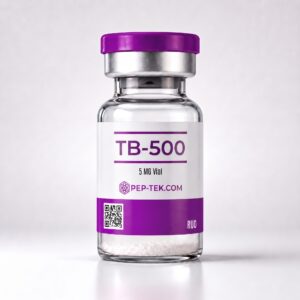
Available from PepTek
TB-500, the synthetic analogue of Thymosin Beta-4, is a research peptide studied for its roles in actin regulation, tissue repair signaling, and cellular migration in preclinical models.
Researchers investigating what is TB-500 thymosin beta 4 research often begin with the peptide’s origin: Thymosin Beta-4 (Tβ4) is a naturally occurring 43-amino acid protein encoded by the TMSB4X gene, present in virtually all nucleated mammalian cells. TB-500 is the synthetic analogue designed to replicate the core active region of Tβ4, specifically a conserved actin-sequestering domain that has attracted substantial interest in molecular and cellular biology. Since the early 1990s, peer-reviewed investigations have explored its roles in cytoskeletal regulation, wound signaling, angiogenesis, and inflammatory modulation — exclusively in in vitro systems and animal models.
This article summarizes key published studies that have shaped the current scientific understanding of TB-500’s mechanisms, situating it within the broader landscape of peptide research compounds like BPC-157, another extensively studied repair-signaling peptide, and structural analogues explored in regenerative biology.
Thymosin Beta-4 was first isolated from thymosin fraction 5 of bovine thymus tissue in 1981 by Low et al. Its primary biochemical function is the sequestration of G-actin (globular actin), preventing premature polymerization and thereby regulating the dynamic remodeling of the actin cytoskeleton. This mechanism underpins cellular migration, division, and morphological adaptation — processes central to tissue homeostasis in animal model research.
TB-500 focuses on a tetrapeptide core sequence — Ac-LKKTETQ — within Tβ4 that researchers have identified as essential for its biological signaling activity. This specificity makes TB-500 a tractable research tool for isolating the peptide’s effects on target pathways without the full complexity of the native protein sequence.
One of the foundational investigations into what is TB-500 thymosin beta 4 research was published by Safer and colleagues, who demonstrated that Tβ4 binds monomeric G-actin with high affinity, maintaining an intracellular pool of unpolymerized actin. This study established the molecular basis for Tβ4’s role in cytoskeletal dynamics and provided the mechanistic rationale for subsequent research into its effects on cell motility [Safer et al., 1991]. Researchers observed that disruption of this sequestration function resulted in aberrant actin polymerization, underscoring Tβ4’s regulatory importance in normal cellular architecture.
Malinda and colleagues conducted in vivo studies using rodent models to examine whether Thymosin Beta-4 administration influenced the rate of dermal repair signaling. Researchers observed significantly accelerated wound contraction and re-epithelialization in Tβ4-treated animals compared to controls, alongside upregulation of matrix metalloproteinases (MMPs) and laminin-5 expression. The authors proposed that Tβ4’s promotion of keratinocyte and endothelial cell migration was central to these observations [Malinda et al., 1999]. This remains one of the most frequently cited preclinical findings in the field and a cornerstone of understanding what is TB-500 thymosin beta 4 research in tissue biology contexts.
In a parallel line of investigation, Grant et al. examined the angiogenic properties of Tβ4 in corneal and matrigel assays. Their findings indicated that Thymosin Beta-4 promoted endothelial cell migration and tube formation — hallmarks of neovascularization — through pathways involving integrin-linked kinase (ILK) signaling and downstream activation of Akt [Grant et al., 1999]. These in vitro and in vivo animal model data suggested that Tβ4’s influence on vascular biology was distinct from, though complementary to, its cytoskeletal functions. This intersects conceptually with research on other signaling peptides; for comparison, researchers studying GHK-Cu and its copper peptide signaling pathways have similarly identified angiogenic modulation as a key investigational endpoint.
A landmark study by Bock-Marquette and colleagues published in Nature investigated Tβ4’s role in cardiac progenitor cell activation following experimental myocardial infarction in mice. The research team reported that Tβ4 treatment was associated with migration and survival of epicardial progenitor cells, alongside increased neovascularization in the infarct zone. Critically, researchers observed that ILK activity was necessary for these effects, as ILK-deficient models did not recapitulate the findings [Bock-Marquette et al., 2004]. These animal model data have made cardiac biology one of the most active areas of inquiry within Thymosin Beta-4 research, while emphatically remaining at the preclinical stage.
Sosne and colleagues examined the anti-inflammatory properties of Tβ4 in ocular surface models, specifically focusing on its interaction with NF-κB pathway components. In vitro studies and rabbit corneal models indicated that Tβ4 downregulated TNF-α-induced inflammatory cytokine expression, including IL-1β and IL-8, without cytotoxic effects at studied concentrations [Sosne et al., 2007]. The researchers proposed that this NF-κB modulation was mechanistically linked to Tβ4’s broader cytoprotective signaling profile. This parallels research directions seen in other peptide classes; for example, scientists exploring the full cellular mechanisms of TB-500 have consistently identified inflammatory pathway modulation as a recurring theme across tissue types.
Synthesizing across these published studies, several mechanistic themes emerge in what is TB-500 thymosin beta 4 research:
Researchers investigating cellular redox environments and repair signaling may find it valuable to cross-reference these findings with studies on glutathione as a tripeptide antioxidant in redox signaling contexts, as oxidative stress modulation and cytoskeletal dynamics frequently intersect in tissue biology models. Similarly, investigations into metabolic co-factors such as those detailed in the NAD+ coenzyme research profile provide relevant context for understanding energy-dependent cellular repair cascades that may operate in parallel with Tβ4-influenced pathways.
Despite the breadth of preclinical data, several important limitations define the current state of what is TB-500 thymosin beta 4 research. The majority of mechanistic data derives from in vitro cell culture systems or rodent and rabbit animal models, which may not fully translate to other biological contexts. The specific pharmacokinetic profiles of the TB-500 synthetic fragment versus full-length Tβ4 require further comparative investigation. Additionally, the dose-response relationships characterized in animal studies are specific to those experimental systems and carry no implication for any other application.
Researchers have also noted variability in outcomes depending on model tissue type, suggesting context-dependent signaling that warrants further mechanistic dissection. These open questions represent productive directions for future preclinical investigation.
The studies summarized in this article represent published preclinical research conducted in in vitro systems and animal models. TB-500 and Thymosin Beta-4 are research compounds available exclusively for laboratory investigation. This content is intended solely for scientific research purposes. TB-500 is not approved for human or animal consumption, is not a pharmaceutical product, and should not be interpreted as having any therapeutic, clinical, or health application. No information presented here constitutes dosing guidance, medical advice, or treatment recommendation of any kind. All research use must comply with applicable institutional, regulatory, and ethical standards governing scientific investigation.