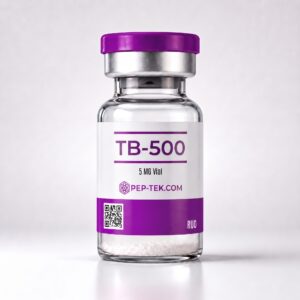
Available from PepTek
TB-500 research centers on thymosin beta-4 G-actin sequestration, a molecular mechanism regulating cytoskeletal dynamics, cellular migration, and tissue remodeling in preclinical models.
Thymosin beta-4 (Tβ4), and its research surrogate TB-500, represents one of the most extensively studied actin-regulatory peptides in modern cell biology. At the core of its investigated mechanism is thymosin beta-4 G-actin sequestration — a process by which the peptide binds monomeric globular actin (G-actin) to modulate cytoskeletal assembly, cellular motility, and downstream signaling cascades. This profile examines the molecular basis of that mechanism, the trajectory of Tβ4 research since its initial characterization, and the body of preclinical evidence that has accumulated across tissue remodeling and cell migration models.
This article is intended strictly for research and educational purposes. TB-500 and thymosin beta-4 compounds available from PepTek are for in vitro and preclinical laboratory research only.
Thymosin beta-4 is a 43-amino acid, water-soluble polypeptide with a molecular weight of approximately 4.9 kDa. It was first isolated from bovine thymic tissue in 1981 by Low and colleagues, and subsequent sequencing revealed it to be a member of the beta-thymosin family — a group of small acidic proteins widely expressed across eukaryotic cell types [Hannappel & Wartenberg, 1993]. TB-500 refers specifically to a synthetic fragment or analogue used in research settings, retaining the core actin-binding domain of the native peptide.
The peptide’s primary sequence contains a highly conserved LKKTET motif, which has been identified as the functional domain responsible for G-actin binding. Crystallographic and NMR studies have confirmed that this region adopts an extended conformation when complexed with actin, occupying the nucleotide-binding cleft of the G-actin monomer and effectively preventing its incorporation into filamentous actin (F-actin) networks [Dominguez, 2004].
Cellular actin exists in a tightly regulated equilibrium between its monomeric G-actin form and polymerized F-actin filaments. This balance is critical for a range of biological processes including cell division, vesicle trafficking, and directed cell migration. Thymosin beta-4 G-actin sequestration research has demonstrated that Tβ4 functions as the principal intracellular G-actin buffer in most mammalian cells, with intracellular concentrations reaching up to 300–500 µM in some cell types — far exceeding those of other actin-binding proteins [Goldschmidt-Clermont et al., 1992].
By sequestering free G-actin, Tβ4 does not simply suppress actin polymerization outright. Rather, it maintains a reservoir of polymerization-competent monomers that can be rapidly mobilized in response to upstream signaling events. Profilin, another G-actin binding protein, competes with Tβ4 for the same actin monomer pool, and the interplay between these two proteins determines the net rate of filament elongation at barbed ends.
Research has shown that thymosin beta-4 G-actin sequestration is not biochemically inert beyond simple cytoskeletal buffering. Preclinical studies have reported that Tβ4 influences the nuclear translocation of myocardin-related transcription factor-A (MRTF-A), a transcriptional coactivator of serum response factor (SRF). Because MRTF-A is held in the cytoplasm by G-actin binding, changes in the free G-actin pool mediated by Tβ4 directly modulate gene expression programs involved in fibroblast activation, smooth muscle differentiation, and extracellular matrix remodeling [Ho et al., 2015].
This connection between cytoskeletal regulation and transcriptional output has made thymosin beta-4 G-actin sequestration research a point of significant interest for investigators studying mechanotransduction and tissue remodeling responses in vitro.
Tβ4 was originally studied as a thymic hormone with immunomodulatory properties, and early research focused on its role in T-cell development and differentiation. However, the discovery of its near-ubiquitous expression outside of thymic tissue, and the identification of its actin-binding domain, redirected substantial research focus toward cytoskeletal biology throughout the late 1980s and 1990s.
A seminal body of work from Malinda and colleagues in the late 1990s examined Tβ4’s role in corneal epithelial cell migration and dermal wound healing in animal models. These studies reported accelerated wound closure in rodent scratch assays and excisional wound models following exogenous Tβ4 administration, attributing the effect primarily to enhanced keratinocyte and endothelial cell motility [Malinda et al., 1999]. The investigators proposed that thymosin beta-4 G-actin sequestration facilitated lamellipodia formation at the leading edge of migrating cells by locally releasing sequestered G-actin for rapid filament polymerization.
Subsequent in vitro work using scratch migration assays in human umbilical vein endothelial cells (HUVECs) and fibroblast cultures extended these findings, demonstrating dose-dependent effects on migration velocity and directional persistence that were abrogated when the LKKTET motif was mutated or competitively blocked.
Research interest expanded considerably following reports that Tβ4 was among the most upregulated transcripts in embryonic cardiac progenitor cells. Animal model studies using myocardial infarction paradigms in rodents reported observations including preserved ejection fraction metrics and reduced fibrotic area in Tβ4-treated cohorts compared to controls, with proposed mechanisms involving epicardial progenitor cell mobilization and angiogenic signaling [Bock-Marquette et al., 2004]. These findings positioned thymosin beta-4 G-actin sequestration research within a broader cardioprotective biology framework, though all such observations remain within preclinical contexts.
For researchers examining peptides involved in cytoprotective and regenerative signaling pathways more broadly, the GHK-Cu copper peptide research profile provides a complementary perspective on growth factor induction and extracellular matrix signaling in preclinical models.
TB-500 is frequently studied alongside BPC-157 in preclinical tissue remodeling paradigms, though the two peptides operate through distinct primary mechanisms. While TB-500’s activity centers on cytoskeletal regulation via actin sequestration, BPC-157 has been investigated primarily through growth factor receptor modulation and nitric oxide pathway involvement. Researchers interested in comparative mechanistic profiling may find the BPC-157 peptide research profile and mechanism of action a useful reference for situating TB-500 within the broader landscape of repair-associated peptide biology.
A more comprehensive overview of TB-500’s general preclinical profile is available in the dedicated TB-500 thymosin beta-4 research profile and cellular mechanisms article.
In vitro evidence consistently supports the model that Tβ4-mediated G-actin sequestration establishes a dynamic actin monomer pool available for Arp2/3-complex-mediated branched filament nucleation at the cell leading edge. Live-cell imaging studies using fluorescently labeled actin in fibroblasts have visualized rapid lamellipodia extension following Tβ4 supplementation, with kinetics correlating with local reductions in G-actin:F-actin ratios measured by DNase I inhibition assay.
Research has also identified potential cross-talk between thymosin beta-4 activity and integrin-mediated adhesion signaling. Studies suggest that Tβ4 may interact with integrin-linked kinase (ILK) pathways to modulate focal adhesion dynamics — a process critical for cell migration efficiency. This interaction, if confirmed in further models, would represent a secondary mechanism complementing direct thymosin beta-4 G-actin sequestration effects on cytoskeletal architecture.
Researchers investigating cytoskeletal and redox-related cellular signaling may find additional mechanistic context in the glutathione tripeptide antioxidant research and redox signaling profile, as oxidative regulation of actin cysteine residues has been proposed to modulate G-actin availability in stressed cellular environments. Similarly, metabolic support of cytoskeletal remodeling processes has been explored in the context of the NAD+ coenzyme research profile and cellular metabolism studies, where energy-dependent cytoskeletal dynamics represent an area of ongoing scientific inquiry.
The accumulation of preclinical evidence surrounding thymosin beta-4 G-actin sequestration research has positioned TB-500 as a valuable tool compound for studying cytoskeletal dynamics, directed cell migration, and transcriptional regulation downstream of actin state changes in controlled laboratory environments. Key observations from cell culture and rodent model studies provide a mechanistic foundation for ongoing investigation, though significant work remains to fully characterize concentration-response relationships, receptor-level interactions, and the full scope of signaling networks engaged by Tβ4 activity.
Research Use Disclaimer: All information presented in this article is intended exclusively for scientific research and educational purposes. TB-500, thymosin beta-4, and all related compounds available through PepTek are supplied strictly for in vitro laboratory and preclinical research use. These compounds are not approved for human or animal administration, are not intended to diagnose, treat, cure, or prevent any disease or medical condition, and should not be used outside of a properly controlled research setting. No content herein constitutes medical advice, dosing guidance, or therapeutic recommendation of any kind.