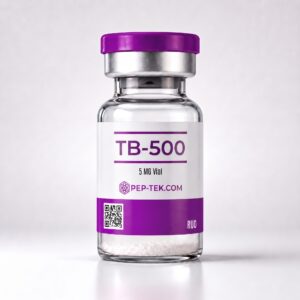
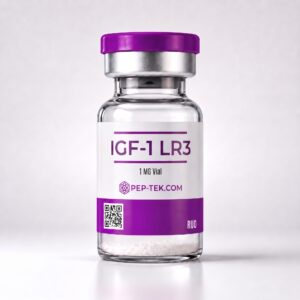
Available from PepTek
TB-500 and IGF-1 LR3 represent two distinct research peptides with divergent mechanisms. This comparison explores their structural profiles, signaling pathways, and research applications in TB-500 vs IGF-1 LR3 repair research.
In the expanding landscape of peptide research, few comparisons generate as much academic interest as TB-500 vs IGF-1 LR3 repair research. These two compounds operate through fundamentally different molecular mechanisms — one modulating cytoskeletal dynamics through actin sequestration, the other engaging the insulin-like growth factor receptor axis to influence cellular proliferation and protein synthesis. Understanding their structural distinctions and downstream signaling helps researchers select the most appropriate model compound for a given experimental objective.
TB-500 is a synthetic analogue derived from Thymosin Beta-4 (Tβ4), a highly conserved 43-amino acid protein endogenously expressed across mammalian tissues. TB-500 specifically represents a short active sequence — primarily the actin-binding domain — that retains the core biological activity attributed to its parent molecule. The peptide’s primary structural feature is its LKKTETQ motif, which mediates G-actin sequestration and prevents polymerization into filamentous (F-actin) structures [Goldstein et al., 2012].
Researchers interested in the full mechanistic background of this compound can consult the detailed TB-500 (Thymosin Beta-4): Research Profile and Cellular Mechanisms article for a thorough overview of its molecular characterization.
IGF-1 LR3 (Long R3 Insulin-like Growth Factor-1) is a 83-amino acid recombinant analogue of native IGF-1. The “Long R3” designation refers to two key structural modifications: an N-terminal 13-amino acid extension and a glutamic acid-to-arginine substitution at position 3. These alterations significantly reduce the peptide’s affinity for IGF-binding proteins (IGFBPs), resulting in a substantially extended half-life compared to native IGF-1 — estimated at approximately 20–30 hours versus the 12–15 minutes observed for the native form [Baxter et al., 1992]. IGF-1 LR3 binds the IGF-1 receptor (IGF-1R), a receptor tyrosine kinase, triggering downstream phosphorylation cascades including the PI3K/Akt and MAPK/ERK pathways.
The primary mechanism through which TB-500 exerts its studied effects involves binding monomeric G-actin in a 1:1 ratio, thereby regulating the dynamic equilibrium between globular and filamentous actin. This cytoskeletal modulation has been associated in preclinical models with enhanced cell migration, upregulation of matrix metalloproteinases, and angiogenic signaling through vascular endothelial growth factor (VEGF) pathways [Sosne et al., 2010]. Animal model studies indicate that TB-500 administration is associated with accelerated tissue remodeling responses, particularly in cardiac and connective tissue contexts.
Beyond actin regulation, in vitro studies suggest TB-500 may modulate inflammatory mediators and influence stem cell differentiation pathways, broadening its utility as a research tool for studying regenerative biology. This mechanistic profile is notably distinct from other cytoprotective peptides such as those studied in BPC-157 Peptide: Research Profile and Mechanism of Action, which engages nitric oxide and growth hormone receptor signaling rather than actin dynamics.
IGF-1 LR3 operates primarily through IGF-1R engagement, initiating receptor autophosphorylation and subsequent activation of insulin receptor substrate (IRS) proteins. The PI3K/Akt/mTOR pathway activated downstream is a central regulator of protein synthesis, cellular hypertrophy, and anti-apoptotic signaling [Clemmons, 2007]. The MAPK/ERK branch additionally contributes to cell proliferation and differentiation signals, making IGF-1 LR3 a widely used tool compound in studies examining skeletal muscle satellite cell biology, metabolic signaling, and tissue anabolism in vitro.
Researchers studying growth hormone axis peptides may also find contextual value in reviewing the CJC-1295 + Ipamorelin Blend: Research Overview of Synergistic Mechanisms article, which covers upstream GHRH and ghrelin receptor signaling that indirectly influences endogenous IGF-1 production pathways.
In TB-500 vs IGF-1 LR3 repair research, a critical distinction lies in the cell types most responsive to each compound. TB-500’s actin-binding mechanism is broadly relevant across cell types that depend on cytoskeletal remodeling — including endothelial cells, keratinocytes, and cardiac myocytes. Animal model studies have explored its role in cardiac repair following ischemic injury, with researchers observing increased cardiomyocyte survival and angiogenesis markers [Smart et al., 2007].
IGF-1 LR3, by contrast, demonstrates strongest activity in cells with high IGF-1R expression, including skeletal muscle myoblasts, chondrocytes, and neural progenitor cells. Its extended half-life compared to native IGF-1 makes it particularly useful in cell culture paradigms where sustained receptor activation is methodologically important, reducing the need for frequent media replenishment in longitudinal experiments.
From an experimental design perspective, the two compounds offer complementary but non-overlapping utilities. TB-500 studies tend to focus on acute cytoskeletal responses, wound closure assays, and angiogenic tube formation assays. IGF-1 LR3, given its extended bioactivity, is more commonly employed in multi-day proliferation or differentiation protocols, protein synthesis assays, and mTOR pathway activation studies. Researchers conducting TB-500 vs IGF-1 LR3 repair research should carefully consider whether the target outcome reflects cytoskeletal reorganization or receptor-driven anabolic signaling, as conflating these endpoints may introduce significant methodological ambiguity.
Researchers exploring the broader metabolic signaling environment may also find it useful to review research on compounds that interface with energy sensing pathways, such as those covered in NAD+: Coenzyme Research Profile and Cellular Metabolism Studies, particularly when designing experiments that intersect IGF-1R signaling with cellular bioenergetics.
Both compounds present distinct handling considerations for laboratory use. TB-500 is generally reconstituted in bacteriostatic water or sterile saline and demonstrates reasonable stability at 4°C for short-term storage, with lyophilized preparations suitable for longer archival at −20°C. IGF-1 LR3, being a larger recombinant protein, typically requires reconstitution in acidified water (0.1% acetic acid) to maintain solubility, with carrier protein supplementation (e.g., BSA) often recommended in cell culture media to prevent surface adsorption and degradation. In TB-500 vs IGF-1 LR3 repair research contexts, ensuring appropriate vehicle controls is essential for experimental rigor, as solubilization buffers themselves may influence certain assay readouts.
Additionally, IGF-1 LR3’s recombinant origin necessitates attention to endotoxin content in research-grade preparations, as lipopolysaccharide contamination can confound inflammatory endpoint measurements in sensitive cell-based assays [Clemmons, 2007].
The comparative analysis of TB-500 vs IGF-1 LR3 repair research highlights how two structurally and mechanistically distinct peptides can address complementary but non-identical questions in preclinical biology. TB-500 offers a targeted entry point for studying actin-dependent cellular processes, while IGF-1 LR3 provides a robust tool for interrogating receptor tyrosine kinase-driven anabolic signaling with extended duration. Researchers designing experiments involving either compound are encouraged to align compound selection rigorously with the molecular target and assay system in question.
For researchers interested in other signaling modalities relevant to tissue biology, the GHK-Cu: Copper Peptide Research Profile and Signaling Pathways article provides additional context on how copper-binding peptides engage wound-healing and remodeling pathways through distinct mechanisms.
Research Use Disclaimer: All information presented in this article is intended strictly for scientific research and educational purposes. TB-500, IGF-1 LR3, and all compounds discussed herein are research chemicals not approved for human or animal consumption, therapeutic use, or clinical application. PepTek supplies these compounds exclusively for in vitro and preclinical research use by qualified investigators. No content in this article constitutes medical advice, dosing guidance, or therapeutic recommendation of any kind.