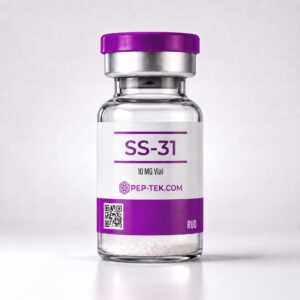
Available from PepTek
SS-31 cardiac ischemia research studies examine how this mitochondria-targeting peptide influences cardiomyocyte survival and oxidative stress during reperfusion injury in preclinical models.
Among the most extensively investigated mitochondria-targeting peptides in cardiovascular research, SS-31 (also known as Elamipretide or MTP-131) has attracted considerable scientific interest for its observed effects in models of cardiac ischemia-reperfusion (I/R) injury. A growing body of preclinical and mechanistic research has focused on how this tetrapeptide interacts with cardiolipin — a phospholipid critical to inner mitochondrial membrane integrity — to influence energy metabolism and cell survival under conditions of ischemic stress. The collection of SS-31 cardiac ischemia research studies reviewed here spans in vitro experiments, isolated heart preparations, and rodent in vivo models, collectively building a detailed mechanistic picture of this compound’s studied properties.
SS-31 is a synthetic aromatic-cationic tetrapeptide with the sequence D-Arg-Dmt-Lys-Phe-NH₂. Its alternating cationic and aromatic residues allow it to selectively concentrate in the inner mitochondrial membrane at a ratio reportedly up to 1,000-fold relative to cytoplasmic concentrations, driven by the large electrochemical gradient across this membrane [Szeto, 2014]. This targeting mechanism positions SS-31 in close proximity to cardiolipin, a dimeric phospholipid essential for organizing the electron transport chain (ETC) supercomplexes that underpin oxidative phosphorylation.
Researchers have observed that under ischemic conditions, cardiolipin undergoes peroxidation and dissociates from cytochrome c, impairing electron flux and triggering apoptotic signaling cascades. SS-31’s proposed mechanism involves stabilizing cardiolipin against oxidative modification, thereby preserving cytochrome c’s role as an electron carrier rather than a peroxidase. This cardiolipin-protective hypothesis is central to understanding why SS-31 cardiac ischemia research studies consistently report reductions in reactive oxygen species (ROS) production and improved mitochondrial function in stressed cardiomyocytes. Researchers interested in related antioxidant peptide mechanisms may find parallel themes in studies on glutathione as a tripeptide antioxidant and its role in redox signaling.
One foundational study by Cho et al. (2007) utilized an isolated rat heart model to investigate whether SS-31 could reduce infarct size following a defined ischemia-reperfusion protocol. Researchers reported that hearts pretreated with SS-31 demonstrated significantly reduced infarct-to-area-at-risk ratios compared to untreated controls, with concurrent improvements in post-ischemic left ventricular developed pressure. Mechanistically, the investigators attributed these observations to inhibition of the mitochondrial permeability transition pore (mPTP), a non-selective channel whose opening at reperfusion is a key driver of cardiomyocyte death [Cho et al., 2007]. Mitochondrial membrane potential, as measured by JC-1 fluorescence, was substantially better preserved in SS-31-treated preparations.
Subsequent work by Szeto and colleagues expanded the mechanistic inquiry into how SS-31 interacts with the ETC under hypoxia-reoxygenation conditions. In vitro studies using isolated cardiomyocytes and H9c2 cell lines demonstrated that SS-31 significantly reduced superoxide production from complexes I and III during simulated ischemia-reperfusion [Szeto, 2014]. Notably, these studies indicated that SS-31’s antioxidant activity was not primarily based on direct free radical scavenging but rather on preventing electron leak at the ETC — a functionally upstream intervention compared to conventional antioxidants. This distinction is relevant when comparing SS-31’s studied mechanisms to compounds that support cellular energy metabolism through complementary pathways, such as those explored in research on NAD+ as a coenzyme in cellular metabolism studies.
Kloner et al. (2012) investigated SS-31 in a canine model of regional myocardial ischemia-reperfusion, providing one of the more clinically translational preclinical datasets. Animals subjected to 60 minutes of coronary artery occlusion followed by reperfusion and treated with SS-31 showed reduced infarct sizes as determined by triphenyltetrazolium chloride (TTC) staining, along with attenuation of mitochondrial ultrastructural damage observed via electron microscopy [Kloner et al., 2012]. The study documented improvements in contractile function assessed by echocardiographic fractional shortening, representing a functional cardiac endpoint in addition to histological measures. This work is frequently cited in SS-31 cardiac ischemia research studies as evidence supporting mitochondrial protection as a viable mechanistic target in I/R research contexts.
Research from Dai et al. (2014) introduced an important dimension by examining SS-31 in aged mouse hearts, which exhibit baseline mitochondrial dysfunction that may exacerbate I/R injury. Researchers observed that aged mice demonstrated amplified I/R injury relative to young controls, but SS-31 treatment normalized mitochondrial respiratory capacity, reduced oxidative DNA damage markers, and attenuated inflammatory cytokine profiles within myocardial tissue [Dai et al., 2014]. These findings are particularly noteworthy because they suggest that the mitochondrial deterioration associated with aging — including altered cardiolipin composition — may represent a state in which SS-31’s studied cardioprotective properties are more pronounced. The parallels between aging-related mitochondrial changes and the studied cytoprotective activity of other structurally targeted peptides, such as those described in research on GHK-Cu copper peptide signaling pathways, provide an interesting comparative framework for researchers.
Beyond direct mitochondrial effects, SS-31 cardiac ischemia research studies have also examined downstream inflammatory and apoptotic signaling. Zhao et al. (2004) documented in their original characterization work that SS-31 application was associated with reduced cytochrome c release into the cytoplasm following oxidative challenge, a key upstream event in the intrinsic apoptosis cascade [Zhao et al., 2004]. Downstream, researchers have observed attenuation of caspase-3 and caspase-9 activation in SS-31-treated cardiomyocyte preparations undergoing simulated ischemia. Additionally, NF-κB-mediated inflammatory gene expression — including TNF-α and IL-6 upregulation — appeared blunted in SS-31-treated myocardial tissue in several rodent studies, suggesting that mitochondrial stabilization may have secondary anti-inflammatory consequences.
These multi-pathway observations reinforce the view that mitochondrial dysfunction at reperfusion is not an isolated cellular event but rather a hub from which ROS production, apoptotic signaling, and inflammatory amplification converge. The structural protection of cardiolipin by SS-31 may therefore exert influence across all three of these interconnected processes simultaneously, which helps explain the breadth of outcomes reported across SS-31 cardiac ischemia research studies.
It is important for researchers reviewing this literature to note several methodological limitations. The majority of high-confidence data derives from rodent and isolated heart models, which may not perfectly recapitulate the complexity of human cardiac physiology. Variability in I/R protocol design — including ischemia duration, reperfusion time, and SS-31 application timing relative to injury — makes cross-study comparisons challenging. Researchers should also consider that cardioprotective interventions studied in otherwise healthy young animals may demonstrate attenuated or modified effects in models incorporating comorbidities such as diabetes or hypertension. Investigators interested in how metabolic state interacts with cardioprotective peptide research may find complementary reading in studies on compounds such as TB-500 (Thymosin Beta-4) and its studied cellular mechanisms.
The accumulated body of SS-31 cardiac ischemia research studies presents a coherent mechanistic framework centered on cardiolipin stabilization, ETC preservation, mPTP inhibition, and secondary attenuation of apoptotic and inflammatory cascades in preclinical models. The structural specificity of SS-31’s mitochondrial targeting distinguishes it as a research tool for dissecting the role of inner mitochondrial membrane integrity in ischemia-reperfusion injury pathophysiology.
Research Use Disclaimer: All information presented in this article is intended strictly for scientific research and educational purposes. SS-31 and all compounds described herein are research chemicals supplied exclusively for use in laboratory and preclinical research settings. This content does not constitute medical advice, and these compounds are not approved for human or animal therapeutic use. No dosing recommendations, treatment protocols, or health benefit claims are made or implied. Researchers should comply with all applicable institutional and regulatory guidelines governing the use of research compounds.