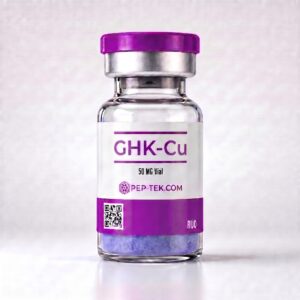
Available from PepTek
GHK-Cu skin collagen research studies reveal significant upregulation of collagen synthesis pathways in fibroblast models. This summary reviews key published findings on the copper peptide's extracellular matrix activity.
The tripeptide-copper complex glycyl-L-histidyl-L-lysine:Cu(II), commonly abbreviated as GHK-Cu, has attracted sustained scientific attention over several decades due to its observed roles in extracellular matrix remodeling, gene expression modulation, and fibroblast activation. Among its most consistently studied properties in laboratory settings is its capacity to influence collagen biosynthesis. A growing body of GHK-Cu skin collagen research studies provides molecular-level insight into how this endogenous peptide interacts with dermal fibroblasts and connective tissue architecture. This article summarizes landmark published research in this area, with particular focus on peer-reviewed in vitro and animal model findings.
GHK-Cu was first isolated from human plasma by Loren Pickart in 1973 and has since been characterized as a naturally occurring tripeptide that binds copper(II) ions with high affinity. Its plasma concentration declines significantly with age, a pattern researchers have hypothesized may correlate with age-associated reductions in connective tissue integrity [Pickart, 1973]. The copper moiety is considered integral to its biological activity, functioning as a cofactor in enzymatic processes relevant to collagen crosslinking and antioxidant defense.
For a broader overview of this compound’s signaling properties and synthesis characteristics, researchers may refer to PepTek’s profile on GHK-Cu copper peptide research profile and signaling pathways.
One of the earliest and most cited findings in GHK-Cu skin collagen research studies is from Maquart and colleagues, who demonstrated in human fibroblast cultures that GHK-Cu significantly stimulated the synthesis of collagen types I and III, as well as fibronectin and glycosaminoglycans. Using radiolabeled proline incorporation assays, the researchers quantified new collagen production in response to GHK-Cu exposure at nanomolar concentrations. These results provided a mechanistic basis for subsequent investigations into the peptide’s influence on dermal matrix biology [Maquart et al., 1993].
Critically, these effects were observed to be concentration-dependent, with submicromolar concentrations demonstrating optimal activity. Higher concentrations in some models produced attenuated responses, underscoring the importance of controlled experimental conditions in any laboratory investigation.
Subsequent research examined GHK-Cu’s influence not only on collagen synthesis but on the regulatory balance between matrix metalloproteinases (MMPs) and their tissue inhibitors (TIMPs). Simeon and colleagues investigated MMP-2 activity in fibroblast cultures treated with GHK-Cu and reported a measurable increase in TIMP-2 expression, suggesting that the peptide may modulate both the production and degradation sides of extracellular matrix turnover [Simeon et al., 1999]. This dual regulatory effect places GHK-Cu within a broader category of extracellular matrix-modulating research compounds, and distinguishes it mechanistically from simple collagen precursors.
These findings are notable in the context of broader peptide-based research, where compounds like BPC-157 and TB-500 (Thymosin Beta-4) have also been studied for their roles in connective tissue remodeling through distinct but occasionally overlapping pathways.
A pivotal contribution to GHK-Cu skin collagen research studies came from a 2010 analysis by Pickart, Vasquez-Soltero, and Margolina, who utilized bioinformatic and gene array data to characterize the broad transcriptomic effects of GHK-Cu. Their analysis suggested that the peptide influenced the expression of over 4,000 human genes, with particular enrichment in pathways related to collagen biosynthesis, TGF-β signaling, and anti-inflammatory regulation. Collagen-associated genes including COL1A1, COL3A1, and genes encoding lysyl oxidase — an enzyme essential for collagen crosslinking — were identified as upregulated in response to GHK-Cu exposure [Pickart et al., 2015].
This work significantly expanded the conceptual framework for understanding GHK-Cu’s mechanism of action, positioning it as a broad gene-regulatory signal rather than a simple enzymatic substrate.
Several animal model studies have investigated the effects of topically or locally administered GHK-Cu on wound healing endpoints with collagen deposition as a measured outcome. Researcers at the University of Washington and affiliated institutions demonstrated in rat wound models that GHK-Cu-treated wounds exhibited accelerated collagen deposition and improved tensile strength compared to vehicle-treated controls. Histological analysis showed denser collagen fiber organization in treated tissue sections [Ehrlich et al., 1988].
These results inform researchers designing experimental models in which extracellular matrix quality — not merely quantity — is a variable of interest. The architectural organization of collagen fibers, as distinct from total collagen content, represents a biologically meaningful endpoint that GHK-Cu studies have begun to address systematically.
A consistent finding across GHK-Cu skin collagen research studies is the peptide’s apparent interaction with transforming growth factor-beta (TGF-β) pathways. TGF-β is a well-characterized driver of fibroblast activation and collagen gene transcription. In vitro data suggest that GHK-Cu may potentiate TGF-β receptor sensitivity or modulate downstream SMAD signaling, though the precise molecular mechanism remains an active area of investigation. Researchers have noted that this pathway interaction may also have implications for the peptide’s observed anti-fibrotic properties in high-concentration models, where it appears to limit excessive collagen deposition — a nuance that distinguishes its activity from straightforward collagen-stimulating agents.
The copper component of GHK-Cu is believed to be biologically active in its own right. Copper(II) ions serve as essential cofactors for lysyl oxidase, the enzyme responsible for catalyzing crosslinks between collagen and elastin fibers. By acting as a copper delivery vehicle, GHK-Cu may enhance the functional stability of newly synthesized collagen. This mechanism places the compound at an intersection of mineral bioavailability research and peptide biology — an area that shares conceptual ground with studies on redox-active molecules such as those reviewed in PepTek’s article on glutathione as a tripeptide antioxidant in redox signaling.
The breadth of these findings across GHK-Cu skin collagen research studies illustrates why this compound continues to be a subject of active laboratory investigation. Researchers exploring extracellular matrix biology, fibroblast physiology, or copper-dependent enzymatic systems will find GHK-Cu to be a mechanistically rich model compound. Its relevance to broader peptide research programs — including those examining growth hormone secretagogues such as Ipamorelin, which similarly interface with tissue-level anabolic signaling — reflects the growing recognition that small peptides can exert surprisingly broad regulatory effects.
The studies summarized in this article represent laboratory-based research conducted in cell culture systems and animal models. All findings are exploratory in nature and exist within a preclinical research framework. The data presented here are intended to support scientific understanding and further in vitro or in vivo research investigation only.
Disclaimer: GHK-Cu, as supplied by PepTek, is intended strictly for laboratory and research use only. It is not approved for human or animal consumption, is not a therapeutic agent, and should not be used in any clinical, diagnostic, or self-administration context. No content in this article constitutes medical advice, dosing guidance, or a claim of therapeutic efficacy. Researchers should comply with all applicable institutional and regulatory guidelines governing the use of research compounds.