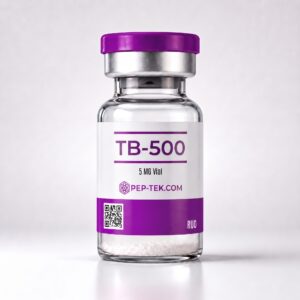
Available from PepTek
Preclinical studies on thymosin beta-4 wound healing research reveal significant roles in cell migration, angiogenesis, and tissue repair across multiple animal models.
Thymosin beta-4 (Tβ4), the synthetic analogue of which is commercially referenced as TB-500, is a 43-amino acid actin-sequestering peptide that has attracted sustained scientific interest for its multifaceted roles in tissue repair and regenerative biology. Since its initial isolation from thymic tissue, researchers have catalogued its involvement in cytoskeletal organization, cell motility, angiogenesis, and inflammatory modulation. The body of thymosin beta-4 wound healing research now spans dermal, corneal, cardiac, and musculoskeletal injury models, making it one of the more thoroughly characterized peptides in preclinical regenerative science. This article summarizes key published findings that have shaped the current mechanistic understanding of Tβ4 in wound biology.
Tβ4 exerts a significant proportion of its biological activity through sequestration of globular actin (G-actin), thereby regulating the pool of actin available for polymerization into filamentous actin (F-actin). This dynamic has downstream consequences for lamellipodia formation, directional cell migration, and the overall motility of keratinocytes and endothelial cells — all critical events in wound closure. Researchers have also identified that Tβ4 upregulates the expression of laminin-5, an extracellular matrix component integral to basal keratinocyte adhesion and migration [Malinda et al., 1999].
Beyond actin dynamics, Tβ4 has been shown to interact with ILK (integrin-linked kinase), promoting cell survival signaling via the PI3K/Akt pathway. This pathway is relevant not only to cell migration but also to the suppression of apoptosis in wounded tissue environments, where oxidative stress and anoikis represent significant barriers to healing. Research into antioxidant and redox-signaling peptides — such as work reviewed in Glutathione: Tripeptide Antioxidant Research and Redox Signaling — illustrates how cellular stress responses intersect with repair mechanisms, a context increasingly relevant to understanding Tβ4’s cytoprotective profile.
One of the earliest and most replicated demonstrations of thymosin beta-4 wound healing research comes from corneal injury models. Sosne and colleagues demonstrated that topical Tβ4 application in murine corneal abrasion models significantly accelerated epithelial cell migration and wound closure compared to vehicle controls [Sosne et al., 2001]. The researchers attributed this effect to enhanced laminin-5 expression and upregulation of matrix metalloproteinase activity, both of which facilitate epithelial sheet movement across the wound bed. Subsequent work by the same group confirmed that Tβ4 also suppressed pro-inflammatory cytokine production — including IL-1β and TNF-α — within the corneal stroma, suggesting a dual role in promoting repair while limiting excessive inflammation [Sosne et al., 2004].
Philp and colleagues conducted landmark experiments using full-thickness excisional wound models in mice, in which systemic and topical administration of Tβ4 was assessed for its effects on wound closure rate, collagen deposition, and angiogenesis [Philp et al., 2004]. Researchers observed that Tβ4-treated animals demonstrated statistically significant acceleration in wound closure, with histological analysis revealing increased collagen type I deposition and a higher density of CD31-positive microvessels within the granulation tissue. These findings positioned Tβ4 as a peptide capable of simultaneously promoting dermal matrix reconstitution and neovascularization — two processes that are frequently rate-limiting in chronic wound scenarios.
The angiogenic dimension of these findings is particularly noteworthy. Tβ4 has been shown to promote the migration and tube formation of human umbilical vein endothelial cells (HUVECs) in vitro, and to stimulate vessel sprouting in the chick chorioallantoic membrane (CAM) assay [Grant et al., 1999]. This pro-angiogenic activity is thought to occur partly through upregulation of vascular endothelial growth factor (VEGF) and modulation of integrin-mediated signaling. Researchers studying other tissue-repair peptides, such as those reviewed in the GHK-Cu: Copper Peptide Research Profile and Signaling Pathways overview, have documented comparable angiogenic stimulation, underscoring how multiple peptide classes converge on neovascularization as a shared mechanism in wound biology.
The scope of thymosin beta-4 wound healing research extends well beyond the integument. In cardiac injury models, Bock-Marquette and colleagues demonstrated that Tβ4 treatment following myocardial infarction in mice led to measurable improvements in cardiac function, including increased fractional shortening and reduced infarct size [Bock-Marquette et al., 2004]. Mechanistic analysis revealed that Tβ4 activated ILK, which in turn phosphorylated and activated Akt, promoting cardiomyocyte survival. Critically, Tβ4 also appeared to stimulate the mobilization and differentiation of epicardial progenitor cells, suggesting a regenerative rather than purely cytoprotective action.
In skeletal muscle models, researchers observed that Tβ4 accelerated satellite cell activation and muscle fiber regeneration following cardiotoxin-induced injury, with treated animals exhibiting reduced fibrotic infiltration and more organized myofibrillar architecture at the repair site. This parallel between cardiac and skeletal muscle regeneration highlights Tβ4’s capacity to engage conserved progenitor cell pathways across different tissue types.
This cross-tissue regenerative profile has drawn comparisons to other peptides investigated in repair biology. For instance, research on BPC-157 Peptide: Research Profile and Mechanism of Action similarly documents multi-tissue repair activity, including tendon and gastrointestinal healing, suggesting that certain peptide classes may engage broadly conserved repair pathways.
A recurring theme across thymosin beta-4 wound healing research is the peptide’s capacity to modulate inflammatory signaling without globally suppressing immune function. In vitro studies have demonstrated that Tβ4 downregulates NF-κB activation in macrophages exposed to lipopolysaccharide (LPS), reducing downstream production of nitric oxide and pro-inflammatory prostaglandins. Animal model studies indicate that this immunomodulatory effect translates to attenuated neutrophil infiltration in early wound phases, potentially shortening the inflammatory phase and enabling more rapid transition to proliferative repair.
Researchers investigating neuropeptide-based compounds with immunomodulatory properties — such as those profiled in Selank: Synthetic Anxiolytic Peptide Research Overview — have similarly noted that peptide-mediated cytokine modulation can have systemic downstream effects on tissue environments, a consideration relevant to interpreting the full scope of Tβ4’s biological activity.
For a broader overview of the compound’s identified cellular mechanisms and structural characterization, researchers may refer to the TB-500 (Thymosin Beta-4): Research Profile and Cellular Mechanisms article available in the PepTek research library.
The studies summarized here represent a cross-section of the peer-reviewed preclinical literature on thymosin beta-4 wound healing research and are presented solely to document findings from published scientific investigations. TB-500, as supplied by PepTek, is a research compound intended exclusively for use in controlled laboratory settings by qualified scientific investigators. It is not approved by the FDA or any regulatory body for human or veterinary therapeutic use. Nothing in this article constitutes medical advice, a dosing recommendation, or a claim of therapeutic efficacy. Researchers working with this compound should adhere to all applicable institutional, ethical, and regulatory guidelines governing the use of research peptides.