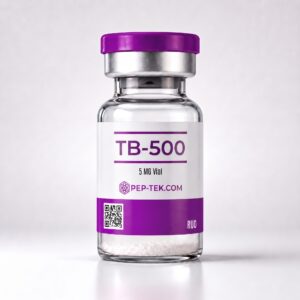
Available from PepTek
TB-500 actin binding research studies reveal how this synthetic thymosin beta-4 analogue sequesters G-actin to regulate cytoskeletal dynamics and cell motility in vitro.
TB-500 is a synthetic peptide analogue derived from the conserved actin-binding domain of thymosin beta-4 (Tβ4), a naturally occurring 43-amino-acid protein first isolated from thymic tissue. Among the most extensively investigated properties of this compound is its capacity to sequester globular actin (G-actin), a mechanism that underpins a broad range of downstream effects on cytoskeletal architecture and cell migration. TB-500 actin binding research studies have illuminated how this peptide interacts with the G-actin monomer pool to modulate the assembly and disassembly kinetics of filamentous actin (F-actin), influencing processes critical to cellular homeostasis, migration, and tissue-level responses in experimental models.
For a broader mechanistic overview of this compound, researchers may consult PepTek’s dedicated profile on TB-500 (Thymosin Beta-4): Research Profile and Cellular Mechanisms, which contextualizes actin regulation within the peptide’s wider biological research landscape.
The dynamic equilibrium between G-actin monomers and polymerized F-actin filaments is a fundamental determinant of cell shape, polarity, and motility. Thymosin beta-4 family members are among the most abundant actin-sequestering proteins in mammalian cells, capable of binding G-actin in a 1:1 stoichiometric ratio. This sequestration maintains a reserve pool of actin monomers available for rapid filament elongation in response to extracellular signals.
The central actin-binding motif of thymosin beta-4—the LKKTET sequence—has been identified as essential for high-affinity G-actin interaction. TB-500 is engineered to preserve this motif, making it a research tool for probing actin-dependent cellular processes without introducing the full-length protein’s additional signaling activities [Safer et al., 1991].
A foundational study by Domanski et al. (2004) employed nuclear magnetic resonance (NMR) spectroscopy and biochemical assays to map the structural contacts between thymosin beta-4 and G-actin. Researchers determined that the N-terminal region of Tβ4 engages with subdomain 1 of actin, while the C-terminal segment contacts subdomain 3, effectively capping the barbed end and preventing spontaneous polymerization. This bipartite binding mode was found to be critical for the peptide’s ability to maintain actin in a non-filamentous state under physiological conditions [Domanski et al., 2004].
These findings established the structural rationale for TB-500 actin binding research studies, confirming that the synthetic peptide’s conserved LKKTET domain engages actin with nanomolar affinity. The study also demonstrated that point mutations within this domain abolished sequestration activity, underscoring the sequence specificity of the interaction.
Malinda et al. (1997) investigated the effect of thymosin beta-4 on endothelial cell migration using in vitro wound-healing (scratch) assays and Matrigel invasion assays. Researchers observed that exogenous application of Tβ4 to human umbilical vein endothelial cells (HUVECs) significantly accelerated wound closure compared to untreated controls, with an approximate 2-fold increase in migration rate at optimal peptide concentrations. Importantly, this migratory enhancement was abrogated when actin polymerization was pharmacologically blocked, suggesting that the effect is downstream of actin monomer availability [Malinda et al., 1997].
The authors proposed that Tβ4-mediated G-actin sequestration creates a dynamic reservoir of actin monomers that can be rapidly mobilized at lamellipodia and filopodia, the actin-rich structures at the leading edge of migrating cells. This interpretation has been cited repeatedly in subsequent TB-500 actin binding research studies as mechanistic evidence linking actin sequestration to directional cell movement.
Bock-Marquette et al. (2004) published a pivotal study in Nature demonstrating that thymosin beta-4 activates integrin-linked kinase (ILK) in cardiac progenitor cells, leading to downstream phosphorylation of AKT and upregulation of cell survival pathways. Critically, the researchers showed that ILK activation was contingent upon the peptide’s actin-sequestering function—constructs lacking the LKKTET motif failed to activate ILK, indicating that cytoskeletal reorganization mediated by G-actin binding is a prerequisite for broader signaling cascades [Bock-Marquette et al., 2004].
This study is significant within TB-500 actin binding research studies because it bridges the peptide’s cytoskeletal role with intracellular kinase signaling, suggesting that actin sequestration is not merely a structural phenomenon but a regulatory switch with upstream consequences for cell survival and proliferation pathways in laboratory models.
Sosne et al. (2010) conducted a comparative biochemical analysis of thymosin beta-4 truncation fragments to identify the minimal actin-binding sequence sufficient to recapitulate cell motility effects in corneal epithelial cultures. Using a series of deletion mutants, researchers established that a central 11-amino-acid fragment encompassing the LKKTET motif retained approximately 70% of full-length Tβ4’s actin-sequestering capacity as measured by DNase I inhibition assays—a standard method for quantifying G-actin availability [Sosne et al., 2010].
The study further confirmed that actin sequestration correlated directly with migration-promoting activity in scratch assays, reinforcing the mechanistic link identified in earlier work. These data support the use of TB-500 as a focused research instrument for studying actin-dependent cell behavior without confounding effects from non-actin-binding domains of full-length thymosin beta-4.
Beyond isolated cell migration studies, researchers have examined actin remodeling in tissue-level contexts. Experiments in animal wound models have documented accelerated re-epithelialization associated with Tβ4 administration, with histological analyses revealing organized actin filament networks at wound margins consistent with coordinated lamellipodia extension [Philp et al., 2004]. These observations align with the in vitro mechanistic data and suggest that actin sequestration-driven motility operates at the tissue scale in experimental systems.
Researchers interested in how other peptides influence cellular repair and matrix remodeling at the cytoskeletal level may find comparative value in reviewing BPC-157 Peptide: Research Profile and Mechanism of Action, which documents distinct but overlapping cytoskeletal signaling phenomena, as well as GHK-Cu: Copper Peptide Research Profile and Signaling Pathways, which explores copper-mediated regulation of extracellular matrix proteins that interact with actin-anchored integrins.
A recurring methodological theme across TB-500 actin binding research studies is the use of DNase I inhibition assays to quantify G-actin sequestration, exploiting the competitive inhibition of DNase I activity by G-actin monomers as a proxy for free monomer concentration. Complementary techniques including fluorescence recovery after photobleaching (FRAP), total internal reflection fluorescence (TIRF) microscopy, and pyrene-actin polymerization assays have been applied to characterize filament dynamics in real time.
Researchers should note that concentration-dependent effects are consistently reported in the literature: at sub-stoichiometric ratios relative to cellular actin concentrations, Tβ4 fragments enhance net polymerization by buffering the free monomer pool against depletion at growing filament ends, while at super-stoichiometric concentrations, net depolymerization is favored. This concentration sensitivity is a critical variable in experimental design for in vitro actin reconstitution studies.
The body of published work summarized here collectively establishes TB-500 as a well-characterized research tool for investigating actin sequestration mechanisms, cytoskeletal dynamics, and cell motility in controlled laboratory settings. TB-500 actin binding research studies continue to advance the scientific community’s understanding of how G-actin monomer availability is regulated at the molecular level and how this regulation propagates into higher-order cellular behaviors.
Researchers exploring broader themes in peptide-mediated cellular signaling may also find relevant methodological parallels in PepTek’s overview of Selank: Synthetic Anxiolytic Peptide Research Overview, which similarly examines how synthetic peptides modulate intracellular signaling cascades in defined experimental contexts.
Research Use Disclaimer: All information presented in this article is intended strictly for scientific research and educational purposes. TB-500 is a research compound supplied exclusively for use in laboratory and preclinical research settings. It is not approved for human or animal consumption, is not intended to diagnose, treat, cure, or prevent any disease or medical condition, and should not be administered to humans or animals under any circumstances. Researchers must comply with all applicable institutional, local, and national regulations governing the use of research compounds. PepTek provides this compound solely to qualified researchers for in vitro and preclinical investigation.