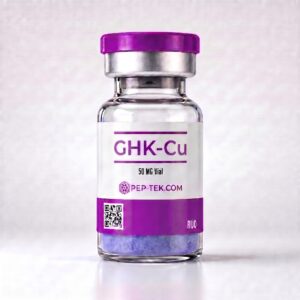
Available from PepTek
A research protocol overview covering GHK-Cu copper peptide experimental setups, reconstitution methods, and concentration ranges observed in published in vitro and animal model studies.
Glycyl-L-histidyl-L-lysine copper (II), commonly designated GHK-Cu, is a naturally occurring tripeptide-copper complex that has attracted sustained interest across multiple research disciplines, including wound biology, gene expression analysis, and oxidative stress modulation. Researchers working with GHK-Cu copper peptide research protocol designs must account for the compound’s unique coordination chemistry, its sensitivity to certain environmental conditions, and the range of concentrations at which biological effects have been observed in published literature. This overview is intended solely for laboratory researchers seeking methodological guidance drawn from peer-reviewed experimental frameworks.
For a broader orientation to GHK-Cu’s signaling mechanisms and documented biological activity profiles, researchers may wish to consult the GHK-Cu: Copper Peptide Research Profile and Signaling Pathways article available in the PepTek research library.
GHK-Cu (molecular weight: ~340 Da for the free tripeptide; ~403 Da as the copper complex) is highly water-soluble under physiological pH conditions. The copper (II) ion is chelated in a square-planar coordination geometry involving the glycine alpha-amino group, the histidine imidazole nitrogen, and the lysine amino group. This coordination is pH-sensitive: researchers have noted that copper dissociation may occur under strongly acidic conditions (pH < 5), which has direct implications for stock solution preparation and storage [Pickart & Margolina, 2018].
Purity verification via HPLC and mass spectrometry prior to experimental use is considered standard practice in published GHK-Cu research protocols. Researchers should confirm copper complexation ratio (typically 1:1 Cu:peptide) and verify the absence of free copper contamination, which can independently confound cell viability assays.
In published experimental designs, GHK-Cu is most commonly reconstituted in sterile, ultrapure water or phosphate-buffered saline (PBS, pH 7.2–7.4). Dimethyl sulfoxide (DMSO) is generally avoided in GHK-Cu protocols, unlike many lipophilic research peptides, because the compound’s hydrophilicity makes aqueous solutions both appropriate and stable. Stock solutions in the range of 1–10 mM are typical for in vitro studies, with working concentrations prepared through serial dilution immediately prior to experimental application.
Aqueous stock solutions of GHK-Cu stored at –20°C in tightly sealed, light-protected vials have been reported to retain stability for several weeks in research settings. Working solutions should be prepared fresh on each experimental day. Researchers should avoid extended exposure to ambient temperature and should not store reconstituted solutions in copper-reactive vessels (e.g., uncoated copper or brass fittings in fluid lines).
The majority of published GHK-Cu copper peptide research protocol designs employing cell culture have utilized human fibroblast lines (e.g., MRC-5, WI-38, or primary dermal fibroblasts), keratinocyte cultures (HaCaT), and various endothelial cell lines. Studies examining gene expression modulation have applied GHK-Cu at concentrations spanning 1 nM to 10 µM, with dose-response curves typically spanning three to four log orders [Pickart et al., 2012].
Standard in vitro protocol elements include:
Endpoint measurements in published studies include quantitative RT-PCR for collagen I/III and elastin gene expression, ELISA-based collagen quantification in conditioned media, and scratch-wound migration assays [Gorouhi & Maibach, 2009].
Research has examined GHK-Cu’s relationship to antioxidant defense systems, including superoxide dismutase (SOD) activity and the regulation of antioxidant response elements (ARE). Researchers studying redox biology may find it useful to compare GHK-Cu’s reported activity with other antioxidant-relevant research compounds; the Glutathione: Tripeptide Antioxidant Research and Redox Signaling article provides useful context for designing parallel pathway analyses.
For oxidative stress endpoints, researchers have employed assays including DCFH-DA fluorescent ROS quantification, SOD activity kits, and Nrf2 nuclear translocation immunofluorescence. Concentrations of 1–100 nM have been most commonly reported in this context [Pickart & Margolina, 2018].
Animal model investigations have predominantly used rodent (rat and mouse) excisional wound models to assess tissue remodeling endpoints. Published GHK-Cu copper peptide research protocol designs in animal models have applied the compound via topical formulation or subcutaneous injection adjacent to wound margins. Topical formulations in published studies have ranged from 0.1% to 1% w/v GHK-Cu in aqueous gel carriers, with application frequencies of once to twice daily over 7–14 day observation periods [Canapp et al., 2003].
Key measured endpoints in animal model studies include:
A notable dimension of GHK-Cu research involves large-scale transcriptomic analysis. Pickart and colleagues reported that GHK-Cu modulates the expression of over 4,000 human genes when applied at concentrations in the 1–10 nM range to cell culture systems, with significant representation among genes related to tissue remodeling, inflammation resolution, and metabolic regulation [Pickart et al., 2012]. Researchers designing gene expression studies are advised to use RNA stabilization reagents (e.g., RNAlater) immediately upon cell harvest and to include biological triplicates at minimum for statistical validity.
Researchers interested in broader neuropeptide and signaling compound experimental comparisons may also find the TB-500 (Thymosin Beta-4): Research Profile and Cellular Mechanisms and BPC-157 Peptide: Research Profile and Mechanism of Action articles useful when designing multi-compound tissue remodeling research frameworks.
Copper contamination in cell culture media represents a recognized confounding variable in GHK-Cu experimental work. Researchers are advised to measure baseline copper levels in culture media and serum lots using inductively coupled plasma mass spectrometry (ICP-MS) prior to experimental initiation. Additionally, parallel wells treated with equimolar copper sulfate (CuSO₄) and free GHK tripeptide (without copper) serve as essential controls to deconvolute peptide-specific from copper-specific effects [Dou et al., 2021].
All GHK-Cu copper peptide research protocol designs should incorporate appropriate statistical analysis plans prior to data collection, including power calculations to determine minimum sample sizes and pre-specified primary endpoints to reduce outcome reporting bias.
The methodological frameworks described in this article are drawn exclusively from peer-reviewed published research and are presented to support the design of rigorous laboratory investigations involving GHK-Cu as a research compound. All concentrations, experimental parameters, and assay methods referenced herein reflect procedures documented in academic and scientific literature for in vitro and animal model contexts only.
Disclaimer: GHK-Cu is supplied by PepTek strictly as a research compound for use in qualified laboratory settings. It is not intended for human or animal consumption, is not a pharmaceutical product, and has not been evaluated or approved by the FDA or any regulatory authority for therapeutic, diagnostic, or preventive use. Nothing in this article constitutes medical advice, dosing guidance, or a recommendation for use outside of controlled research environments. Researchers are responsible for compliance with all applicable institutional and regulatory guidelines governing the use of research compounds.