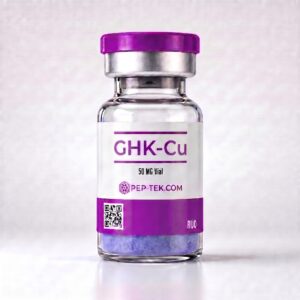
Available from PepTek
GHK-Cu gene expression research reveals the tripeptide-copper complex modulates thousands of human genes involved in tissue remodeling, antioxidant defense, and anti-inflammatory signaling.
The copper-binding tripeptide glycyl-L-histidyl-L-lysine (GHK-Cu) has attracted sustained scientific interest for its remarkable capacity to influence gene transcription at a broad, systems-level scale. Over the past two decades, a growing body of peer-reviewed research has documented how GHK-Cu gene expression research is reshaping investigators’ understanding of endogenous peptide signaling and its downstream effects on cellular homeostasis. Rather than acting on a single molecular target, GHK-Cu appears to function as a pleiotropic regulator capable of simultaneously upregulating tissue-protective genes while suppressing genes associated with inflammation and oxidative stress.
For a broader overview of GHK-Cu’s chemical structure, copper-chelation mechanism, and known signaling pathways, researchers may wish to consult the GHK-Cu: Copper Peptide Research Profile and Signaling Pathways article available in the PepTek research library before proceeding to the study-level evidence summarized below.
One of the most comprehensive investigations into GHK-Cu gene expression research was published by Loren Pickart and Anna Margolina in Biomolecules in 2017 [Pickart & Margolina, 2017]. Using publicly available Broad Institute Connectivity Map (CMap) datasets, the authors performed a large-scale bioinformatic analysis to evaluate how GHK-Cu modulates human gene expression in cell culture systems. Their analysis encompassed data from multiple human cell lines and catalogued the effect of GHK-Cu exposure on thousands of individual transcripts.
The 2017 study identified that GHK-Cu upregulates genes associated with several biologically significant categories, including:
Simultaneously, the analysis reported downregulation of gene sets associated with inflammation (including multiple interleukin pathways and NF-κB signaling components) and genes linked to cancer progression pathways such as those regulating unchecked cell proliferation.
Prior to the transcriptome-wide analyses, targeted in vitro experiments had already suggested GHK-Cu’s capacity for gene-level modulation. Maquart et al. (1993) demonstrated in fibroblast culture systems that GHK-Cu stimulates the synthesis of collagen, dermatan sulfate proteoglycans, and decorin at concentrations in the nanomolar to low micromolar range [Maquart et al., 1993]. The researchers attributed these effects in part to transcriptional upregulation, noting increased mRNA levels for collagen subtypes in treated cell populations.
Investigations by Pollard et al. and related groups using human skin fibroblast models further established that GHK-Cu influences the expression of vascular endothelial growth factor (VEGF) and related angiogenic factors at the mRNA level. These findings positioned GHK-Cu gene expression research within the broader field of wound-healing biology, where coordinated gene programs governing matrix remodeling, angiogenesis, and inflammation resolution are considered critical research endpoints [Gorouhi & Maibach, 2009].
Researchers have proposed that GHK-Cu’s gene regulatory effects may be partially mediated through its copper-delivery function. Copper is a required cofactor for several transcription factors and metalloenzymes. By chaperoning ionic copper (Cu²⁺) into the intracellular environment in a bioavailable form, GHK-Cu may facilitate the activation of copper-dependent transcriptional programs. Metal-responsive transcription factor 1 (MTF-1), for example, is known to be activated by intracellular copper and controls expression of metallothioneins and other stress-response genes.
The 2017 Pickart and Margolina analysis also noted that GHK-Cu appears to influence gene sets associated with ubiquitin-proteasome system (UPS) function, specifically genes involved in protein quality control and degradation of misfolded proteins. This observation aligns with proposals that GHK-Cu promotes cellular housekeeping programs related to proteostasis. Interestingly, NAD⁺-dependent pathways such as those mediated by sirtuins also intersect with proteasome regulation, and investigators studying complementary metabolic signaling mechanisms may find relevant context in the article on NAD+: Coenzyme Research Profile and Cellular Metabolism Studies.
A distinct aspect of GHK-Cu gene expression research concerns its apparent antifibrotic transcriptional profile. Whereas some collagen-stimulating agents can also upregulate transforming growth factor-beta (TGF-β) targets and promote excessive scarring, published data suggest GHK-Cu may produce a more balanced matrix remodeling response. Studies in relevant cell models have noted selective upregulation of matrix metalloproteinases (MMPs) responsible for remodeling excess collagen, alongside their endogenous inhibitors (TIMPs), suggesting a context-dependent regulatory rather than simply stimulatory role [Simeon et al., 1999].
GHK-Cu’s transcriptomic breadth is notable even when placed alongside other peptides studied for gene-regulatory properties. Research on neuropeptides such as those examined in the Semax: ACTH-Derived Neuropeptide Research Profile similarly highlights how small peptide structures can exert disproportionately wide effects on gene networks, a theme recurrent across peptide research disciplines. The specificity and reversibility of GHK-Cu’s observed transcriptional effects make it a compelling subject for investigations into endogenous peptide-based regulation of gene expression programs.
The scientific community has noted important caveats in interpreting the current body of GHK-Cu gene expression research. A substantial portion of the transcriptomic evidence originates from bioinformatic reanalysis of existing datasets rather than purpose-designed wet-lab experiments with GHK-Cu as the primary variable. Cell line models may not fully recapitulate the complexity of tissue-level gene regulation. Researchers have called for additional controlled in vitro and ex vivo experiments using standardized GHK-Cu concentrations with validated RNA sequencing approaches to confirm and extend the bioinformatic findings [Pickart & Margolina, 2017].
The studies summarized in this article represent published in vitro and bioinformatic research conducted under controlled laboratory conditions. All findings described pertain exclusively to experimental models and cell culture systems. GHK-Cu is made available by PepTek strictly as a research compound for in vitro and preclinical investigation only. It is not approved by the FDA or any regulatory authority for human or veterinary use. No information in this article constitutes medical advice, a therapeutic claim, or a recommendation for human administration. Researchers utilizing GHK-Cu should adhere to all applicable institutional, local, and federal guidelines governing the use of research compounds. Dosing, administration, or clinical application of this compound in humans is outside the scope of this research summary and is not endorsed or implied by PepTek.