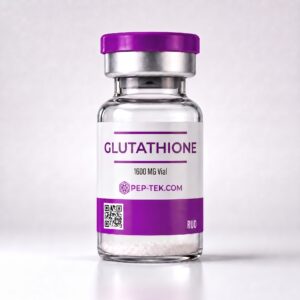
Available from PepTek
Glutathione is a tripeptide antioxidant central to redox signaling, cellular detoxification, and oxidative stress research. This profile examines its biochemistry, studied mechanisms, and emerging research applications.
Glutathione (GSH) is a low-molecular-weight tripeptide composed of three amino acids — glycine, cysteine, and glutamic acid — and is one of the most extensively studied endogenous antioxidant molecules in biochemical research. As the primary non-protein thiol in mammalian cells, it plays a pivotal role in redox homeostasis, xenobiotic metabolism, and intracellular signaling cascades. Researchers investigating glutathione antioxidant peptide research have produced a substantial body of literature exploring how this tripeptide maintains cellular equilibrium across a wide range of biological conditions.
Glutathione exists in two principal forms: the reduced form (GSH) and the oxidized disulfide form (GSSG). The ratio of GSH to GSSG within cells is widely used in research as a quantitative indicator of oxidative stress and redox state. The tripeptide is synthesized endogenously through two sequential ATP-dependent enzymatic reactions: first, glutamate-cysteine ligase (GCL) catalyzes the formation of gamma-glutamylcysteine, and subsequently, glutathione synthetase (GS) adds glycine to complete the molecule [Lu, 2013].
The unique gamma-peptide bond linking glutamate to cysteine confers resistance to most intracellular peptidases, contributing to GSH’s stability within the cytoplasm. Intracellular concentrations in mammalian cells typically range from 1 to 10 mM, making it among the most abundant small molecules of its class studied in cell biology.
In experimental models, GSH acts as a direct electron donor to neutralize reactive oxygen species (ROS), including hydroxyl radicals, peroxynitrite, and lipid peroxides. During this process, two GSH molecules are oxidized to form GSSG, which is subsequently reduced back to GSH by the NADPH-dependent enzyme glutathione reductase. This regeneration cycle is foundational to understanding how cells manage oxidative burden in controlled laboratory conditions [Meister & Anderson, 1983].
Beyond direct scavenging, glutathione antioxidant peptide research has consistently highlighted GSH’s role as a cofactor for glutathione peroxidases (GPx), a family of selenoproteins that catalyze the reduction of hydrogen peroxide and organic hydroperoxides. This enzymatic activity has been characterized across multiple in vitro and ex vivo models, providing insight into how peroxide-mediated damage may be modulated in tissue research systems.
A well-characterized family of phase II detoxification enzymes, glutathione S-transferases (GSTs), catalyze the conjugation of GSH to electrophilic substrates — a process that renders numerous toxic compounds more water-soluble and suitable for excretion. These reactions have been studied extensively in hepatocyte models and represent a significant area of toxicological research [Hayes et al., 2005].
Glutathione was first identified in 1888 by de Rey-Pailhade, who described a sulfur-containing substance extracted from yeast. The complete chemical structure was elucidated by Sir Frederick Hopkins in 1921, who named it “glutathione.” Subsequent decades saw progressive characterization of its biosynthetic pathway, with Alton Meister’s laboratory providing landmark contributions throughout the 1970s and 1980s that established the enzymatic framework for GSH synthesis and recycling. Today, glutathione antioxidant peptide research spans thousands of published studies across disciplines including oncology, neuroscience, immunology, and metabolic biology.
In cell culture and animal model studies, researchers have observed that depletion of GSH — often achieved experimentally using buthionine sulfoximine (BSO) — leads to marked increases in oxidative damage markers, including lipid peroxidation products and protein carbonylation. Conversely, augmentation of GSH levels has been explored as a strategy for studying cellular resilience to oxidative challenges [Griffith, 1999]. These observations provide a framework for understanding redox biology without implying clinical intervention.
Research in immunological contexts has investigated how intracellular GSH concentrations influence T-lymphocyte proliferation, natural killer cell activity, and cytokine signaling cascades in vitro. Studies have noted that lymphocytes maintain high GSH concentrations relative to other cell types, suggesting a functional significance that continues to be explored in experimental immunology research.
A distinct mitochondrial GSH pool (mGSH) has been identified and characterized as a separate compartment from cytosolic GSH. In vitro studies suggest that mGSH plays a specialized role in protecting mitochondrial membranes from lipid peroxidation and maintaining the integrity of the electron transport chain under oxidative conditions [Fernandez-Checa et al., 1997]. This compartmentalization has significant implications for mitochondrial biology research.
GSH has been studied extensively in neuronal cell models, where researchers have observed that neurons maintain comparatively lower GSH levels than astrocytes, potentially contributing to differential vulnerability to oxidative stress in neural tissue. This has prompted significant interest in understanding how redox homeostasis operates in the central nervous system at a mechanistic level. Researchers studying neuropeptide mechanisms — such as those profiling the ACTH-derived neuropeptide Semax — have similarly examined how oxidative pathways intersect with peptide signaling in neural tissues.
As a tripeptide, glutathione shares research relevance with other bioactive short-chain peptides studied for their signaling and regulatory functions. The broader field of glutathione antioxidant peptide research often intersects with investigations into peptides that modulate tissue homeostasis and cellular repair. For example, researchers examining the copper-binding tripeptide GHK-Cu have explored overlapping themes of oxidative regulation, gene expression modulation, and tissue-level redox signaling, highlighting how short peptides can exert profound effects on cellular biochemistry.
Similarly, studies on tissue-protective peptides such as BPC-157 have investigated interactions with nitric oxide systems and oxidative pathways, illustrating how antioxidant mechanisms frequently intersect with peptide biology in preclinical research models.
A variety of validated analytical techniques are employed in glutathione antioxidant peptide research, including high-performance liquid chromatography (HPLC) with electrochemical detection, mass spectrometry, and fluorometric assays using monochlorobimane or ThioGlo dyes. The GSH/GSSG ratio is commonly quantified using spectrophotometric enzyme recycling assays originally developed by Tietze and later refined for high-throughput applications [Tietze, 1969]. These methodologies allow precise characterization of redox status in biological samples under controlled experimental conditions.
Contemporary research has expanded the understanding of glutathione beyond its classical antioxidant role. Studies increasingly investigate GSH’s involvement in protein S-glutathionylation — a post-translational modification that reversibly alters protein function under oxidative conditions and may serve as a redox-sensitive signaling mechanism. Additional research has examined GSH’s role in ferroptosis, an iron-dependent form of regulated cell death, where GPx4-mediated reduction of lipid hydroperoxides is critically dependent on glutathione availability [Dixon et al., 2012]. These emerging areas represent active frontiers in redox biology and cell death research.
Glutathione (GSH) represents one of the most comprehensively studied molecules in cellular biochemistry, with decades of peer-reviewed research establishing its central role in redox homeostasis, detoxification, and intracellular signaling. Its structural simplicity as a tripeptide belies the complexity of its biological functions, which continue to be elucidated through rigorous in vitro, ex vivo, and animal model investigations. The depth of glutathione antioxidant peptide research available in the published literature provides an invaluable foundation for ongoing scientific inquiry into oxidative stress mechanisms.
Research Use Disclaimer: All information presented in this article is intended strictly for research and educational purposes. Glutathione, as discussed here, is a research compound supplied for in vitro, laboratory, and preclinical research use only. Nothing contained in this profile constitutes medical advice, therapeutic guidance, or clinical recommendation. This compound is not approved for human or animal consumption, and no dosing, administration, or treatment protocols are implied or suggested. Researchers should consult applicable institutional and regulatory guidelines before conducting any experimental work involving this compound.