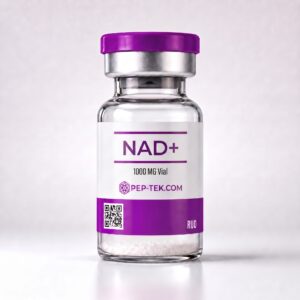
Available from PepTek
NAD+ (nicotinamide adenine dinucleotide) is a critical coenzyme studied extensively for its roles in cellular metabolism, energy transduction, and DNA repair signaling across in vitro and animal model research.
Research Use Disclaimer: All information presented in this article is intended strictly for scientific research purposes. NAD+ and related compounds discussed herein are not approved for human or veterinary use, and nothing in this article constitutes medical advice, dosing guidance, or therapeutic recommendation.
Nicotinamide adenine dinucleotide (NAD+) is one of the most extensively studied coenzymes in biochemistry, serving as a fundamental mediator of redox reactions, energy metabolism, and intracellular signaling. Present in virtually all living cells, NAD+ participates in hundreds of enzymatic reactions, functioning both as an electron carrier in its oxidized (NAD+) and reduced (NADH) forms and as a substrate for a growing class of regulatory enzymes. The breadth of NAD+ nicotinamide adenine dinucleotide research has expanded dramatically over the past two decades, with investigators exploring its roles in mitochondrial function, genomic stability, and circadian biology using in vitro and animal model systems.
NAD+ is a dinucleotide composed of two nucleotides joined by a phosphate bridge: one containing adenine and one containing nicotinamide. Its molecular formula is C₂₁H₂₇N₇O₁₄P₂, with a molecular weight of approximately 663.43 g/mol. The nicotinamide ring is the redox-active moiety; it accepts a hydride ion (H⁻) to form NADH, and this interconversion is central to oxidative phosphorylation and the citric acid cycle.
NAD+ also exists in phosphorylated forms, most notably NADP+, which serves distinct anabolic functions in biosynthetic pathways and antioxidant defense. Researchers studying NAD+ nicotinamide adenine dinucleotide research often distinguish between these pools, as cellular compartmentalization of NAD+ and NADP+ is tightly regulated and varies across tissue types and metabolic states.
In mammalian model systems, NAD+ can be synthesized de novo from tryptophan via the kynurenine pathway, ultimately yielding quinolinic acid, which is converted to nicotinic acid mononucleotide (NaMN) and then to NAD+. This pathway has been studied in the context of immune activation and neurological tissue models [Agudelo et al., 2018].
The predominant biosynthetic route in most mammalian tissues studied involves the salvage of nicotinamide (NAM) via nicotinamide phosphoribosyltransferase (NAMPT), producing nicotinamide mononucleotide (NMN), which is then adenylated to NAD+ by NMN adenylyltransferases (NMNATs). Research has identified NAMPT as a rate-limiting enzyme and a potential regulatory node in cellular NAD+ homeostasis [Revollo et al., 2004].
In its classical role, NAD+ functions as a coenzyme for dehydrogenases including lactate dehydrogenase, malate dehydrogenase, and complex I of the mitochondrial electron transport chain. In vitro studies in isolated mitochondria have demonstrated that the NAD+/NADH ratio is a key determinant of mitochondrial membrane potential and ATP synthesis efficiency. Researchers have used this ratio as a readout of cellular bioenergetic status across diverse experimental models.
Among the most studied non-redox functions of NAD+ is its role as an obligate substrate for sirtuins (SIRT1–7), a family of NAD+-dependent protein deacylases that regulate gene expression, mitochondrial biogenesis, and stress response pathways. Sirtuin-mediated deacetylation requires NAD+ consumption and generates nicotinamide, O-acetyl-ADP-ribose, and the deacetylated target protein. Research in cell culture and rodent models has linked sirtuin activity to transcriptional regulation via targets including PGC-1α and FOXO transcription factors [Imai et al., 2000].
The intersection of NAD+ biology with growth hormone secretagogue research is an area of growing interest; investigators studying compounds such as those profiled in the Ipamorelin selective GHRP research profile have noted metabolic signaling crosstalk that may involve NAD+-dependent pathways in energy homeostasis models.
Poly(ADP-ribose) polymerases (PARPs), particularly PARP1, consume NAD+ as a substrate to synthesize poly(ADP-ribose) (PAR) chains on target proteins in response to DNA strand breaks. This process is essential for DNA damage sensing and repair coordination in experimental cell models. Hyperactivation of PARP1 under conditions of extensive DNA damage can deplete intracellular NAD+ pools substantially, a phenomenon researchers have studied in oxidative stress and genotoxicity models [Bai and Cantó, 2012].
CD38, a multifunctional ectoenzyme, is recognized as a major NAD+-consuming enzyme in mammalian tissues. Research in knockout mouse models has demonstrated that CD38 deficiency results in substantially elevated tissue NAD+ levels, implicating CD38 as a principal regulator of systemic NAD+ homeostasis. This has driven interest in CD38 as a research target for modulating NAD+ availability in experimental contexts.
NAD+ was first identified by Arthur Harden and William John Young in 1906 during fermentation studies, with its structure elucidated by Hans von Euler-Chelpin in the late 1920s, work that earned a Nobel Prize in Chemistry in 1929. Otto Warburg later demonstrated its central role in cellular respiration. Contemporary NAD+ nicotinamide adenine dinucleotide research was catalyzed in part by the landmark 2000 study identifying NAD+ as the required substrate for the yeast Sir2 deacetylase [Imai et al., 2000], which inspired a wave of investigation into sirtuins and their relationship to metabolic regulation in animal models.
Subsequent rodent studies explored whether augmenting NAD+ biosynthetic precursors—such as NMN or nicotinamide riboside (NR)—could modulate sirtuin activity and downstream metabolic parameters in experimental systems. Researchers have noted parallels between NAD+-related metabolic signaling and the pathways engaged by incretin-axis peptides; investigators studying compounds like those described in the Tirzepatide GLP-1/GIP dual agonist research profile and the Semaglutide GLP-1 receptor agonist mechanism continue to examine how mitochondrial bioenergetics—partly governed by NAD+ cycling—interface with hormonal metabolic regulation in animal and cell-based models.
Animal model research has investigated whether sustained elevation of cellular NAD+ levels activates SIRT1-mediated deacetylation of PGC-1α, thereby promoting mitochondrial biogenesis and oxidative metabolism. Studies in aged rodent models have reported increased mitochondrial density and improved bioenergetic markers following precursor supplementation in research settings [Gomes et al., 2013].
Researchers have demonstrated in cell and animal models that NAD+ biosynthesis exhibits circadian oscillation, driven in part by the transcriptional activators CLOCK and BMAL1 acting on the NAMPT promoter. This positions NAD+ as a potential molecular link between circadian clock machinery and metabolic gene expression programs, an area of active preclinical investigation.
In vitro studies using neuronal cell lines and primary cultures have examined NAD+ metabolism in the context of axonal integrity, with research identifying the SARM1 enzyme—a NAD+ hydrolase—as a mediator of Wallerian axonal degeneration. These findings have stimulated interest in NAD+ pathways within neurological disease models at the preclinical research level.
The intersection of NAD+ signaling with tissue repair pathways has drawn comparisons to research conducted on regenerative peptides. Investigators familiar with studies such as those detailed in the GHK-Cu copper peptide signaling pathway profile will recognize the convergence of redox regulation and extracellular matrix remodeling signals as a theme in cellular repair research models.
Published NAD+ nicotinamide adenine dinucleotide research in peer-reviewed literature encompasses thousands of studies across metabolic biology, molecular genetics, and cell physiology. Key in vitro and animal model observations include: demonstration that NAMPT inhibition depletes intracellular NAD+ and disrupts sirtuin-dependent transcription; that NMN or NR administration in rodent models restores age-associated NAD+ decline; and that PARP inhibitor co-treatment preserves NAD+ pools under genotoxic stress conditions in cell culture systems. Researchers note, however, that extrapolation from these model systems to other biological contexts requires careful experimental design and replication [Yoshino et al., 2011].
NAD+ remains one of the most consequential molecules in fundamental biochemistry research, with its study spanning redox metabolism, epigenetic regulation via sirtuins, genomic maintenance through PARP enzymes, and circadian biology. The depth and diversity of NAD+ nicotinamide adenine dinucleotide research in peer-reviewed literature reflects its central position in cellular physiology as understood through laboratory investigation.
All findings described in this article derive from controlled in vitro experiments, cell culture models, or animal model studies published in peer-reviewed scientific literature. NAD+ as a research compound is supplied by PepTek exclusively for laboratory and scientific research purposes. It is not intended for human or animal consumption, is not approved by any regulatory authority for therapeutic use, and no information in this article should be interpreted as medical advice, dosing guidance, or a health claim of any kind. Researchers are encouraged to consult primary literature and institutional review protocols when designing studies involving NAD+ or its biosynthetic precursors.