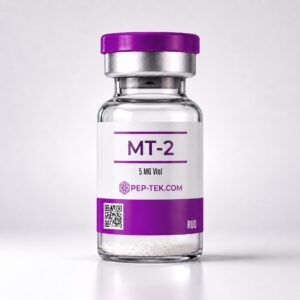
Research Use Disclaimer: All information presented in this article is intended strictly for scientific research and educational purposes. Melanotan II (MT-2) is not approved for human or animal consumption and is not a therapeutic product. This profile is provided for researchers studying melanocortin receptor biology in controlled laboratory or preclinical settings only.
Introduction to Melanotan II (MT-2)
Melanotan II (MT-2) is a synthetic cyclic heptapeptide analogue of alpha-melanocyte-stimulating hormone (α-MSH), a naturally occurring peptide derived from the proopiomelanocortin (POMC) precursor protein. With the molecular formula Ac-Nle-c[Asp-His-D-Phe-Arg-Trp-Lys]-NH₂ and a molecular weight of approximately 1024 Da, MT-2 was designed to offer improved receptor binding affinity and metabolic stability relative to the linear α-MSH parent sequence. Since its synthesis in the early 1980s, melanotan II MT-2 research has expanded substantially, encompassing investigations into pigmentation biology, central nervous system signaling, energy homeostasis, and cardiovascular function across multiple preclinical model systems.
The compound’s cyclic lactam structure confers resistance to enzymatic degradation and facilitates a constrained conformation that enhances selectivity and potency at melanocortin receptors—a feature that has made it a valuable pharmacological tool in receptor biology research.
Melanocortin Receptor System: Background
The melanocortin system comprises five G protein-coupled receptors (MC1R–MC5R), each distributed across distinct tissue types and associated with diverse physiological processes. These receptors are activated endogenously by melanocortins derived from POMC, including α-MSH, β-MSH, and adrenocorticotropic hormone (ACTH). MT-2 demonstrates broad-spectrum agonist activity at MC1R, MC3R, MC4R, and MC5R, with lower affinity for MC2R (the ACTH-specific receptor). This multi-receptor profile distinguishes melanotan II MT-2 research from studies using more selective analogues and has prompted investigation across a range of biological systems.
MC1R and Pigmentation Pathways
MC1R is expressed predominantly on melanocytes in the skin and hair follicles. Activation of MC1R by α-MSH and its analogues stimulates adenylyl cyclase, elevating intracellular cyclic AMP (cAMP), which in turn activates the MITF (microphthalmia-associated transcription factor) pathway and upregulates eumelanin synthesis. Researchers have observed that MT-2 potently activates MC1R with markedly greater potency than native α-MSH, making it a standard pharmacological probe in melanocyte biology studies [Hadley & Dorr, 2006].
MC3R and MC4R: Central Nervous System Roles
MC3R and MC4R are expressed centrally, particularly within the hypothalamus, where they participate in energy balance regulation. MC4R in the paraventricular nucleus has been studied extensively in the context of food intake and metabolism. Animal model studies indicate that hypothalamic melanocortin signaling influences satiety circuits, drawing conceptual parallels with other peptide-based metabolic research tools such as those profiled in the Tirzepatide: GLP-1/GIP Dual Agonist Research Profile, though the receptor systems involved are mechanistically distinct.
Research History and Development
MT-2 was first synthesized by Victor J. Hruby and colleagues at the University of Arizona in the early 1980s as part of a broader program to develop potent, stable melanocortin agonists for use as research tools. The original goal was to characterize the structural determinants of melanocortin receptor binding and to create compounds suitable for studying the physiological roles of the melanocortin system in controlled models [Sawyer et al., 1982].
Subsequent decades of melanotan II MT-2 research in rodent and other animal models explored a wide range of MC receptor-mediated effects. The compound’s broad receptor coverage and pharmacokinetic stability made it particularly useful for delineating which receptor subtypes mediate specific physiological outputs, contributing to the later development of more selective MC4R agonists and antagonists as distinct research tools.
Studied Properties in Preclinical Models
Pigmentation and Melanogenesis
In vitro studies using cultured human melanocytes and B16 melanoma cell lines have documented dose-dependent increases in melanin production following MT-2 treatment, mediated through MC1R-driven cAMP elevation and subsequent activation of tyrosinase, the rate-limiting enzyme in melanin biosynthesis. Researchers have observed that the cyclic structure of MT-2 results in significantly prolonged receptor activation relative to linear α-MSH analogues [Dorr et al., 1996].
Energy Homeostasis Investigations
Animal model studies using rodent systems have investigated the effects of centrally administered MT-2 on food intake and body weight. In these preclinical contexts, researchers have observed reductions in feeding behavior and alterations in metabolic parameters associated with MC3R and MC4R activation in hypothalamic circuits. These findings have contributed to the broader understanding of how the central melanocortin system interfaces with energy balance pathways—a research area that continues to intersect with investigations of other metabolic peptides. For context on peptide-based metabolic research tools, researchers may also reference the Semaglutide: GLP-1 Receptor Agonist Research and Mechanism of Action profile, which covers a mechanistically distinct but conceptually related area of metabolic peptide research.
Cardiovascular Research Observations
Several animal model studies have examined cardiovascular parameters in the context of melanocortin receptor activation. Researchers have observed transient changes in heart rate and blood pressure following systemic administration of MT-2 in rodent models, effects attributed primarily to central MC3R/MC4R engagement and peripheral MC1R and MC5R activity. These observations have informed the design of subtype-selective analogues intended to dissociate cardiovascular effects from other studied properties [Van der Ploeg et al., 2002].
Neurological and Behavioral Research
The expression of melanocortin receptors in limbic and hypothalamic brain regions has prompted researchers to study MT-2’s effects on a variety of centrally mediated behaviors in animal models. This includes investigations into grooming behaviors, anxiety-related endpoints, and nociceptive thresholds in rodent paradigms. These studies have provided foundational data regarding the functional neuroanatomy of the melanocortin system and have helped map the distribution and roles of MC receptor subtypes across brain regions [Wikberg et al., 2000].
Mechanism of Action: Molecular Detail
At the molecular level, MT-2 binds to the orthosteric site of melanocortin receptors and acts as a full agonist, stabilizing the receptor in an active conformation that promotes Gαs-protein coupling, adenylyl cyclase activation, and intracellular cAMP accumulation. This cAMP signal transduces downstream through protein kinase A (PKA), resulting in phosphorylation of CREB (cAMP response element-binding protein) and transcriptional activation of melanocortin-responsive genes. The constrained cyclic lactam scaffold of MT-2 is understood to mimic the active conformation of the His-Phe-Arg-Trp pharmacophore present in α-MSH, which is essential for receptor engagement.
Unlike growth hormone-related peptides studied in other research contexts—such as those reviewed in the Ipamorelin: Selective GHRP Research Profile—MT-2 exerts its effects through the melanocortin receptor family rather than through growth hormone secretagogue receptors, underscoring the distinct mechanistic landscape of the melanocortin system.
Available Evidence and Research Limitations
The body of published evidence supporting melanotan II MT-2 research is primarily derived from in vitro cell-based assays, ex vivo tissue studies, and in vivo rodent model experiments. Peer-reviewed data have documented consistent receptor binding profiles, cAMP signaling responses, and downstream gene expression changes across multiple laboratory settings. Radioligand binding assays have established Ki values in the low nanomolar range for MC1R, MC3R, and MC4R interactions [Haskell-Luevano et al., 1996].
Researchers should note, however, that preclinical findings with MT-2 must be interpreted within the constraints of the model systems used. Species differences in melanocortin receptor distribution and signaling, as well as the broad receptor subtype coverage of MT-2, introduce complexity in extrapolating findings across experimental contexts. The development of more selective MC receptor tools has been informed by, and continues to refine, the foundational observations generated through melanotan II MT-2 research.
Investigators studying peptide-mediated signaling pathways more broadly may find it useful to compare the mechanistic frameworks described here with those of other bioactive peptides, such as those covered in the GHK-Cu: Copper Peptide Research Profile and Signaling Pathways, which similarly employs second messenger and transcription factor cascades in its studied cellular activities.
Research Context
Melanotan II MT-2 research has contributed meaningfully to the understanding of melanocortin receptor pharmacology, pigmentation biology, and central energy regulation mechanisms in preclinical model systems. As a structurally optimized α-MSH analogue with broad melanocortin receptor activity, MT-2 remains a valuable pharmacological tool for researchers investigating receptor structure–activity relationships, intracellular signaling cascades, and the physiological roles of the melanocortin system.
All research involving MT-2 should be conducted in accordance with applicable institutional, regulatory, and ethical guidelines governing the use of research compounds. MT-2 is strictly a research compound and is not approved, intended, or suitable for human or animal administration, therapeutic use, or consumption of any kind. The data referenced in this profile are drawn from peer-reviewed preclinical literature and do not constitute medical advice, clinical guidance, or endorsement of any application outside of controlled scientific research settings. Researchers are encouraged to consult primary literature and exercise rigorous experimental design when incorporating MT-2 into investigative programs.