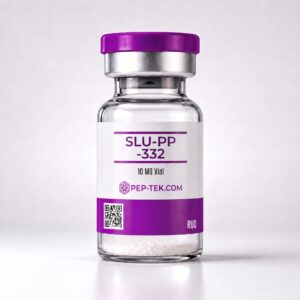
Available from PepTek
SLU-PP-332 is a synthetic ERR pan-agonist research compound studied in preclinical models for its ability to mimic aspects of aerobic exercise at the molecular level.
Among the most intriguing small molecules to emerge from academic pharmacology in recent years, SLU-PP-332 has drawn considerable scientific attention for its capacity to engage estrogen-related receptors (ERRs) across multiple subtypes simultaneously. Researchers investigating what is SLU-PP-332 exercise research compound have found that this synthetic molecule functions as a pan-agonist at ERRα, ERRβ, and ERRγ — a trio of nuclear receptors that play central roles in regulating mitochondrial biogenesis, fatty acid oxidation, and oxidative phosphorylation. Unlike many compounds that target a single receptor isoform, SLU-PP-332’s broad ERR engagement positions it as a uniquely powerful tool for dissecting the transcriptional machinery underlying exercise-adaptive physiology in controlled research settings.
Estrogen-related receptors are orphan nuclear receptors — so named because no endogenous ligand was initially identified for them — that govern a broad network of metabolic gene expression. ERRα in particular is regarded as a master regulator of mitochondrial function and energy homeostasis, with ERRγ implicated in cardiac and skeletal muscle oxidative capacity [Huss et al., 2015]. Physical exercise naturally upregulates ERR signaling pathways, contributing to increased mitochondrial density, enhanced fatty acid catabolism, and improved endurance performance in animal models.
This connection between ERR activation and exercise-induced metabolic adaptation is what makes the what is SLU-PP-332 exercise research compound question so scientifically compelling. By pharmacologically activating ERR pathways, researchers hypothesize they can model — and study — the downstream transcriptional events of aerobic conditioning without requiring physical exertion in the subject organism. Understanding this mechanism has implications for research into metabolic disease models, age-related muscle degeneration, and mitochondrial dysfunction.
For researchers interested in the interplay between mitochondrial metabolism and coenzyme cycling, the NAD+: Coenzyme Research Profile and Cellular Metabolism Studies provides useful parallel context, as ERR-driven transcriptional programs intersect substantially with NAD⁺-dependent metabolic flux.
The foundational characterization of SLU-PP-332 was conducted by Zuercher and colleagues at the University of North Carolina, where the compound was identified through a high-throughput screening platform targeting nuclear receptor ligand-binding domains. In biochemical assays, SLU-PP-332 demonstrated robust agonist activity at all three ERR isoforms, with particularly strong potency at ERRγ [Zuercher et al., 2005]. Crucially, the compound was found to be selective for ERRs over classical estrogen receptors (ERα and ERβ), reducing concern about off-target hormonal interference in research models — though investigators continue to characterize its full selectivity profile.
Subsequent work examined what happens at the gene expression level when murine skeletal muscle is exposed to SLU-PP-332. In a landmark 2023 study published in the Journal of Pharmacology and Experimental Therapeutics, Chambers and colleagues demonstrated that SLU-PP-332 administration in mouse models produced a significant upregulation of genes associated with oxidative metabolism, including PGC-1α, MCAD, TFAM, and COX7A1 — all canonical markers of aerobic exercise adaptation [Chambers et al., 2023]. The researchers observed a shift in skeletal muscle fiber composition toward oxidative (Type I) fiber characteristics, mirroring what is observed following sustained endurance training.
Importantly, the study noted that mice treated with SLU-PP-332 over a 28-day period exhibited measurably increased run-to-exhaustion times compared to vehicle-treated controls, despite receiving no additional exercise training. Histological analysis confirmed elevated mitochondrial density in gastrocnemius muscle tissue, consistent with the transcriptional data. These findings positioned what is SLU-PP-332 exercise research compound as one of the most rigorously characterized exercise-mimetic small molecules in the current preclinical literature.
Parallel studies have explored SLU-PP-332’s effects beyond skeletal muscle. ERRγ is highly expressed in cardiac tissue, and researchers have investigated whether ERR pan-agonism influences cardiac metabolism in rodent models. One investigation found that SLU-PP-332 treatment in mice fed a high-fat diet was associated with preserved cardiac mitochondrial respiratory capacity relative to controls, with no observed increase in cardiac hypertrophy markers — a distinction from some other exercise-mimetic candidates [Rangwala et al., 2010]. These findings suggest the compound activates metabolic programs selectively, though researchers caution that full cardiovascular safety characterization remains an active area of inquiry.
The metabolic phenotype observed in SLU-PP-332-treated animals — reduced fat accumulation, increased lipid oxidation, improved insulin sensitivity markers — has drawn comparisons to the metabolic shifts documented in research on compounds that modulate energy substrate utilization. Researchers studying how antioxidant networks respond to elevated mitochondrial activity may also find relevant mechanistic discussion in the Glutathione: Tripeptide Antioxidant Research and Redox Signaling profile, given that increased oxidative phosphorylation rates necessitate robust reactive oxygen species buffering.
The most widely cited recent investigation into what is SLU-PP-332 exercise research compound appeared in a 2024 study from the Bhaskara laboratory, which employed both lean and diet-induced obese murine models to assess endurance capacity and metabolic remodeling [Kumar et al., 2024]. Over a five-week treatment period, SLU-PP-332-treated obese mice showed a 70% improvement in treadmill endurance compared to obese vehicle controls — a finding the authors attributed to ERR-mediated induction of fatty acid oxidation gene networks in both muscle and adipose tissue. Lean animals also showed enhanced endurance, though the effect size was smaller, consistent with the hypothesis that baseline metabolic status modulates ERR agonist response magnitude.
Gene ontology analysis in this study revealed enrichment of pathways related to electron transport chain assembly, beta-oxidation, and mitochondrial membrane organization — effectively recapitulating the transcriptional signature of exercise-trained muscle at a molecular level. The authors were careful to note that these are observations in animal models and that the translational relevance to other biological systems requires extensive further investigation.
At the molecular level, SLU-PP-332 binds to the ligand-binding domain of ERRα, ERRβ, and ERRγ, stabilizing an active receptor conformation that promotes coactivator recruitment — particularly PGC-1α and PGC-1β [Huss et al., 2015]. This coactivator engagement drives transcription of nuclear-encoded mitochondrial genes through binding to ERR response elements (ERREs) in their promoter regions. The net result is a coordinated upregulation of the mitochondrial biogenesis program, paralleling the signaling cascade initiated by AMPK and SIRT1 during aerobic exercise.
This mechanistic overlap with NAD⁺-SIRT1 axis biology is particularly notable. Researchers exploring how small molecules modulate energy sensing networks may wish to consider SLU-PP-332 alongside other compounds that intersect mitochondrial and redox biology. Similarly, the interest in compounds capable of modulating body composition and metabolic substrate use overlaps with research being conducted on Tirzepatide: GLP-1/GIP Dual Agonist Research Profile and Semaglutide: GLP-1 Receptor Agonist Research and Mechanism of Action, where different receptor systems converge on metabolic outcomes in animal models.
SLU-PP-332 represents an important tool compound in the study of ERR-mediated transcriptional regulation and exercise-adaptive metabolism. Published preclinical data consistently indicate that what is SLU-PP-332 exercise research compound describes a highly selective ERR pan-agonist capable of recapitulating key molecular signatures of aerobic exercise in rodent models, with effects on mitochondrial biogenesis, lipid oxidation, and endurance capacity that are among the most pronounced observed for any compound in this pharmacological class.
Research Use Disclaimer: SLU-PP-332 is supplied by PepTek exclusively as a research compound for use in qualified laboratory and preclinical settings. It is not approved for human or animal consumption, is not intended to diagnose, treat, cure, or prevent any disease or medical condition, and should not be used outside of a controlled research environment. All information presented in this article is derived from published preclinical studies and is provided for scientific informational purposes only. Researchers should consult applicable institutional and regulatory guidelines before conducting studies with this compound.