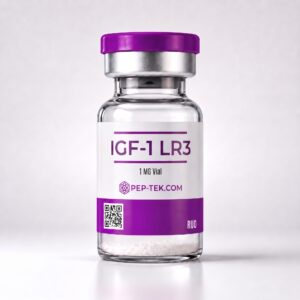
Available from PepTek
IGF-1 LR3 is a synthetic, long-acting analogue of insulin-like growth factor-1 studied extensively in cell biology and animal models for its potent mitogenic and metabolic signaling properties.
Among the engineered peptide analogues studied in modern biochemical research, what is IGF-1 LR3 long arginine growth factor has become a recurring question in the scientific literature on growth factor signaling. IGF-1 LR3 — formally designated as Long-[Arg3]-IGF-1 — is a recombinant analogue of human insulin-like growth factor-1 (IGF-1) that has been structurally modified to extend its bioactivity and reduce its affinity for IGF-binding proteins (IGFBPs). This article summarizes key published research examining the compound’s mechanism of action, receptor binding characteristics, and observations across in vitro and animal model studies.
Native IGF-1 is a 70-amino acid peptide regulated primarily by growth hormone (GH) signaling through the GH/IGF-1 axis. In circulation, the vast majority of endogenous IGF-1 is bound to one of six insulin-like growth factor binding proteins (IGFBP-1 through IGFBP-6), which modulate its half-life and bioavailability [Baxter, 1993].
IGF-1 LR3 differs from the native peptide in two principal ways. First, it contains a 13-amino acid N-terminal extension peptide. Second, position 3 in the sequence features an arginine substitution in place of glutamic acid — hence the designation “Long-[Arg3].” Researchers at GroPep (later acquired by Novozymes) engineered this substitution specifically to diminish IGFBP affinity without substantially reducing IGF-1 receptor (IGF-1R) binding [Francis et al., 1992]. The result is a molecule with an estimated 2–3 times greater in vitro potency than native IGF-1, due largely to the greater proportion of free, unbound peptide available to interact with cellular receptors.
Like native IGF-1, IGF-1 LR3 binds to and activates the IGF-1 receptor (IGF-1R), a receptor tyrosine kinase expressed broadly across cell types. Upon ligand binding, IGF-1R undergoes autophosphorylation and initiates downstream signaling primarily through two cascades: the PI3K/Akt/mTOR pathway and the MAPK/ERK pathway. These cascades have been extensively characterized as key regulators of cell survival, proliferation, and protein synthesis [Dupont and LeRoith, 2001].
In vitro studies in myoblast and fibroblast cell lines have demonstrated that IGF-1 LR3 activates these pathways with greater sustained duration compared to native IGF-1, consistent with its reduced IGFBP sequestration. Researchers have observed that the prolonged receptor occupancy enabled by LR3 modification produces correspondingly extended downstream phosphorylation of Akt and S6 kinase — both markers of anabolic intracellular signaling.
A study by Francis et al. characterized the binding kinetics of Long-[Arg3]-IGF-1 relative to native IGF-1. The research demonstrated that while the Arg3 substitution slightly reduces absolute IGF-1R binding affinity (approximately 2–10 fold lower than native), the dramatically reduced IGFBP-3 affinity — reported at roughly 500–1000-fold less than native IGF-1 — results in far greater bioavailable free peptide under physiological-like conditions [Francis et al., 1992]. This pharmacological trade-off is a cornerstone of why researchers have adopted IGF-1 LR3 as a tool compound for studying IGF-1R-mediated biology in cell culture systems.
Understanding what is IGF-1 LR3 long arginine growth factor requires examining how the compound has been used as a research tool in controlled laboratory settings. It has been widely incorporated into cell culture media — particularly in biopharmaceutical manufacturing contexts — to support the proliferation of Chinese Hamster Ovary (CHO) cells and other recombinant protein-producing cell lines. In these applications, IGF-1 LR3 functions as a serum-free medium supplement that promotes cell viability and productivity [Chun et al., 1999].
In skeletal muscle cell models, researchers have used IGF-1 LR3 to study satellite cell activation and myotube differentiation. In vitro studies suggest the compound promotes myoblast proliferation and delays differentiation in a concentration-dependent manner, consistent with IGF-1R/PI3K/Akt pathway engagement. These observations have made it a valuable tool compound in muscle biology research, particularly in studies examining the molecular interplay between growth factor signaling and protein turnover.
Researchers studying tissue regeneration have also examined IGF-1 LR3 alongside other peptides with cytoprotective or anabolic properties. For instance, investigations into extracellular matrix remodeling and growth factor crosstalk have occasionally paired IGF-1 LR3 with peptides like those profiled in our research overview of TB-500 (Thymosin Beta-4): Research Profile and Cellular Mechanisms, given their overlapping involvement in cell migration and tissue remodeling pathways.
Animal model studies with IGF-1 LR3 have provided substantial insight into IGF-1 axis biology. In hypophysectomized rat models — animals surgically rendered GH-deficient — subcutaneous administration of IGF-1 LR3 has been shown to promote somatic growth, as measured by tibial length and body weight gain, at lower molar doses than native IGF-1 [Francis et al., 1992]. These findings have been interpreted by researchers as evidence that the reduced IGFBP affinity of LR3 results in enhanced in vivo bioavailability relative to the parent molecule.
A notable area of animal model research concerns IGF-1 LR3’s effects on insulin-like metabolic signaling. Because IGF-1R shares approximately 50–60% structural homology with the insulin receptor, IGF-1 analogues can engage overlapping metabolic pathways. Animal model studies indicate that IGF-1 LR3 can promote glucose uptake in peripheral tissues through IGF-1R and, to a lesser extent, insulin receptor activation. This area of research intersects with broader investigations into metabolic peptides — researchers interested in overlapping growth hormone axis signaling may also consult the published profile of Tesamorelin: GHRH Analogue Research Profile and Studied Effects, a GHRH analogue with studied effects on somatotropic axis regulation.
The question of what is IGF-1 LR3 long arginine growth factor is perhaps best answered in the context of its utility as a research instrument. Because it provides extended, IGFBP-independent IGF-1R stimulation, it has become a standard positive control and investigational tool in studies of:
The compound’s utility in studying the upstream GH/IGF-1 axis has also led researchers to examine it in concert with GH-stimulating peptides. For context on upstream growth hormone axis peptides, the research profiles of Ipamorelin: Selective GHRP Research Profile and the CJC-1295 + Ipamorelin Blend: Research Overview of Synergistic Mechanisms provide relevant background on peptides that modulate endogenous GH secretion, which in turn governs hepatic IGF-1 production.
The cellular energy context in which IGF-1 LR3 signaling occurs is also of research interest. The mTOR pathway activated by IGF-1R signaling is tightly coupled to cellular metabolic status, including NAD+ availability and mitochondrial function — themes explored in the NAD+: Coenzyme Research Profile and Cellular Metabolism Studies research overview.
IGF-1 LR3 occupies a well-characterized position in the toolkit of growth factor biology researchers. Its structural modifications — the N-terminal extension and Arg3 substitution — yield a molecule with dramatically reduced IGFBP binding and correspondingly extended receptor-level bioactivity, making it a valuable instrument for dissecting IGF-1R-mediated signaling in controlled experimental systems. Published in vitro and animal model data have consistently demonstrated its potency relative to native IGF-1 in stimulating mitogenic and anabolic cellular responses, establishing what is IGF-1 LR3 long arginine growth factor as a well-defined subject of ongoing scientific inquiry.
Disclaimer: All information presented in this article pertains exclusively to preclinical and in vitro research. IGF-1 LR3 is a research compound supplied by PepTek solely for use in laboratory research settings. It is not approved by the FDA or any regulatory body for human or animal consumption, therapeutic use, or any clinical application. Nothing in this article constitutes medical advice, dosing guidance, or a recommendation for use in or on any biological system outside of controlled research environments. Researchers should consult all applicable institutional and regulatory guidelines before use.