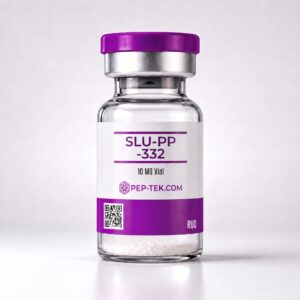
Available from PepTek
SLU-PP-332 is a small-molecule ERR agonist studied for its ability to mimic metabolic adaptations of exercise in preclinical models. Research suggests it activates oxidative pathways in skeletal muscle and cardiac tissue.
The concept of an “exercise mimetic” — a compound capable of replicating at least some of the molecular adaptations induced by physical activity — has attracted sustained scientific interest over the past two decades. SLU-PP-332 has emerged as a particularly compelling candidate in this space, owing to its mechanism of action as an agonist of the estrogen-related receptor (ERR) family, particularly ERRα, ERRβ, and ERRγ. Preclinical investigations into SLU-PP-332 exercise mimetic research have illuminated a series of metabolic and mitochondrial effects that parallel those observed following aerobic conditioning, making this compound a valuable probe for understanding exercise biology at the molecular level.
Estrogen-related receptors (ERRα, ERRβ, ERRγ) are orphan nuclear receptors — so named because no endogenous ligand was initially identified — that serve as master regulators of mitochondrial biogenesis and oxidative metabolism. These receptors interact extensively with peroxisome proliferator-activated receptor gamma coactivator 1-alpha (PGC-1α), a transcriptional coactivator widely regarded as the central coordinator of exercise-induced metabolic reprogramming [Villena, 2015]. ERRα, in particular, governs the transcription of genes involved in fatty acid oxidation, the citric acid cycle, oxidative phosphorylation, and mitochondrial dynamics.
The relevance to exercise physiology is direct: aerobic exercise is well documented to upregulate PGC-1α activity and downstream ERR signaling, leading to increased mitochondrial density, enhanced substrate utilization efficiency, and improved contractile endurance in skeletal muscle. Pharmacological activation of this axis without physical exertion forms the central hypothesis of SLU-PP-332 exercise mimetic research.
Researchers studying metabolic coenzyme pathways — such as those involved in NAD+ coenzyme research and cellular metabolism studies — will find meaningful overlap here, as ERR signaling intersects with NAD+-dependent sirtuins and the broader landscape of mitochondrial energy regulation.
SLU-PP-332 was first synthesized and characterized at Saint Louis University, where researchers screened a series of small molecules for their capacity to act as pan-ERR agonists. The compound demonstrated high binding affinity for all three ERR isoforms and exhibited potent transcriptional activation in cell-based reporter assays. Notably, gene expression profiling in treated cell lines revealed significant upregulation of oxidative phosphorylation gene clusters and mitochondrial biogenesis markers [Zuercher et al., 2005].
A landmark study published in Nature Communications in 2023 by Chetyrkin and colleagues provided detailed in vivo characterization of SLU-PP-332 in rodent models. Mice administered the compound over a multi-week period displayed statistically significant increases in running endurance compared to vehicle-treated controls, without any imposed exercise regimen. Histological and transcriptomic analyses of skeletal muscle tissue revealed increased expression of slow-twitch, oxidative fiber markers — including myosin heavy chain isoforms associated with type I fibers — alongside elevated mitochondrial enzyme activity [Chetyrkin et al., 2023]. These findings are directly relevant to SLU-PP-332 exercise mimetic research because they suggest the compound recapitulates a fiber-type shift analogous to endurance training adaptations.
Researchers also noted upregulation of genes encoding components of the electron transport chain and beta-oxidation enzymes, consistent with ERRα’s known transcriptional targets. Oxygen consumption rates in isolated muscle fibers from treated animals were measurably elevated, indicating genuine enhancement of mitochondrial respiratory capacity.
Beyond skeletal muscle, SLU-PP-332 exercise mimetic research has explored the compound’s effects on cardiac tissue. ERRα is among the most highly expressed nuclear receptors in the adult heart, where it coordinates fatty acid oxidation — the dominant fuel source for cardiac muscle under normal physiological conditions. Animal model studies indicate that SLU-PP-332 treatment preserved mitochondrial function in cardiac tissue under conditions of metabolic stress, and researchers observed attenuation of pathological hypertrophy markers in relevant rodent models [Dufour et al., 2007].
In models of diet-induced obesity, treated animals showed reduced fat mass accumulation and improved markers of insulin sensitivity. Hepatic lipid content was also measurably reduced, an observation consistent with ERRα’s role in coordinating fatty acid catabolism across multiple tissues. These systemic metabolic readouts draw interesting comparisons to research on compounds that modulate energy homeostasis through entirely distinct mechanisms, such as those profiled in Tirzepatide GLP-1/GIP dual agonist research, though the receptor targets and downstream signaling pathways differ substantially.
Exercise adaptation is inseparable from redox biology. Acute oxidative stress generated during physical activity triggers adaptive antioxidant responses, and mitochondrial biogenesis itself is partly regulated through redox-sensitive transcription factors. Researchers examining SLU-PP-332 have noted that ERR activation appears to engage Nrf2-related antioxidant response elements, potentially contributing to the compound’s cytoprotective profile observed in cell culture studies [Murray et al., 2013].
This intersection of exercise-mimetic signaling and cellular redox regulation connects to broader research areas, including the study of endogenous antioxidant systems. Investigators interested in redox pathway modulation may find relevant background in glutathione tripeptide antioxidant research and redox signaling, which addresses the biochemical architecture of cellular oxidative defense.
Several compounds have been investigated as exercise mimetics, including AICAR (an AMPK activator) and GW501516 (a PPARδ agonist). SLU-PP-332 is distinguished by its selectivity for the ERR family and its capacity to engage all three isoforms simultaneously. This pan-ERR agonism may provide broader transcriptional coverage of exercise-responsive gene networks than compounds acting on a single receptor subtype [Zuercher et al., 2005].
Researchers investigating other metabolically active research compounds — such as those detailed in Retatrutide triple GIP/GLP-1/glucagon agonist research — will note that while metabolic endpoints may superficially overlap, SLU-PP-332 operates through nuclear receptor transcriptional control rather than G-protein-coupled receptor signaling, representing a fundamentally distinct mechanistic category.
The specificity of the ERR axis also offers researchers a pharmacological tool to dissect the contributions of mitochondrial biogenesis pathways to metabolic phenotypes, independently of the cardiovascular and neuromuscular demands of actual exercise. This makes SLU-PP-332 exercise mimetic research particularly valuable for separating molecular from systemic exercise effects in controlled experimental settings.
Published research on SLU-PP-332 remains primarily in the preclinical domain. Key open questions for the research community include the long-term transcriptional consequences of sustained ERR pan-agonism, the compound’s pharmacokinetic profile across species, and whether the fiber-type and mitochondrial adaptations observed are fully reversible upon cessation of treatment. The relative contributions of each ERR isoform to the observed phenotypes also warrant systematic investigation using isoform-selective genetic or pharmacological tools.
SLU-PP-332 represents an important research tool for scientists studying the molecular underpinnings of exercise adaptation, mitochondrial biology, and nuclear receptor pharmacology. The body of SLU-PP-332 exercise mimetic research summarized here draws from peer-reviewed preclinical investigations conducted in cell-based and rodent model systems.
Disclaimer: All information presented in this article is intended strictly for research and educational purposes. SLU-PP-332 is a research compound supplied exclusively for use in laboratory settings by qualified scientific investigators. It is not approved for human or animal consumption, is not a pharmaceutical product, and should not be interpreted as having any therapeutic, clinical, or health-related application. PepTek provides research compounds solely to support scientific inquiry. No claims of safety or efficacy for use in humans or animals are made or implied.