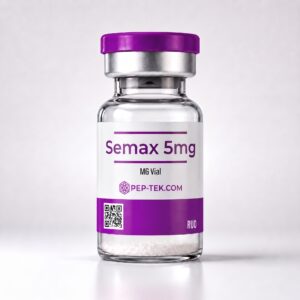
Available from PepTek
Research on semax BDNF neuroprotection reveals how this ACTH-derived peptide upregulates brain-derived neurotrophic factor in animal and in vitro models, with implications for neuronal survival studies.
Among the most compelling areas of modern neuropeptide research is the investigation of how synthetic peptide analogues influence endogenous neurotrophic factor expression. Semax — a heptapeptide derived from the adrenocorticotropic hormone (ACTH) fragment 4–10 — has attracted substantial scientific interest for its studied capacity to modulate brain-derived neurotrophic factor (BDNF) signaling. The body of work examining semax BDNF neuroprotection research represents a significant frontier in preclinical neuroscience, offering insights into how peptide-based compounds interact with neurotrophin systems. This article summarizes key findings from published animal model and in vitro studies exploring these mechanisms.
For a foundational overview of the compound’s structural and pharmacological characteristics, researchers may consult the Semax: ACTH-Derived Neuropeptide Research Profile, which details its sequence, receptor interactions, and general neurobiological context.
Brain-derived neurotrophic factor (BDNF) is a member of the neurotrophin family and is considered one of the most critical regulators of neuronal survival, differentiation, synaptic plasticity, and long-term potentiation. BDNF exerts its effects primarily through the tropomyosin receptor kinase B (TrkB) receptor, activating downstream signaling cascades including the MAPK/ERK and PI3K/Akt pathways. In animal models of neurodegeneration and ischemic injury, reduced BDNF expression has been consistently associated with increased neuronal apoptosis and impaired recovery [Binder and Bhaskaran, 2004].
Researchers studying neuroprotective compounds have therefore used BDNF upregulation as a measurable endpoint in preclinical studies — making it a relevant biomarker for evaluating whether candidate peptides like Semax may support neuronal resilience under experimentally induced stress conditions.
One of the most cited investigations in semax BDNF neuroprotection research was conducted by Dmitrieva et al. (2010), who examined Semax administration in a rat model of focal cerebral ischemia. Using quantitative PCR and in situ hybridization, the researchers observed significantly elevated BDNF mRNA levels in the cortex and hippocampus of Semax-treated animals compared to controls. Notably, the researchers reported increases in BDNF expression occurring within hours of compound exposure, with peak transcript levels observed at approximately 24 hours post-administration [Dmitrieva et al., 2010]. These findings suggested that the peptide may influence the early transcriptional response to ischemic injury, though the authors were careful to note these results are specific to the animal model context.
Semax has also been investigated in relation to nerve growth factor (NGF) alongside BDNF. A study published in the journal Neuroscience Letters examined the effects of Semax on neurotrophin gene expression in basal forebrain structures of intact rats. Researchers observed upregulation of both BDNF and NGF transcripts following repeated intranasal exposure, with the hippocampal dentate gyrus showing particularly robust responses [Dolotov et al., 2006]. The authors proposed that the peptide may engage melanocortin receptor subtypes expressed on glial and neuronal populations, thereby influencing neurotrophic factor transcription through secondary messenger pathways.
This is conceptually relevant when considered alongside other melanocortin receptor research. For comparison, the Melanotan II (MT-2): Melanocortin Receptor Agonist Research Profile discusses how melanocortin system engagement can produce diverse downstream signaling effects — illustrating the broad functional relevance of this receptor family in preclinical research contexts.
In vitro studies have offered additional mechanistic insights into semax BDNF neuroprotection research. Cell culture experiments using primary cortical neurons subjected to oxidative stress conditions demonstrated that Semax treatment was associated with increased BDNF secretion into the culture medium and reduced markers of apoptotic cell death compared to untreated controls [Shadrina et al., 2010]. The researchers hypothesized that BDNF upregulation may represent one component of a broader neuroprotective response, potentially intersecting with antioxidant defense mechanisms.
The intersection of peptide research and oxidative stress biology is an active area of inquiry. Researchers interested in how antioxidant pathways interact with neuroprotective signaling may find relevant context in the Glutathione: Tripeptide Antioxidant Research and Redox Signaling article, which explores redox-based mechanisms in cellular protection models.
Researchers have proposed several mechanistic pathways through which Semax may influence BDNF expression. Because Semax retains the ACTH(4–7) core sequence, it is believed to interact with melanocortin receptor subtypes — particularly MC4R — which are expressed in hippocampal and cortical regions. Activation of these receptors has been linked to cAMP-dependent signaling, which can promote CREB phosphorylation, a well-established transcriptional activator of the BDNF gene [Dolotov et al., 2006].
Some studies have indicated that astrocytes and microglia may serve as intermediary cell types in Semax-related BDNF modulation. In animal model preparations, researchers observed that glial populations showed altered cytokine and neurotrophin secretion profiles following Semax exposure, suggesting that the compound’s influence on BDNF may be partly indirect — mediated through glial activation of neurotrophin synthesis rather than solely through direct neuronal receptor engagement [Shadrina et al., 2010].
Emerging preclinical work has begun to explore how neurotrophin signaling intersects with cellular energetics. BDNF is known to influence mitochondrial biogenesis and metabolic efficiency in neurons. This mechanistic linkage is of interest when considering compounds that affect NAD⁺-dependent pathways and metabolic signaling more broadly. Researchers studying these intersections may find complementary information in the NAD+: Coenzyme Research Profile and Cellular Metabolism Studies, which examines how coenzyme availability affects cellular resilience and signaling capacity.
Semax is not the only synthetic peptide that has been studied for its influence on the nervous system. Its structural and functional relative, Selank — another peptide of Russian research origin — has been investigated for anxiolytic and nootropic effects in animal models. Researchers comparing these compounds have noted that while Semax research has focused substantially on neurotrophin upregulation and ischemia protection, Selank studies have emphasized GABAergic and serotonergic modulation. For a detailed review of Selank’s studied mechanisms, the Selank: Synthetic Anxiolytic Peptide Research Overview provides a thorough preclinical summary.
Together, these compounds represent a class of short-chain synthetic peptides that have generated substantial preclinical interest due to their apparent capacity to influence multiple neurobiological systems simultaneously — including neurotrophic, inflammatory, and oxidative stress pathways.
It is important to contextualize semax BDNF neuroprotection research within its limitations. The majority of published studies have been conducted in rodent models or cell culture systems, with relatively small sample sizes and variable methodological approaches. Many key studies originate from Russian research institutions and are published in journals that may have limited peer review standards by Western benchmarks. Replication in independent laboratories using standardized protocols remains limited [Dolotov et al., 2006; Dmitrieva et al., 2010].
Additionally, the translational relevance of rodent BDNF responses to human neurophysiology cannot be assumed. The pharmacokinetics of intranasal peptide delivery — a commonly used route in Semax animal research — may differ substantially across species. These gaps represent important areas for future preclinical investigation before broader conclusions can be drawn about the compound’s neurobiological significance.
The studies summarized in this article represent preclinical and in vitro findings only. The research on semax BDNF neuroprotection discussed here has been conducted exclusively in animal models and cell culture systems. Semax and all compounds referenced in this article are provided by PepTek strictly for laboratory research purposes.
Disclaimer: All content on this page is intended for informational and scientific research purposes only. Semax is not approved for human or animal consumption, and nothing in this article should be interpreted as medical advice, therapeutic guidance, or a health claim. PepTek research compounds are sold exclusively for in vitro and preclinical research use by qualified investigators. Researchers should comply with all applicable regulations governing the use of research compounds in their jurisdiction.