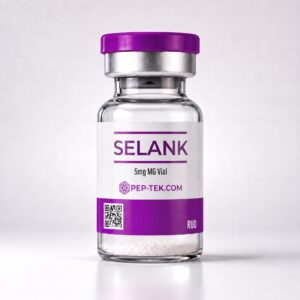
Available from PepTek
Research summaries examining selank GABA anxiety research studies reveal how this synthetic heptapeptide modulates GABAergic transmission in rodent anxiety models, offering insights into neuropeptide-based anxiolytic mechanisms.
Selank (Thr-Lys-Pro-Arg-Pro-Gly-Pro) is a synthetic heptapeptide derived from the endogenous immunomodulatory tetrapeptide tuftsin. Since its development at the Institute of Molecular Genetics of the Russian Academy of Sciences, selank has been extensively studied in preclinical models for its interactions with GABAergic neurotransmission and stress-related behavioral phenotypes. This article summarizes key published findings from selank GABA anxiety research studies, with particular attention to mechanistic data gathered from in vitro assays and validated animal models.
For a broader introduction to the compound’s pharmacological profile, researchers may consult the Selank: Synthetic Anxiolytic Peptide Research Overview published in the PepTek research library.
Gamma-aminobutyric acid (GABA) is the principal inhibitory neurotransmitter in the mammalian central nervous system. Research in rodent models has consistently demonstrated that pharmacological enhancement of GABA-A receptor activity reduces anxiety-like behaviors as measured by validated paradigms such as the elevated plus maze (EPM), open field test (OFT), and Vogel conflict test. Conversely, disruption of GABAergic signaling reliably produces anxiogenic phenotypes. The GABA-A receptor complex, with its multiple binding sites including the benzodiazepine site, is a well-characterized target for anxiolytic research compounds.
Selank GABA anxiety research studies have probed whether this peptide interacts directly or indirectly with GABAergic mechanisms, seeking to understand whether its observed effects in animal models implicate GABA-A receptor modulation as a key pathway.
One of the most frequently cited works in the selank GABA anxiety research studies literature is the investigation by Semenova and colleagues, which systematically evaluated selank’s anxiolytic-like profile in Wistar rats using the EPM and OFT [Semenova et al., 2010]. Researchers administered selank intranasally to subject animals and measured behavioral endpoints at defined intervals. The study reported statistically significant increases in open-arm exploration time in the EPM, a canonical indicator of reduced anxiety-like behavior in rodents.
Critically, Semenova and colleagues employed pharmacological challenge with flumazenil, a selective benzodiazepine receptor antagonist, to probe whether the GABA-A benzodiazepine site was involved in selank’s activity. Flumazenil pre-treatment partially attenuated the behavioral effects of selank in the EPM paradigm, suggesting that benzodiazepine site modulation at the GABA-A receptor complex contributes to, though does not entirely explain, the compound’s observed anxiolytic-like profile. The authors concluded that selank’s mechanism involves, at least in part, an enhancement of inhibitory GABAergic tone, while acknowledging that additional pathways — including serotonergic and enkephalinergic systems — likely contribute.
An earlier but foundational study by Zozulya and colleagues examined selank’s influence on enkephalin-degrading enzymes and drew mechanistic connections between peptidergic and GABAergic systems [Zozulya et al., 2001]. Researchers demonstrated in vitro that selank inhibits the enzymatic degradation of Leu- and Met-enkephalins by stabilizing these endogenous opioid peptides. Because enkephalinergic neurons modulate GABAergic interneuron activity in limbic regions including the amygdala and hippocampus, this finding was interpreted as evidence for an indirect route by which selank may potentiate GABAergic inhibitory neurotransmission. Animal model studies in this series further corroborated that selank produced dose-related reductions in anxiety-like behavior, consistent with enhanced inhibitory tone across corticolimbic circuits.
Kozlovskii and colleagues investigated whether selank’s behavioral effects in rodent anxiety models were phenotype-specific — that is, whether the compound differentially influenced high-anxiety versus low-anxiety rat subpopulations [Kozlovskii et al., 2003]. Using behavioral screening to stratify Wistar rats into high-anxiety and low-anxiety cohorts prior to intervention, researchers observed that selank administration produced robust anxiolytic-like effects primarily in the high-anxiety phenotype group. The low-anxiety group showed comparatively modest changes in EPM behavior. These findings have been interpreted in subsequent selank GABA anxiety research studies as consistent with a modulatory, rather than globally suppressive, action on GABAergic inhibitory circuits — a profile that parallels the partial agonism seen with some GABA-A positive allosteric modulators.
Research by Uchakina and colleagues extended the understanding of selank beyond purely neurotransmitter-level mechanisms by demonstrating changes in cytokine expression profiles in animal subjects [Uchakina et al., 2008]. Researchers noted alterations in interleukin-6 (IL-6) and other inflammatory mediators following selank administration in rodent models. Because neuroinflammatory signaling is increasingly recognized as a modulator of GABAergic interneuron function — particularly parvalbumin-expressing interneurons in the prefrontal cortex and hippocampus — these findings provide a complementary mechanistic layer to direct GABA-A receptor interaction studies. The immune-to-GABAergic axis represents a compelling area of ongoing preclinical research that these selank GABA anxiety research studies helped to illuminate.
The studies summarized above employed standardized rodent anxiety paradigms with well-characterized construct validity. The EPM exploits the natural conflict between rodents’ exploratory drive and their aversion to exposed, elevated spaces; time spent in open arms is inversely correlated with anxiety-like behavior. The OFT measures locomotor activity and center-field dwell time as indices of exploration and anxiety. Researchers generally note that selank did not produce significant sedation or motor impairment at doses producing anxiolytic-like effects, an observation that distinguishes it mechanistically from classical GABA-A agonists such as barbiturates, which produce global CNS depression. This selectivity profile has made selank an active subject of inquiry in neuropeptide pharmacology research.
Researchers interested in related neuropeptide mechanisms may find value in reviewing the Semax: ACTH-Derived Neuropeptide Research Profile, which examines another Russian-origin neuropeptide with overlapping research applications in CNS function.
GABAergic modulation does not occur in isolation. Research consistently demonstrates cross-talk between inhibitory GABAergic interneurons and redox signaling pathways, with oxidative stress capable of impairing GABAergic interneuron function in limbic circuits. Studies examining cellular redox homeostasis, such as those reviewed in the PepTek article on Glutathione: Tripeptide Antioxidant Research and Redox Signaling, provide foundational context for understanding how oxidative conditions may interact with the neurochemical systems implicated in selank’s preclinical research profile.
Similarly, research on cellular energy metabolism — including the role of NAD+ in neuronal bioenergetics as outlined in NAD+: Coenzyme Research Profile and Cellular Metabolism Studies — contextualizes how metabolic support of inhibitory interneuron populations may intersect with GABAergic research endpoints relevant to anxiety phenotype studies.
The studies summarized here represent a cross-section of published preclinical research examining selank’s interaction with GABAergic neurotransmission in validated animal models. Data from these investigations are derived exclusively from in vitro assays and non-human animal subjects. The findings are intended to characterize mechanistic hypotheses for further scientific inquiry and do not constitute evidence of efficacy or safety in humans.
Research Use Disclaimer: All information presented in this article is intended strictly for scientific research and educational purposes. Selank is a research compound available for in vitro and animal model research applications only. It is not approved by the FDA or any regulatory authority for human or veterinary use. This article does not constitute medical advice, therapeutic guidance, or dosing recommendations of any kind. Researchers should adhere to all applicable institutional and regulatory guidelines when working with research compounds.