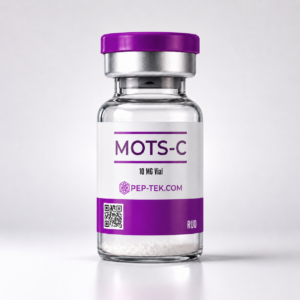
Available from PepTek
MOTS-c is a mitochondrial-derived peptide studied for its role in metabolic regulation, glucose homeostasis, and cellular stress response in preclinical research models.
MOTS-c (Mitochondrial Open Reading Frame of the Twelve S rRNA type-c) is a 16-amino acid peptide encoded within the mitochondrial genome — a discovery that fundamentally expanded scientific understanding of mitochondrial biology. First characterized by Lee et al. in 2015, MOTS-c has since become a focal point in MOTS-C metabolic regulation research, with preclinical studies examining its role in glucose utilization, insulin sensitivity, cellular stress adaptation, and longevity-associated signaling pathways. This summary reviews key published findings from animal model and in vitro research.
Unlike nuclear-encoded peptides, MOTS-c is transcribed from the 12S ribosomal RNA gene within the mitochondrial genome. Its amino acid sequence — MRWQEMGYIFYPRKLR — is highly conserved across species, which researchers note suggests functional importance across evolutionary lineages [Lee et al., 2015]. This conservation has drawn significant attention in MOTS-C metabolic regulation research, as conserved peptides frequently occupy critical physiological niches.
MOTS-c is detected in circulating plasma as well as in tissue-specific compartments including skeletal muscle and the liver. Its expression has been observed to decline with age in murine models, positioning it within a broader framework of mitochondrial-derived signaling molecules that may influence aging biology. This parallels research into other mitochondria-associated metabolic co-factors, such as those explored in NAD+ coenzyme research examining cellular metabolism and energy homeostasis.
The foundational MOTS-c study published in Cell Metabolism by Lee et al. employed both in vitro cell culture models and in vivo murine models to investigate the peptide’s influence on metabolic function. Researchers administered exogenous MOTS-c to C57BL/6 mice placed on a high-fat diet (HFD) — a well-established model for studying diet-induced metabolic disruption — and assessed changes in body weight, adiposity, insulin sensitivity, and glucose tolerance [Lee et al., 2015].
One of the more striking mechanistic findings in MOTS-C metabolic regulation research from this study involved the folate cycle. In vitro experiments indicated that MOTS-c interferes with the folate cycle in a manner that reduces the AICAR-to-ZMP conversion, subsequently activating AMPK — a master regulator of cellular energy status. AMPK activation is broadly associated with increased fatty acid oxidation, inhibition of lipogenic pathways, and enhanced glucose uptake in skeletal muscle tissue [Lee et al., 2015]. This mechanism is of particular scientific interest because it represents a mitochondria-to-nucleus retrograde signaling pathway distinct from previously characterized routes.
A 2019 study by Reynolds et al. published in Nature Communications explored MOTS-c as a potential exercise-induced signal. Researchers reported that circulating MOTS-c concentrations increased in human subjects following acute physical exercise, and that exogenous MOTS-c administration in aged murine models improved exercise performance metrics including grip strength and endurance capacity [Reynolds et al., 2019]. These observations have fueled interest in MOTS-c as a potential exercise-mimetic signal at the molecular level, though researchers emphasize that mechanistic translation to human biology remains under active investigation.
Supplementary analyses in multiple preclinical studies have shown that MOTS-c plasma concentrations decline with chronological aging in both rodent models and older human cohorts. Kim et al. (2018) examined skeletal muscle tissue in aged mice and found that exogenous MOTS-c administration partially restored metabolic gene expression profiles typically associated with younger tissue states [Kim et al., 2018]. This line of inquiry situates MOTS-C metabolic regulation research within the broader field of geroscience — the study of biological mechanisms that connect aging to age-related functional decline.
The relationship between mitochondrial peptide signaling and redox homeostasis is also an area of growing interest. Some researchers have explored whether MOTS-c influences cellular antioxidant responses, a topic that connects to mechanistic studies on peptides like those discussed in glutathione’s role in tripeptide antioxidant activity and redox signaling.
Skeletal muscle accounts for approximately 80% of insulin-stimulated glucose disposal in mammals, making it a critical tissue for studying metabolic peptide effects. In vitro studies using differentiated murine myotubes treated with MOTS-c have consistently demonstrated enhanced glucose uptake independent of insulin signaling, suggesting a parallel or complementary pathway to canonical insulin receptor activation [Lee et al., 2015]. This distinction is mechanistically significant for researchers modeling insulin-resistant cellular environments.
Researchers have also examined MOTS-c in hepatocyte models, where it has been associated with modulation of lipogenic gene expression, including downregulation of SREBP-1c targets. These findings suggest a potential multi-tissue effect on lipid metabolism, though the authors note that hepatic data require further validation in more complex in vivo systems [Kim et al., 2018]. The interplay between mitochondrial peptide signaling and hepatic lipid handling represents one of the more complex dimensions of ongoing MOTS-C metabolic regulation research.
For researchers studying metabolic peptides across different mechanistic categories, related preclinical literature on incretin-based signaling — such as that covered in GLP-1 receptor agonist mechanism of action studies and dual GIP/GLP-1 agonist research profiles — provides useful comparative context for understanding diverse approaches to metabolic signaling research.
The published body of preclinical data positions MOTS-c as a scientifically compelling subject within MOTS-C metabolic regulation research, with reproducible findings across multiple independent laboratories regarding its influence on AMPK activation, glucose uptake in skeletal muscle models, and adiposity in diet-induced obesity murine models. The peptide’s mitochondrial origin distinguishes it from nuclear-encoded peptides and opens new avenues for understanding retrograde mitochondrial signaling in metabolic physiology.
Researchers interested in mitochondrial-derived peptides and their interaction with broader cellular energetics may find value in reviewing complementary research areas, including NAD+ coenzyme cellular metabolism research, which addresses overlapping aspects of mitochondrial energy regulation at the biochemical level.
Research Use Disclaimer: All information presented in this article is intended strictly for scientific and educational research purposes. MOTS-c, as summarized here, is a research compound studied exclusively in preclinical in vitro and animal model contexts. It is not approved for human or veterinary use, is not intended for consumption, and no dosing, administration, or therapeutic guidance is implied or provided. Researchers should consult institutional guidelines and applicable regulations when working with research peptides.