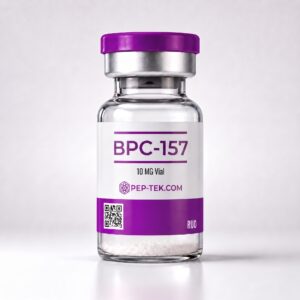
Available from PepTek
BPC-157 healing research studies examine this gastric pentadecapeptide's observed effects on gastrointestinal repair and connective tissue remodeling across multiple preclinical models.
Body Protection Compound-157 (BPC-157) is a synthetic pentadecapeptide consisting of 15 amino acids, derived from a partial sequence of human gastric juice protein. Since its initial characterization in the early 1990s, BPC-157 has become a subject of considerable interest in preclinical research, with investigators examining its effects across gastrointestinal mucosal biology, connective tissue remodeling, vascular signaling, and cytoprotective mechanisms. A growing body of BPC-157 healing research studies — conducted predominantly in rodent and cell-culture models — has produced findings that continue to inform mechanistic hypotheses in gastroenterology and tissue biology. This article summarizes key published studies and their principal observations.
For researchers interested in the broader molecular profile of this compound, PepTek’s foundational article on BPC-157 Peptide: Research Profile and Mechanism of Action provides a comprehensive overview of its biochemical characterization and proposed signaling pathways.
BPC-157 (sequence: Gly-Glu-Pro-Pro-Pro-Gly-Lys-Pro-Ala-Asp-Asp-Ala-Gly-Leu-Val) was isolated and characterized by Sikiric and colleagues at the University of Zagreb, where the majority of foundational BPC-157 healing research studies have been conducted. The peptide demonstrates notable stability in gastric acid and aqueous environments, a property that has made it practical for use in gastrointestinal experimental models [Sikiric et al., 1997].
One of the most replicated areas within BPC-157 healing research studies concerns gastric ulcer models in rodents. Sikiric et al. (1997) demonstrated that systemic and intragastric administration of BPC-157 in rat models of ethanol-, cysteamine-, and indomethacin-induced gastric lesions was associated with a statistically significant reduction in ulcer area and mucosal disruption scores compared to controls [Sikiric et al., 1997]. Researchers observed that the peptide appeared to modulate early-phase inflammatory markers and upregulate pathways associated with cytoprotective prostaglandin synthesis, though exact mechanisms remain under investigation.
Subsequent studies investigated BPC-157’s relationship with nitric oxide (NO) signaling in the gastric mucosa. Animal model studies indicate that BPC-157 may interact with the NO system, with researchers observing altered NOS enzyme expression in treated tissue samples relative to controls [Sikiric et al., 2010]. This interaction is hypothesized to contribute to the vascular and mucosal effects observed in experimental preparations, though confirmation in higher-order organisms has not been established.
Researchers have also evaluated BPC-157 in rat models of experimental colitis and intestinal anastomotic healing. Veljaca et al. examined BPC-157 in a trinitrobenzene sulfonic acid (TNBS)-induced colitis model and reported that treated animals exhibited reduced macroscopic and histological colitis scores alongside attenuated weight loss trajectories compared to vehicle-treated controls [Veljaca et al., 1994]. These findings have been interpreted as indicating a modulatory effect on intestinal inflammatory cascades, though the precise upstream targets remain an active area of inquiry.
In separate rodent experiments focused on intestinal fistula closure, researchers observed accelerated fistula healing in BPC-157-treated animals, with histological sections revealing increased fibroblast activity and collagen deposition relative to controls. Such data have positioned BPC-157 as a candidate compound for further mechanistic investigation in gut anastomotic biology.
A substantial portion of published BPC-157 healing research studies has shifted toward musculoskeletal and connective tissue applications. Chang et al. (2011) investigated the effects of BPC-157 on transected Achilles tendons in rats, reporting that treated animals demonstrated significantly faster functional recovery, reduced tendon gap width at histological examination, and increased expression of growth factor receptors (specifically VEGFR2 and FGFR2) in tendon fibroblasts compared to untreated controls [Chang et al., 2011]. Researchers noted that BPC-157 appeared to promote early angiogenic responses within the tendon repair tissue, a finding consistent with its proposed interactions with the NO and VEGF signaling axes.
In vitro studies using human tendon fibroblast cultures have suggested that BPC-157 may upregulate F-actin formation and early-phase cell spreading, which researchers have interpreted as potentially relevant to the observed in vivo wound-contraction data. These in vitro observations, however, require careful contextualization and do not constitute evidence of efficacy in any clinical or human application.
Research into connective tissue repair mechanisms shares thematic overlap with studies on other peptides studied for tissue signaling, such as those summarized in PepTek’s profile on TB-500 (Thymosin Beta-4): Research Profile and Cellular Mechanisms, which examines a distinct peptide with its own proposed actin-sequestration mechanism in preclinical wound models.
Several rodent studies have examined BPC-157 in bone defect and segmental fracture models. Animal model studies indicate that BPC-157-treated subjects demonstrated improved histological bone bridging and increased osteocalcin immunoreactivity at fracture sites relative to control groups, though these findings have not been replicated beyond the original research group in peer-reviewed literature at this time [Sikiric et al., 1997]. Independent replication across diverse laboratory settings remains an important unmet need in this research area.
Across the landscape of BPC-157 healing research studies, several molecular pathways have been proposed to underlie the experimental observations. These include:
Researchers studying cellular protection and redox biology may find points of comparison with antioxidant peptide research. PepTek’s article on Glutathione: Tripeptide Antioxidant Research and Redox Signaling explores how short peptide structures engage with cellular oxidative stress pathways — a mechanistic context relevant to cytoprotective hypotheses surrounding BPC-157.
Similarly, researchers examining energy-dependent tissue repair processes may find relevant comparative reading in PepTek’s overview of NAD+: Coenzyme Research Profile and Cellular Metabolism Studies, which covers coenzyme-mediated contributions to cellular resilience.
While the volume of preclinical data surrounding BPC-157 is substantial, several critical limitations must be acknowledged by researchers reviewing this literature. The majority of published BPC-157 healing research studies originate from a single research group, raising questions about independent reproducibility. No peer-reviewed, randomized, controlled human clinical trial data have been published to date. Furthermore, the pharmacokinetic profile of BPC-157 in mammals beyond rodents has not been thoroughly characterized in the open scientific literature. Researchers should approach existing findings as hypothesis-generating rather than conclusive, and independent replication remains a significant scientific priority in this field.
The studies summarized in this article represent findings from preclinical animal models and in vitro cell culture systems. All information presented here is intended exclusively for researchers, scientists, and academics engaged in the scientific study of peptide biology and related disciplines. BPC-157 is a research compound supplied by PepTek strictly for laboratory and investigational use. It is not approved for human or animal consumption, is not a pharmaceutical product, and is not intended to diagnose, treat, cure, or prevent any disease or medical condition. No content in this article constitutes medical advice, dosing guidance, or clinical recommendation of any kind. Researchers are encouraged to consult current peer-reviewed literature and applicable institutional review guidelines when designing studies involving this compound.