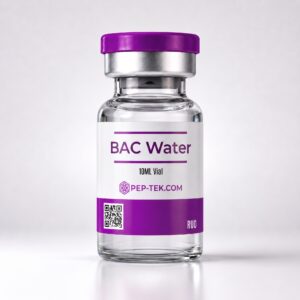
Available from PepTek
A methodology guide covering bacteriostatic water peptide reconstitution research, including analytical techniques, proper storage, handling protocols, and laboratory safety considerations for research settings.
In peptide research, the choice of solvent used for reconstitution is not a trivial decision. Among the available options, bacteriostatic water — sterile water containing 0.9% benzyl alcohol as a preservative — has become one of the most widely referenced solvents in laboratory settings. Understanding the chemistry, handling requirements, and appropriate analytical verification of bacteriostatic water peptide reconstitution research is essential for researchers seeking reproducible and reliable in vitro or preclinical results.
This methodology article outlines best practices for researchers working with lyophilized peptide compounds, covering everything from reconstitution technique to storage parameters and quality verification. All information contained herein is strictly intended for use in controlled research environments.
Bacteriostatic water for injection (BWFI) is a preparation of sterile water preserved with 0.9% benzyl alcohol (9 mg/mL). The benzyl alcohol component inhibits microbial growth, extending the usable life of multi-draw preparations in laboratory conditions. Unlike standard sterile water for injection, which is intended for single use, BWFI is formulated to resist bacterial contamination over multiple access events — a property that makes it particularly useful in research settings where reconstituted peptide solutions may need to be accessed repeatedly over several days.
The United States Pharmacopeia (USP) outlines specifications for BWFI, including pH range (4.5–7.0), clarity, and preservative concentration. Researchers should ensure that any bacteriostatic water used in laboratory studies meets applicable compendial standards and is sourced from a verified supplier.
Lyophilized peptides are typically stable in their dry form under appropriate storage conditions, but once reconstituted, they become susceptible to hydrolysis, oxidation, and aggregation. The antimicrobial properties of benzyl alcohol in bacteriostatic water help minimize microbial degradation of reconstituted solutions, thereby supporting solution integrity over the research window [Dass et al., 2006].
Researchers studying compounds such as growth hormone-releasing peptides — for example, those reviewing Ipamorelin’s selective GHRP research profile — or longer-acting analogues like those covered in the CJC-1295 + Ipamorelin blend research overview frequently encounter the need for stable multi-day reconstituted solutions, making bacteriostatic water the standard reference solvent in published methodology sections.
Most synthetic peptides are formulated as acetate or trifluoroacetate (TFA) salts after HPLC purification, resulting in lyophilized powders with slightly acidic character. The mildly acidic pH range of BWFI (4.5–7.0) is generally compatible with a broad spectrum of peptide sequences, though researchers should verify pH compatibility for each specific compound. For peptides with extreme pI values or unusual solubility profiles, acetic acid solutions (0.1–1%) or phosphate-buffered saline may be more appropriate alternatives.
Before beginning bacteriostatic water peptide reconstitution research, researchers should assemble the following in a clean laminar flow hood or biosafety cabinet:
The following procedure reflects common methodology described in the peer-reviewed peptide research literature [Manning et al., 2010]:
Once reconstituted, peptide solutions in bacteriostatic water should be stored at 2–8°C (standard laboratory refrigerator temperature) unless compound-specific data indicate otherwise. Research literature consistently identifies cold storage as essential for maintaining peptide integrity post-reconstitution [Kratz et al., 2008].
Key storage considerations for researchers include:
For quantitatively rigorous bacteriostatic water peptide reconstitution research, researchers may employ UV-Vis spectrophotometry at 280 nm for peptides containing tryptophan or tyrosine residues. The Beer-Lambert law can be applied using calculated molar extinction coefficients. For peptides lacking UV-absorbing residues, alternative techniques such as BCA (bicinchoninic acid) assay or amino acid analysis may be appropriate [Stoscheck, 1990].
Reverse-phase high-performance liquid chromatography (RP-HPLC) with UV detection at 214 nm (peptide bond absorbance) remains the gold standard for purity verification of reconstituted peptide research samples. Mass spectrometry (LC-MS or MALDI-TOF) confirms molecular identity and detects oxidation, deamidation, or aggregation products that may develop during storage.
Researchers working with complex signaling peptides — including those examining the GHK-Cu copper peptide signaling pathways or redox-sensitive compounds such as those described in the glutathione tripeptide antioxidant and redox signaling research — should be especially attentive to oxidation-related degradation products when performing post-reconstitution analytical checks.
Benzyl alcohol, though present at low concentration in BWFI, is a pharmacologically active preservative. Laboratory researchers should handle bacteriostatic water using standard chemical safety precautions: avoid direct contact with mucous membranes, use appropriate PPE, and dispose of spent vials in accordance with institutional waste management policies.
All reconstitution work involving research-grade peptides should be conducted within a certified biosafety cabinet or laminar flow hood to minimize contamination risk and protect researcher safety. Standard laboratory decontamination procedures should be followed after each session [USP General Chapter <797>, referenced in Kastango, 2013].
Bacteriostatic water peptide reconstitution research represents a foundational methodology layer applicable across a wide spectrum of peptide research disciplines. Whether researchers are investigating structural peptides, neuropeptides, metabolic peptide analogues, or growth factor-related sequences, the principles of proper reconstitution, storage, and analytical verification remain consistent and critical to experimental validity.
Standardized reconstitution methodology enables more reproducible inter-laboratory comparisons and reduces the likelihood that experimental variability arises from solvent-related degradation rather than true biological effects in cell-based or animal model assays.
Research Use Disclaimer: All information presented in this article is intended exclusively for use by qualified researchers in controlled laboratory settings. Bacteriostatic water and all peptide compounds referenced herein are strictly for in vitro and preclinical research purposes only. None of the compounds, methods, or information described on this page are intended for human or animal consumption, therapeutic application, or clinical use. PepTek supplies research-grade compounds solely for scientific investigation. Researchers are responsible for compliance with all applicable institutional, local, and federal regulations governing the use of research chemicals.