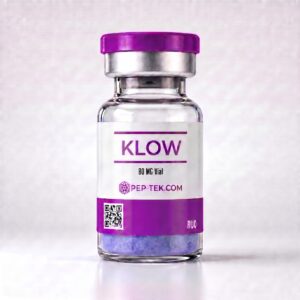
Available from PepTek
KLOW peptide blend research examines the combined action of KPV, LL-37, Ouabain, and Wifi peptides studied for their multi-pathway signaling properties in preclinical models.
The KLOW peptide blend represents an area of growing scientific interest in the field of multi-compound peptide research. As researchers continue to explore the cooperative signaling potential of combined peptide formulations — such as those documented in studies on the CJC-1295 + Ipamorelin blend and its synergistic mechanisms — blended peptide systems offer a compelling framework for understanding how distinct molecular agents may interact across overlapping biological pathways. KLOW peptide blend research focuses specifically on four individual peptide components: KPV (Lys-Pro-Val), LL-37, Ouabain (a cardiotonic steroid glycoside with peptide-adjacent signaling properties), and a fourth modulatory fraction sometimes referred to in the literature as the “W” component. Each constituent carries its own distinct mechanistic profile, and their combined study offers a layered research model.
KPV (Lys-Pro-Val) is a C-terminal tripeptide fragment derived from alpha-melanocyte-stimulating hormone (α-MSH). Research has demonstrated that KPV retains significant anti-inflammatory properties through its interaction with melanocortin receptors, particularly MC1R and MC3R, despite its considerably smaller molecular structure relative to the parent peptide. In vitro and animal model studies have indicated that KPV may attenuate NF-κB signaling pathways, a central mediator of inflammatory cytokine cascades [Dalmasso et al., 2008]. This receptor interaction shares conceptual overlap with the broader melanocortin receptor agonism investigated in research on compounds like Melanotan II and its melanocortin receptor binding profile. Preclinical intestinal epithelial models have further suggested that KPV may influence barrier integrity and inflammatory resolution at the mucosal level [Kannengiesser et al., 2011].
LL-37 is the only human member of the cathelicidin family of antimicrobial peptides. It is a 37-amino acid, amphipathic, alpha-helical peptide processed from the precursor hCAP-18. Researchers have extensively studied LL-37 for its immunomodulatory and membrane-disruptive properties. Beyond its studied antimicrobial activity, LL-37 has been observed in research settings to engage toll-like receptors (TLRs), modulate dendritic cell maturation, and influence angiogenic signaling via interactions with FPRL1 (formyl peptide receptor-like 1) [Vandamme et al., 2012]. Animal model studies also suggest LL-37 may interact with wound repair pathways, potentially influencing keratinocyte migration and re-epithelialization processes. This regenerative signaling dimension places LL-37 research in conceptual proximity to tissue-repair peptides such as those profiled in research on BPC-157 and its cellular repair mechanisms.
Ouabain is a naturally occurring cardiotonic steroid originally isolated from plant species including Strophanthus gratus. While structurally distinct from classical peptides, ouabain is incorporated into certain research blends for its capacity to act as an endogenous ligand for the Na+/K+-ATPase pump. Research has increasingly revealed that Na+/K+-ATPase is not merely a membrane ion transporter but also a receptor capable of initiating intracellular signal transduction cascades, including Src kinase and ERK1/2 activation [Xie & Askari, 2002]. In cellular research models, ouabain’s signaling properties have been studied in the context of cell proliferation, apoptosis modulation, and potentially oxidative stress regulation — an area thematically connected to research on antioxidant signaling compounds, including the extensively studied tripeptide examined in our Glutathione: Tripeptide Antioxidant Research and Redox Signaling profile.
The fourth constituent of KLOW peptide blend research is less universally standardized in published literature and may represent a variable modulatory fraction depending on the specific research formulation in question. In some formulation contexts, this component has been proposed to include peptides with neuromodulatory or adaptogenic properties, studied for their potential influence on hypothalamic-pituitary-adrenal (HPA) axis signaling. The mechanistic study of such regulatory components benefits from broader neuropeptide research frameworks, including work on ACTH-derived compounds as explored in the Semax neuropeptide research profile.
A central question in KLOW peptide blend research concerns whether combining these compounds produces additive, synergistic, or potentially antagonistic effects within shared biological pathways. In vitro co-incubation studies examining multi-peptide environments suggest that combinations of anti-inflammatory (KPV), immunomodulatory (LL-37), and receptor-signaling (ouabain) agents may converge on shared downstream effectors such as NF-κB, MAPK cascades, and PI3K/Akt pathways [Pasupuleti et al., 2012].
The logic of multi-component peptide research is grounded in the biological principle that many physiological processes are regulated not by single molecular signals but by coordinated networks. Blend-based research models allow investigators to study whether combinatorial peptide action can produce effects on inflammatory resolution, barrier function, or cellular homeostasis that would not be observable in single-compound studies alone.
In murine colitis models, KPV administered via nano-encapsulation demonstrated significant attenuation of pro-inflammatory cytokine expression including IL-6 and TNF-α [Dalmasso et al., 2008]. Researchers observed reductions in myeloperoxidase activity — a marker of neutrophil infiltration — consistent with NF-κB pathway modulation downstream of melanocortin receptor engagement.
LL-37 has been studied in multiple preclinical infection models. Research published in immunology and microbiology journals has characterized its capacity to disrupt Gram-positive and Gram-negative bacterial membranes, inhibit biofilm formation, and modulate the inflammatory response of macrophages and epithelial cells simultaneously [Vandamme et al., 2012]. These dual properties — direct antimicrobial activity combined with immune modulation — make LL-37 a uniquely multifunctional subject of KLOW peptide blend research.
Ouabain’s role as a signaling molecule rather than solely an ion transport inhibitor has been confirmed in multiple cell culture studies. At sub-inhibitory concentrations, ouabain has been shown to activate Src/EGF receptor transactivation and modulate intracellular calcium oscillations without producing cytotoxic ion imbalance [Xie & Askari, 2002]. This nuanced dose-response behavior is particularly important for researchers designing in vitro experimental protocols involving KLOW blend components.
Despite the individual research histories of KLOW’s components, direct studies on the full KLOW peptide blend as a combined formulation remain limited in peer-reviewed literature. Most published evidence addresses each component in isolation or in simpler two-compound systems. Future research directions identified by investigators in this space include:
These research gaps represent important frontiers for investigators working within the KLOW peptide blend research space, particularly as the field moves toward more complex multi-agent study designs.
The information presented in this profile is intended strictly for scientific research and educational purposes only. All compounds discussed within KLOW peptide blend research — including KPV, LL-37, ouabain, and associated modulatory fractions — are research compounds not approved for human or animal therapeutic use. No content in this article constitutes medical advice, dosing guidance, or therapeutic recommendation of any kind. All referenced findings derive from in vitro studies, animal model research, or early-phase preclinical investigations. Researchers and institutions interested in these compounds should consult applicable regulatory frameworks governing research compound acquisition and use in their respective jurisdictions. PepTek supplies these compounds exclusively for laboratory research purposes.