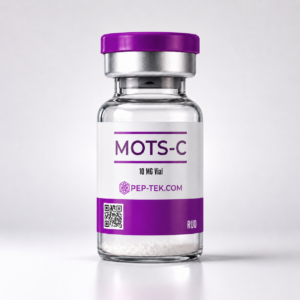
Research-Use Disclaimer: All content in this article is intended strictly for scientific research and educational purposes. MOTS-c is an investigational research compound. Nothing herein constitutes medical advice, a therapeutic claim, or a recommendation for human or animal use. This compound is not approved by the FDA for any clinical application.
What Is MOTS-C? Mitochondrial-Derived Peptide Research Explained
Over the past decade, mitochondria have been recognized not merely as the cell’s energy producers but as active signaling organelles capable of encoding biologically active peptides. MOTS-c (Mitochondrial Open Reading Frame of the 12S rRNA-c) is among the most extensively investigated of these mitochondrial-derived peptides (MDPs). Researchers exploring what is MOTS-c mitochondrial peptide research will find a growing body of literature connecting this 16-amino-acid sequence to fundamental processes of metabolic homeostasis, cellular stress adaptation, and aging biology. This article summarizes key published studies that have shaped current scientific understanding of MOTS-c.
Discovery and Molecular Identity of MOTS-c
MOTS-c was first formally characterized by Lee et al. in a landmark 2015 study published in Cell Metabolism. The peptide sequence — MRWQEMGYIFYPRKLR — is encoded within the mitochondrial 12S ribosomal RNA gene, a region previously considered non-coding for functional peptides. This discovery was significant because it demonstrated that the mitochondrial genome, long thought to encode only 13 proteins along with structural RNAs, harbors an additional layer of bioactive signaling molecules [Lee et al., 2015].
In cell-based experiments, researchers observed that MOTS-c is primarily produced within mitochondria but can translocate to the cytoplasm and nucleus under specific stress conditions, including glucose restriction. This subcellular mobility suggests the peptide functions as an intracellular messenger capable of communicating mitochondrial status to the broader cellular environment.
Metabolic Regulation: Key Preclinical Findings
Glucose and Lipid Metabolism in Murine Models
The 2015 Lee et al. study remains foundational for understanding what is MOTS-c mitochondrial peptide research in a metabolic context. Using murine models fed a high-fat diet, researchers reported that systemic administration of synthetic MOTS-c was associated with resistance to diet-induced obesity and improved insulin sensitivity. Animals receiving MOTS-c showed altered expression of genes involved in fatty acid oxidation and glycolysis, with researchers observing activation of the AMPK (AMP-activated protein kinase) pathway — a master regulator of cellular energy balance [Lee et al., 2015].
Mechanistically, Lee and colleagues proposed that MOTS-c inhibits the folate cycle and de novo purine synthesis pathway in the one-carbon metabolism network, leading to AICAR (5-aminoimidazole-4-carboxamide ribonucleotide) accumulation. AICAR is a well-established AMPK activator, providing a plausible molecular link between MOTS-c activity and downstream metabolic effects observed in these animal model studies. This intersection of mitochondrial signaling and one-carbon metabolism represents a novel axis that continues to attract research interest, particularly given the broader role of metabolic cofactors — an area also explored in NAD+ coenzyme research and cellular metabolism studies.
Insulin Sensitivity and Skeletal Muscle Studies
A subsequent investigation by Kim et al. (2018), published in Aging, examined MOTS-c’s effects on skeletal muscle insulin signaling in aged mice. Researchers found that circulating MOTS-c levels declined significantly with age in both murine subjects and human plasma samples analyzed from a cohort of healthy volunteers. In vitro experiments using differentiated myotubes indicated that MOTS-c treatment improved glucose uptake under insulin-resistant conditions, with researchers observing upregulation of GLUT4 translocation [Kim et al., 2018]. These findings positioned MOTS-c as a candidate molecule for studying age-associated metabolic decline, though all interpretations remain within preclinical and observational frameworks.
MOTS-c as a Mitokine: Exercise and Systemic Signaling
A 2019 study by Reynolds et al., published in Nature Communications, provided compelling evidence that MOTS-c functions as an exercise-induced mitokine — a mitochondria-derived signal that responds to physical exertion and communicates across tissues. In studies using both human participants undergoing supervised exercise and murine exercise models, researchers observed that plasma MOTS-c concentrations increased significantly following acute exercise bouts. Notably, the study reported that administration of synthetic MOTS-c to sedentary aged mice produced improvements in physical performance metrics comparable in direction (though not magnitude) to those seen in exercised animals [Reynolds et al., 2019].
The concept of MOTS-c as a mitokine broadens its research significance considerably, linking mitochondrial biology to systemic physiology in a manner that parallels other peptide-mediated signaling cascades. This systemic communication paradigm shares conceptual ground with research into other bioactive peptides such as those studied in GHK-Cu copper peptide research and signaling pathways, where extracellular peptide activity modulates gene expression across multiple tissue types.
Cellular Stress Response and Longevity Research
Oxidative Stress and Nuclear Translocation
A critical dimension of understanding what is MOTS-c mitochondrial peptide research involves its behavior under oxidative stress conditions. A 2021 study by Lee et al. published in Nature Aging demonstrated that MOTS-c translocates from the mitochondria to the nucleus in response to reactive oxygen species (ROS) and other stress stimuli. Once in the nuclear compartment, MOTS-c was observed to interact with chromatin regulatory regions and modulate the transcription of stress-response genes, including those involved in antioxidant defense [Lee et al., 2021].
This nuclear signaling role represents a significant conceptual expansion: MOTS-c is not merely a metabolic regulator but a transcriptional modulator that may coordinate cellular responses to mitochondrial distress signals. The interaction between mitochondrial peptide signaling and antioxidant transcription is also thematically relevant to research on endogenous antioxidant systems, including the glutathione pathway discussed in glutathione tripeptide antioxidant research and redox signaling.
Aging Biology and Lifespan Models
Researchers have additionally explored MOTS-c in the context of biological aging. Studies using C. elegans models have reported that exogenous MOTS-c administration extends lifespan under specific genetic conditions associated with mitochondrial dysfunction [Lee et al., 2021]. While invertebrate findings do not directly translate to mammalian outcomes, they provide mechanistic insight into how mitochondrial-derived signals may influence longevity pathways, including those regulated by AMPK and FOXO transcription factors.
The age-dependent decline in endogenous MOTS-c levels, documented across both murine and human observational data, suggests the peptide may serve as a biomarker of mitochondrial fitness. Whether this decline is causally connected to metabolic deterioration or represents a correlative marker remains an active area of investigation in preclinical research settings.
Genetic Variation and Population Studies
Beyond experimental models, epidemiological researchers have examined mitochondrial DNA variants affecting MOTS-c sequence. A study by Zempo et al. (2021) identified a MOTS-c variant (K14Q) enriched in Japanese centenarian populations compared to younger controls [Zempo et al., 2021]. In vitro functional studies of this variant suggested altered interactions with AMPK signaling pathways. These population-level observations have generated hypotheses — not conclusions — regarding the potential relationship between MOTS-c sequence variation and healthy aging phenotypes, warranting further controlled investigation.
Research Context
The published studies summarized here collectively illustrate why researchers studying what is MOTS-c mitochondrial peptide research consider this peptide a scientifically novel and mechanistically rich subject. From its initial discovery as a metabolic regulator encoded in mitochondrial DNA, to its characterization as an exercise-responsive mitokine and nuclear stress-response modulator, MOTS-c represents a convergence point for multiple disciplines — mitochondrial biology, metabolism, aging science, and peptide signaling research.
Its mechanistic parallels with other peptide-based research compounds — including those explored in studies on BPC-157 peptide research and mechanism of action — underscore a broader scientific interest in endogenous and synthetic peptides as tools for understanding cellular physiology at a molecular level.
Important Disclaimer: All research discussed in this article was conducted in vitro, in animal models, or as observational human studies, and does not constitute clinical evidence of efficacy or safety in humans. MOTS-c is available from PepTek strictly as a research compound for qualified laboratory use only. It is not intended for human or animal consumption, is not a drug or dietary supplement, and has not been evaluated or approved by the FDA or any regulatory authority for therapeutic use. Researchers must adhere to all applicable institutional and regulatory guidelines when working with this compound.