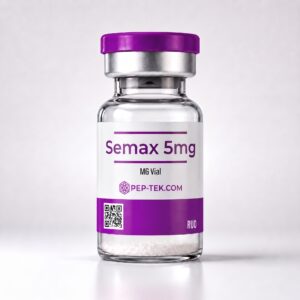
Available from PepTek
Semax is an ACTH-derived synthetic heptapeptide studied for its neuroprotective and cognitive-modulating properties in preclinical and clinical research models.
Among the synthetic peptides that have drawn sustained attention in neurobiological research, Semax occupies a particularly well-documented position. Researchers investigating the question of what is semax peptide nootropic research will find a body of work spanning several decades, originating primarily from Russian scientific institutions and expanding into international inquiry. Semax (Met-Glu-His-Phe-Pro-Gly-Pro) is a heptapeptide analogue derived from the adrenocorticotropic hormone (ACTH) 4–10 fragment, structurally modified to resist rapid enzymatic degradation while retaining biological activity at neurological targets. This article summarizes key published studies examining Semax’s mechanisms of action, observed effects in animal and in vitro models, and its research relevance to neurotrophic signaling.
For researchers seeking a broader overview of this compound’s biochemical profile before examining specific studies, the Semax: ACTH-Derived Neuropeptide Research Profile provides foundational context on its structural properties and receptor interactions.
One of the most cited investigations into Semax’s neurobiological activity was published by Shadrina and colleagues, who examined the compound’s effect on gene expression in rat brain tissue. In this study, researchers administered Semax to Wistar rats and subsequently analyzed mRNA expression profiles in the frontal cortex and hippocampus using quantitative PCR methods. The researchers observed statistically significant upregulation of genes associated with brain-derived neurotrophic factor (BDNF) signaling pathways, including genes encoding the TrkB receptor and downstream effectors in the MAPK/ERK cascade [Shadrina et al., 2010].
This finding was notable because BDNF is widely regarded in neuroscience research as a critical modulator of synaptic plasticity, neuronal survival, and long-term potentiation. The Shadrina study suggested that Semax may function not merely as a receptor agonist but as a modulator of endogenous neurotrophic gene expression — a distinction that has shaped subsequent experimental frameworks in the field.
Extending this line of inquiry, Kolomin and colleagues conducted transcriptomic profiling of rat hippocampal tissue following Semax administration. Their analysis identified differential expression in over 70 genes, with functional clustering pointing toward regulation of neurogenesis, apoptotic suppression, and immune-modulatory signaling [Kolomin et al., 2013]. Notably, gene ontology analysis revealed enrichment in categories related to synaptic transmission and axonal growth, consistent with a neurotrophic mechanism of action. Researchers have observed that these transcriptomic signatures partially overlap with those induced by exogenous BDNF application, lending support to the hypothesis that Semax may act through convergent neurotrophic pathways.
This class of peptide-mediated gene regulation draws interesting comparisons to antioxidant-active peptides studied in neuroprotection contexts. Research on compounds such as those covered in the Glutathione: Tripeptide Antioxidant Research and Redox Signaling article illustrates how small peptides can exert broad regulatory influence through signaling networks rather than direct receptor binding alone.
A significant portion of published Semax research has been conducted in the context of experimental ischemic injury. Gusev and colleagues at the Russian Academy of Medical Sciences investigated Semax administration in rat models of focal cerebral ischemia, measuring infarct volume, neurological deficit scores, and inflammatory cytokine expression at defined post-injury time points. In these animal model studies, researchers observed reduced infarct volume and attenuated expression of pro-inflammatory markers including IL-1β and TNF-α in Semax-treated animals compared to controls [Gusev et al., 2001]. The authors proposed that Semax may modulate neuroinflammatory cascades in addition to its neurotrophic effects, suggesting a dual mechanism relevant to post-ischemic tissue preservation in preclinical models.
Questions surrounding what is semax peptide nootropic research in the ischemia context are relevant because neuroinflammation is increasingly recognized as a common pathophysiological thread across neurodegenerative conditions studied in laboratory settings. The observation that Semax may simultaneously upregulate neurotrophic signaling while suppressing inflammatory cytokine expression positions it as a subject of multifaceted experimental interest.
Researchers have also examined Semax’s interaction with monoaminergic neurotransmitter systems. Inozemtseva and colleagues investigated dopaminergic signaling in rat striatal tissue following intranasal Semax administration, using microdialysis to measure real-time neurotransmitter flux. In vitro studies and ex vivo analysis suggested that Semax administration was associated with measurable changes in dopamine turnover indices and serotonin metabolite ratios, without producing the acute catecholamine surges associated with classical psychostimulants [Inozemtseva et al., 2008]. Animal model studies indicate a modulatory rather than agonistic interaction with these systems, consistent with the compound’s pharmacological profile as an ACTH-derived fragment rather than a direct monoamine receptor ligand.
This neurotransmitter-modulating dimension of Semax research shares conceptual territory with work conducted on other peptides in the synthetic anxiolytic and nootropic categories. Researchers interested in structurally related compounds may find the Selank: Synthetic Anxiolytic Peptide Research Overview a useful comparative reference, as Selank similarly originates from a tuftsin-derived scaffold and has been studied for its modulatory effects on GABAergic and serotonergic signaling in preclinical models.
Understanding what is semax peptide nootropic research requires situating the compound within its parent pharmacological class. The ACTH 4–10 fragment from which Semax is derived is known to interact with melanocortin receptors, specifically MC4R, which is expressed throughout the central nervous system. Semax’s Pro-Gly-Pro C-terminal extension was introduced to confer metabolic stability without fundamentally altering the core melanocortin binding motif. Studies have suggested that MC4R engagement in the hypothalamus and limbic structures contributes to Semax’s observed effects on attention and behavioral performance in rodent paradigms [Shadrina et al., 2010].
For researchers investigating the broader melanocortin receptor pharmacology landscape, including compounds that interact with peripheral and central melanocortin subtypes, the Melanotan II (MT-2): Melanocortin Receptor Agonist Research Profile provides a useful comparative framework, given MT-2’s broader melanocortin receptor binding profile encompassing MC1R through MC5R.
Multiple research groups have employed standardized behavioral assays to evaluate Semax’s effects on learning and memory in rodent models. In Morris Water Maze and passive avoidance paradigms, animal model studies indicate that Semax-treated subjects demonstrate improved acquisition of spatial memory tasks and prolonged retention compared to saline controls. These observations have been replicated across independent laboratories and are consistent with the compound’s proposed BDNF-mediated enhancement of hippocampal synaptic plasticity [Kolomin et al., 2013]. Researchers have observed dose-dependent relationships in some but not all behavioral endpoints, and the specificity of effects appears to differ based on administration route and timing relative to learning trials in the experimental designs studied.
The intersection of neurotrophic support and cognitive performance in research models also connects to broader cellular energy and redox research. Studies on compounds explored in the NAD+: Coenzyme Research Profile and Cellular Metabolism Studies article highlight how metabolic cofactors influence neuronal resilience — a complementary angle to the neurotrophic mechanisms attributed to Semax in published literature.
The body of research summarized here represents preclinical and early translational work conducted under controlled laboratory conditions. Understanding what is semax peptide nootropic research means recognizing that these findings derive from animal models and in vitro systems, and cannot be extrapolated to define outcomes in human subjects without rigorous clinical trial data. All studies cited were conducted by qualified researchers in institutional settings following appropriate protocols for their respective jurisdictions.
Disclaimer: All information presented in this article is intended strictly for research and educational purposes. Semax and related compounds available through PepTek are supplied exclusively for laboratory research use. They are not intended for human or animal consumption, and no content in this article should be interpreted as medical advice, therapeutic guidance, or clinical recommendation. PepTek does not endorse the use of any research compound outside of properly controlled scientific investigation.