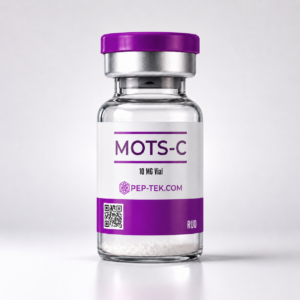
Available from PepTek
MOTS-c is a mitochondrial-derived peptide studied for its role in AMPK pathway activation and metabolic regulation. Research in cell and animal models highlights its potential influence on glucose metabolism and cellular energy homeostasis.
MOTS-c (Mitochondrial Open Reading Frame of the 12S rRNA-c) is a 16-amino acid peptide encoded within the mitochondrial genome — a discovery that challenged long-held assumptions about the coding capacity of mitochondrial DNA. First characterized by Lee et al. in 2015, MOTS-c has since become a subject of significant scientific interest due to its apparent role in regulating metabolic homeostasis through AMPK-dependent and independent signaling cascades. Research into MOTS-c AMPK activation metabolic research continues to expand, with studies investigating how this mitochondrial-derived peptide (MDP) communicates between organelles and systemic tissues.
Unlike nuclear-encoded peptides, MOTS-c is translated from the 12S ribosomal RNA gene located within the mitochondrial genome. Its amino acid sequence — MRWQEMGYIFYPRKLR — is highly conserved across mammalian species, suggesting functional importance preserved through evolution. The peptide has been detected in circulating plasma in human subjects, indicating it may function as a circulating signaling molecule, or what researchers have termed a “mitokine” [Lee et al., 2015].
The discovery of MOTS-c as a bona fide signaling peptide encoded by mitochondrial DNA opened a new branch of inquiry into how mitochondria communicate metabolic status to the nucleus and peripheral tissues. This retrograde mitochondria-to-nucleus signaling is now considered a central area of MOTS-c research, particularly in the context of MOTS-c AMPK activation metabolic research.
AMP-activated protein kinase (AMPK) is a master regulator of cellular energy balance, activated when cellular AMP-to-ATP ratios rise — a signal of energy deficit. In vitro and in vivo studies have consistently shown that MOTS-c administration is associated with increased AMPK phosphorylation, particularly at the Thr172 residue of the alpha subunit, which is the canonical activating phosphorylation site [Lee et al., 2015]. Researchers have proposed that MOTS-c modulates the folate cycle and one-carbon metabolism, leading to accumulation of AICAR (5-aminoimidazole-4-carboxamide ribonucleotide), an endogenous AMPK activator. This positions MOTS-c upstream of AMPK in a metabolically meaningful signaling cascade.
The MOTS-c → folate cycle → AICAR → AMPK axis represents one of the most studied mechanistic frameworks in current MOTS-c AMPK activation metabolic research. Researchers have observed that this pathway interfaces with glucose uptake regulation, mitochondrial biogenesis signaling via PGC-1α, and suppression of de novo lipogenesis — all downstream effects of sustained AMPK activity.
A particularly notable finding in MOTS-c research is its capacity for nuclear translocation under conditions of cellular stress. Studies have reported that MOTS-c can enter the nucleus and interact with stress-responsive transcription factors including Nrf2, AP-1, and NF-κB [Kim et al., 2018]. This dual cytoplasmic and nuclear activity positions MOTS-c as a pleiotropic regulatory peptide rather than a simple enzyme activator. Researchers have observed modulation of antioxidant response element (ARE)-driven gene expression in cell models, a finding conceptually related to other redox-regulating research compounds such as those described in the Glutathione: Tripeptide Antioxidant Research and Redox Signaling profile.
Animal model studies using high-fat diet (HFD)-induced insulin-resistant mice have demonstrated that MOTS-c administration was associated with improved insulin sensitivity, reduced adiposity, and enhanced skeletal muscle glucose uptake [Lee et al., 2015]. These effects appeared partially dependent on AMPK activation, as they were attenuated by pharmacological AMPK inhibition in experimental models. Researchers have also investigated MOTS-c effects on GLUT4 translocation in myocytes, a downstream consequence of AMPK-mediated signaling relevant to peripheral glucose utilization.
This mechanistic overlap with metabolic regulation has drawn comparisons in the research literature to other metabolic pathway regulators. Readers interested in mitochondrial coenzyme research related to cellular energy may find the NAD+: Coenzyme Research Profile and Cellular Metabolism Studies article a relevant parallel, as NAD+ and MOTS-c both interface with mitochondrial function and AMPK-related pathways.
The landmark 2015 paper by Lee et al. published in Cell Metabolism identified MOTS-c as a mitochondrially encoded peptide with metabolic regulatory properties. Using both mouse models and cultured human cells, the researchers demonstrated that exogenous MOTS-c promoted AMPK phosphorylation, reduced lipid accumulation in hepatocytes, and improved insulin sensitivity metrics in diet-induced obese mouse models [Lee et al., 2015]. This study established the foundational mechanistic framework for all subsequent MOTS-c AMPK activation metabolic research.
Subsequent studies have explored circulating MOTS-c levels across age groups. Research in human cohorts found that plasma MOTS-c concentrations were significantly lower in older individuals compared to younger cohorts, suggesting a potential link between declining MOTS-c levels and age-associated metabolic decline [Reynolds et al., 2021]. Additionally, exercise was found to acutely elevate circulating MOTS-c levels in human subjects, leading researchers to hypothesize that MOTS-c may partially mediate the systemic metabolic benefits associated with physical activity [Reynolds et al., 2021].
More recent research has examined MOTS-c’s potential role in modulating inflammatory responses. In vitro studies using macrophage models reported that MOTS-c treatment was associated with reduced pro-inflammatory cytokine secretion, including TNF-α and IL-6, potentially via NF-κB pathway suppression [Kim et al., 2018]. Animal studies in sepsis models further suggested that MOTS-c administration was associated with improved survival metrics and reduced organ damage markers [Kim et al., 2018]. These findings have broadened the research scope of MOTS-c AMPK activation metabolic research beyond purely metabolic contexts.
Animal model research has specifically examined MOTS-c’s effects in skeletal muscle tissue, where AMPK plays a central role in fatty acid oxidation and glucose uptake. Studies in aged mouse models reported that MOTS-c treatment was associated with preservation of skeletal muscle mass and mitochondrial function, with researchers observing enhanced expression of PGC-1α and downstream mitochondrial biogenesis markers [Lu et al., 2019]. The intersection of peptide research and metabolic regulation in muscle tissue is a growing area, contextually comparable to other peptide research profiles covering tissue signaling, such as the TB-500 (Thymosin Beta-4): Research Profile and Cellular Mechanisms.
While the body of evidence supporting MOTS-c’s metabolic regulatory properties is growing, significant gaps remain. The majority of mechanistic studies have been conducted in murine models or cell culture systems, and translational relevance to human physiology requires further investigation through controlled clinical research. The precise receptor or membrane transporter through which extracellular MOTS-c exerts its effects remains incompletely characterized. Additionally, the relative contribution of endogenous versus exogenous MOTS-c to observed phenotypes is an active area of investigation.
Researchers studying broader metabolic peptide systems may find comparative value in profiles of other metabolically relevant research compounds, such as those described in the Tirzepatide: GLP-1/GIP Dual Agonist Research Profile, which represents a structurally distinct but metabolically overlapping research domain.
MOTS-c represents a compelling subject within the field of mitochondrial biology and metabolic peptide research. The convergence of mitochondrial genomics, AMPK signaling, and systemic metabolic regulation makes it a uniquely positioned compound for ongoing basic and translational science inquiry. As interest in MOTS-c AMPK activation metabolic research continues to grow, it is anticipated that future studies will further define the peptide’s mechanisms of action across diverse tissue types and physiological contexts.
Research Use Disclaimer: All information presented in this article pertains exclusively to preclinical and in vitro scientific research. MOTS-c is available from PepTek strictly as a research compound for use in laboratory settings by qualified researchers. This compound is not approved for human or animal consumption, is not intended for therapeutic, diagnostic, or clinical use, and should not be construed as having any medical application. PepTek makes no health claims regarding this or any other research compound. Researchers should adhere to all applicable institutional and regulatory guidelines when handling research peptides.